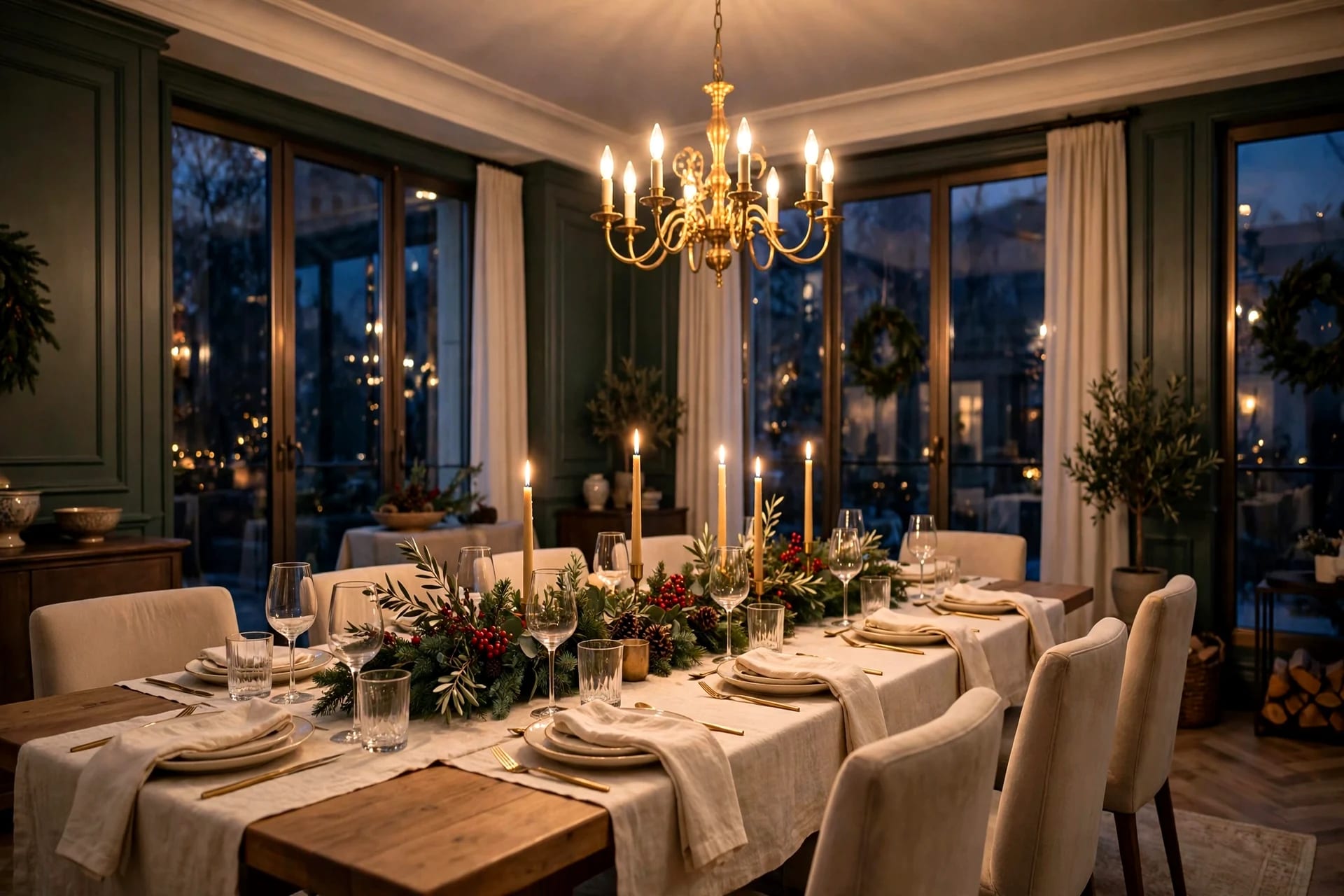
Most Christmas dining rooms fail at the moment dinner is served. The centerpiece owns the middle of the table, which is exactly where the food needs to go. The candles sit at eye level, so nobody can see the person opposite. And the sideboard is so decorated that there is nowhere to put the serving dishes.
This guide decorates the whole room — walls, buffet, chairs, light — and builds the table so it survives actual dinner: a centerpiece that lifts off in seconds, sightlines kept clear, and serving space protected. Fifteen ideas, with the measurements that make them work.
Key Takeaways
- Plan the room in layers: walls and buffet first, table second, light last — decorating the table first is how it ends up overcrowded.
- Keep the centerpiece under 30 centimetres tall, or above 60 centimetres on a slim stem; anything between blocks seated eye level.
- Build the centerpiece as three or four separate pieces, not one long installation, so it lifts off in seconds when the food arrives.
- Allow 60 centimetres of table edge per guest, and keep the middle third of the table free for serving dishes.
- Use unscented candles on the dining table — cinnamon and pine scents fight with actual dinner.
Table of Contents
- Plan the room before you decorate the table
- 15 Christmas dining room decor ideas
- The table that survives dinner
- Buffet, sideboard and serving space
- Light: the layer that makes it feel like Christmas
- Common mistakes and fixes
- FAQ
Plan the room before you decorate the table
Start with the walls, because they set the room's ceiling of festivity. One large wreath over the sideboard, a garland on the wall behind the buffet, or a pair of sconces with greenery gives the room its Christmas identity before a single plate is laid. If the walls already carry the theme, the table can stay calm — and a calm table is a table people can eat at. Guests arrive through the entry, so the Christmas front door decor sets the tone before they reach the dining room, and the Christmas wall decor ideas guide covers the wall treatments in more depth.
Next, claim the serving space. Decide where the serving dishes, the drinks and the extra plates will live during dinner: the sideboard top, a cleared console, or one end of the table. Whatever you choose, protect it now — do not decorate it. A sideboard buried under a village scene, a stack of books and three candle clusters has no room for a gravy boat, and dinner service turns into a juggling act.
Then plan the light. Christmas dining rooms run on warm light: candles, fairy lights and one dimmed overhead source. Decide the overhead first — a chandelier with a dimmer, or a pendant lowered over the table — because candlelight alone leaves guests eating in the dark, and full overhead light kills the mood entirely.
15 Christmas dining room decor ideas
1. A low evergreen runner
A cedar or mixed evergreen garland laid straight down the table's centre, tucked with pinecones and red berries. Keep it narrow — no wider than 25 centimetres — so plates and platters still fit on both sides.
2. A wreath over the sideboard
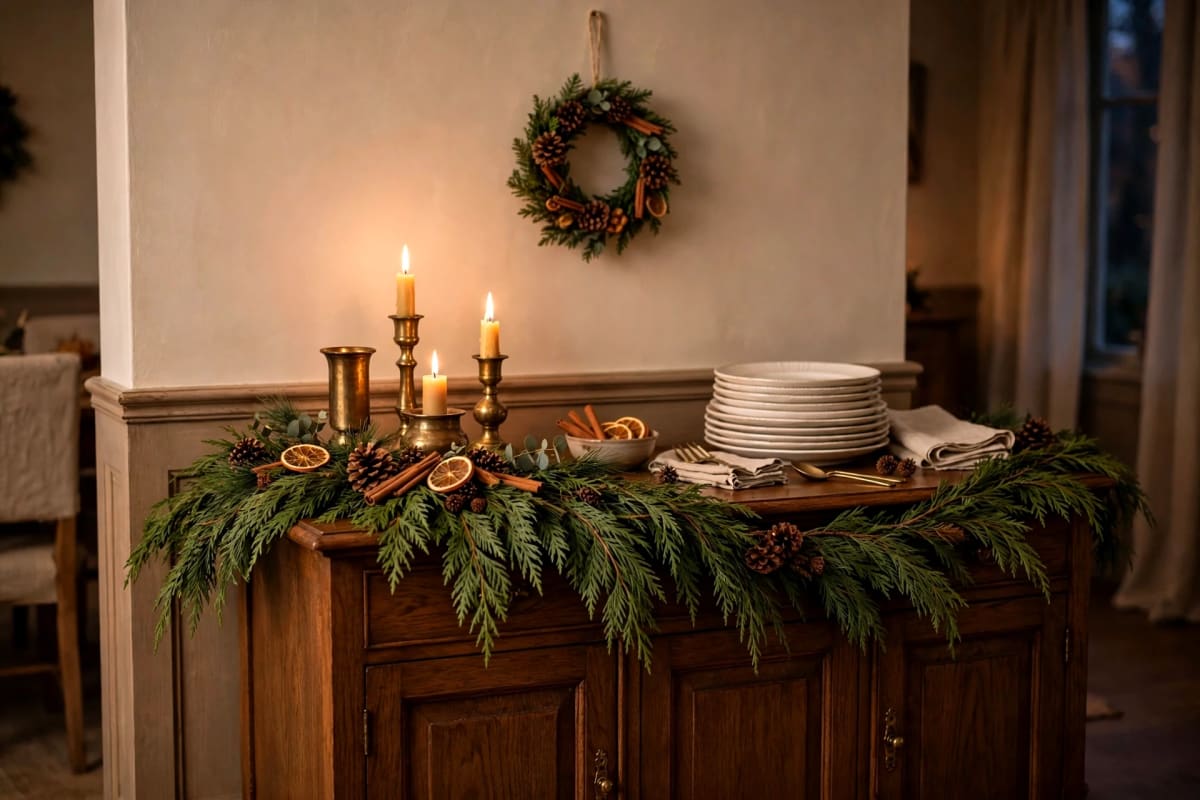
One large wreath, 60 to 75 centimetres across, hung above the sideboard or buffet. It is the room's focal point and the single easiest Christmas statement. Hang it with a removable hook, centred 15 centimetres above the sideboard's top.
3. Taper candles in odd groups
Groups of three or five taper candles in brass or wood holders, at least 5 centimetres apart. Tapers are narrow enough to see past, unlike pillars, which block faces. Use unscented tapers on the table itself.
4. A citrus and clove bowl
Oranges studded with cloves, stacked in a low wooden bowl with cinnamon sticks and evergreen sprigs. It smells like Christmas without a single scented candle, and guests can pick at it after dinner.
5. Chair-back wreaths or bows
Small wreaths or velvet bows tied to the back of each dining chair. They decorate the room from every angle — guests see chair backs more than they see the table — and they cost almost nothing.
6. A garland on the buffet wall
A swag of evergreen garland along the wall behind the buffet, pinned at both ends and dipping in the middle. It frames the serving area and ties the room to the table. For garland lengths and hanging, see Christmas garland ideas.
7. A tablescape in one metallic
Pick one metallic — brass, gold or silver — and repeat it in candle holders, cutlery accents and one serving piece. One metallic looks collected; three mixed metallics look like a clearance shelf.
8. A lantern pair on the sideboard
Two lanterns in different sizes with battery candles inside, flanked by scattered greenery. Lanterns give height and glow without open flames near the serving area, which matters when people are reaching for dishes.
9. A cranberry candle bowl
A shallow bowl of water, fresh cranberries and floating battery candles. It takes five minutes, costs very little, and reads as a deliberate centrepiece rather than an afterthought.
10. A pomegranate and pear display
Whole pomegranates, pears and clementines piled in a low bowl or on a wooden board, tucked with bay sprigs. Edible displays do double duty: they decorate until dinner, then they become dessert's garnish.
11. A window dressed with fairy lights
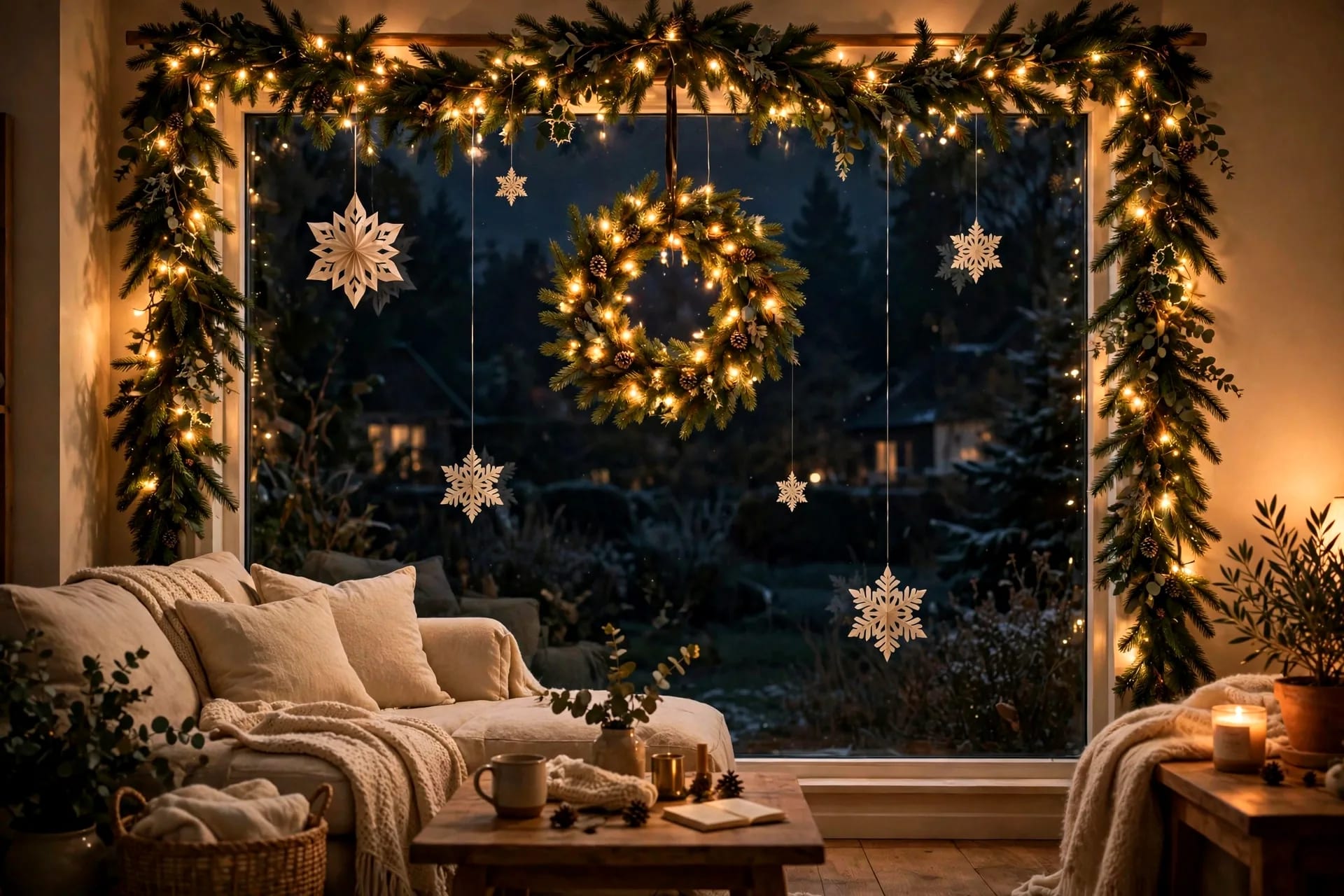
A string of warm-white fairy lights along the dining room window frame, or a lit star in the window. Window light is the first thing guests see from outside, and it costs less than any other decoration in this guide.
12. A chandelier dressed with greenery
A short garland wound around the chandelier's ring, or small sprigs tied to its arms. Keep greenery clear of bulbs and candles by at least 10 centimetres, and never use real flames near dried greenery.
13. Place settings with a sprig
A sprig of cedar or rosemary on each plate, tied with twine, with a handwritten name card tucked beneath. It is the cheapest personal touch in the room, and guests notice it before they notice the centrepiece.
14. A mini tree trio on the sideboard
Three small potted trees in graduated heights on the sideboard, wrapped in linen or kraft paper. They give the serving area its own Christmas identity without competing with the table.
15. A wall gallery swapped for Christmas
Swap two or three prints in the dining room's existing frames for Christmas botanicals, sheet music or vintage cards. It is the fastest whole-room change in this guide, and it reverses in January without a single new hole.
The table that survives dinner
Three numbers decide whether a Christmas table works. First, 60 centimetres of table edge per guest — 75 if you want elbow room. A table that seats eight needs 4.8 metres of edge, which is why a 2.4-metre table seats six comfortably and eight only with a squeeze.
Second, the centrepiece height rule: under 30 centimetres, or above 60 centimetres on a slim stem. Anything between 30 and 60 centimetres lands exactly at seated eye level and blocks the person opposite. Low arrangements and tall, thin candlesticks both pass; medium-height flower arrangements fail.
Third, the middle third rule: on a table served family-style, the middle third is where the serving dishes land. Your centrepiece must either live in a section the food does not need, or lift off in one motion. Building it as three or four separate pieces — a bowl here, a candle group there, a small arrangement at each end — means it moves in fifteen seconds instead of being dismantled. For the full table-layering method, see Christmas table decor.
Runners follow their own rule: a runner should hang 15 centimetres over each end of the table, or stop 15 to 30 centimetres short of each end. A runner that ends exactly at the table's edge looks like it shrank in the wash.
Buffet, sideboard and serving space
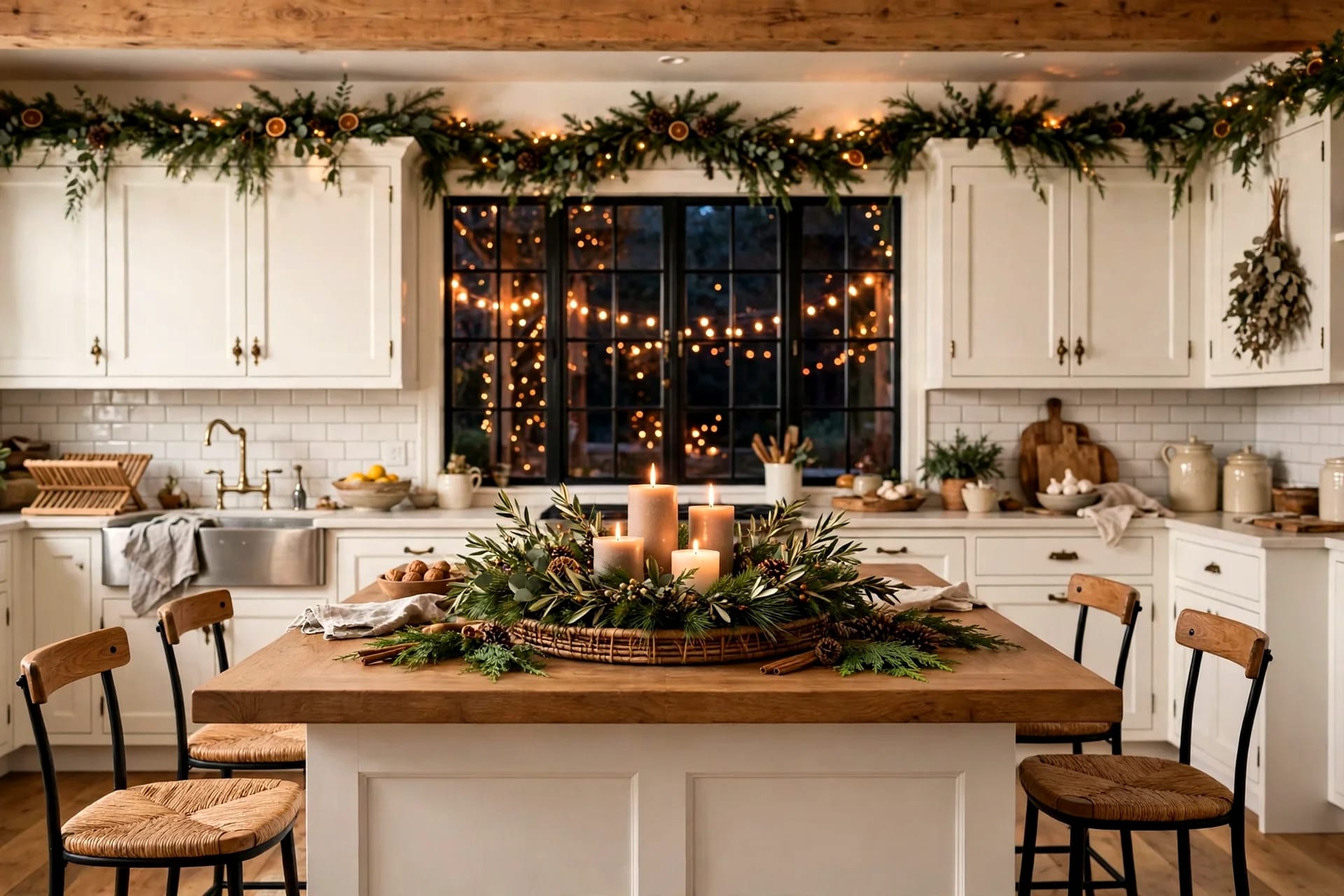
The sideboard is the room's backstage, and it needs the same discipline as the table. Keep its centre clear for serving dishes: decorate the ends and the wall above, not the middle. A wreath on the wall, a lantern at each end, and a clear centre is the whole formula.

If the sideboard is small, move the drinks station elsewhere — a bar cart, a cleared bookshelf, or a console in the hall. Drinks are the first thing guests reach for and the last thing you want crowding the serving dishes. Keep the drinks station to one tray: a bottle, a water jug, glasses and a small ice bucket. A tray corrals the clutter into one object, and it can be carried away when dinner is served, freeing the sideboard for dessert plates.
Label nothing, but plan the flow: plates at one end of the sideboard, food in the middle, drinks at the far end or on the cart. Guests serve themselves in one direction without crossing, and the host is not trapped behind the table refilling glasses all evening.
Light: the layer that makes it feel like Christmas
Overhead light should be dimmed to about half, or replaced by the chandelier's lowest setting. If there is no dimmer, use fewer bulbs: remove every second bulb from a multi-arm chandelier, or swap to lower-wattage warm bulbs for the evening.
Candlelight does the rest, but keep it safe: real flames only where nobody reaches across them, battery candles everywhere else — inside lanterns, in cranberry bowls, and near children. Warm-white fairy lights at 2700K match candlelight; cool-white lights clash with it and make the room feel like a shop window. If your chandelier has no dimmer, a plug-in dimmer on a lamp, or smart bulbs swapped into the chandelier, gives you the same control for under £20. Set the side lamps low and let the candles carry the middle of the evening — the room should feel lit by fire, not by fixtures.
One safety rule overrides all styling: no real flame within 30 centimetres of greenery, fabric or paper, and no lit candle left burning in an empty room. Battery candles have made this rule easy to follow without losing the glow.
Common mistakes and fixes
A centrepiece that blocks faces is the most common dining room mistake, and the fix is the height rule above: under 30 centimetres or above 60 on a slim stem. If you already bought a medium-height arrangement, split it into two low bowls at either end of the table.
Scented candles on the table are the second mistake: cinnamon and pine fight with roast dinner, gravy and dessert. Move scented candles to the hallway, where they greet guests without competing with food, and use unscented candles at the table.
Decorating the serving space is the third mistake. If the sideboard is already decorated to the edges, remove the centrepiece items and leave the middle clear. Dinner service matters more than display, and guests remember a smooth dinner longer than a crowded sideboard.
FAQ
How do I decorate a dining room for Christmas without crowding the table?
Decorate the walls and sideboard first — one wreath, one garland, one lantern pair — and keep the table calm. A low, lift-off centrepiece and 60 centimetres per guest leave room for both decor and dinner.
How tall should a Christmas centrepiece be?
Under 30 centimetres tall, or above 60 centimetres on a slim stem. Anything between 30 and 60 centimetres blocks seated eye level and stops guests seeing each other across the table.
What greenery lasts longest on a dining table?
Cedar, eucalyptus and boxwood hold up for about a week indoors. Fresh fir drops needles into the food within a couple of days, so save fir for the mantel and use cedar at the table.
Are real candles safe on a Christmas table?
Yes, with rules: unscented tapers, at least 5 centimetres apart, never within 30 centimetres of greenery or fabric, and never left burning in an empty room. Use battery candles inside lanterns and near children.
How do I decorate a small dining room for Christmas?
Choose one focal wall — a wreath over the sideboard — and keep the table to a narrow evergreen runner and one candle group. Small rooms need fewer, larger gestures, not more small ones.
Should the dining room match the rest of the house?
It should share one thread — the same metallic, the same greenery, or the same ribbon colour — but it does not need to match exactly. One repeated element ties the rooms together without making the house feel themed.
When should I decorate the dining room?
Walls and sideboard any time from early December; the table itself on the day, or the evening before, so greenery is fresh and the centrepiece does not collect dust. Fresh citrus and herb displays last two to three days at most.