A full-size Christmas tree needs about a square meter of floor space. In a small apartment, that's not decoration — that's a roommate. But skipping the tree entirely feels like skipping Christmas, so here are 7 Christmas tree alternatives for small apartments, each with its exact footprint so you know before you buy whether it fits.
For the rest of your small-space holiday look, our budget Christmas decor guide covers the whole apartment for under $50.
Key Takeaways
- Smallest footprint: wall-mounted branch tree — zero floor space
- Most tree-like: pencil tree — 50 cm diameter, full 180 cm height
- Cheapest: foraged branch in a vase — free to $5
- Measure first: every alternative below lists its exact footprint — check yours before buying
- Renter note: all 7 are damage-free and move-out friendly
In this guide:
- How to measure your spot (2 minutes)
- 1. The wall-mounted branch tree
- 2. The pencil tree
- 3. The tabletop mini
- 4. The corner half-tree
- 5. The ladder tree
- 6. The branch in a vase
- 7. The felt tree (kids and cats)
- Which one should you pick?
- The takeaway
- Frequently asked questions
How to measure your spot (2 minutes)
Before anything: measure your candidate corner. You need three numbers — width (wall to furniture), depth (wall outward), and ceiling height. A standard apartment corner gives you 60–80 cm of depth; that's the number that kills most tree dreams. Write it down. Every alternative below lists the footprint it needs — match, don't guess.
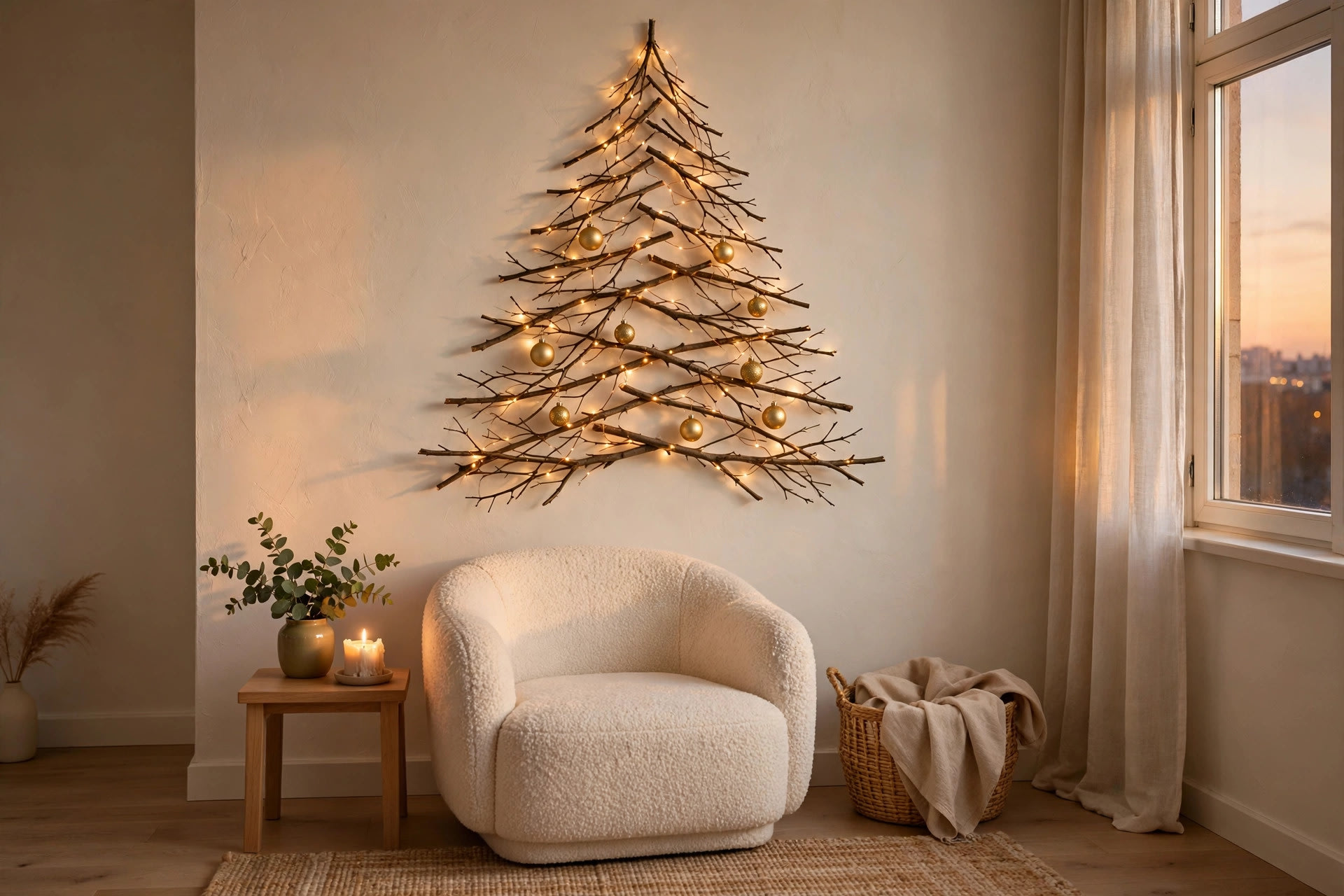
1. The wall-mounted branch tree
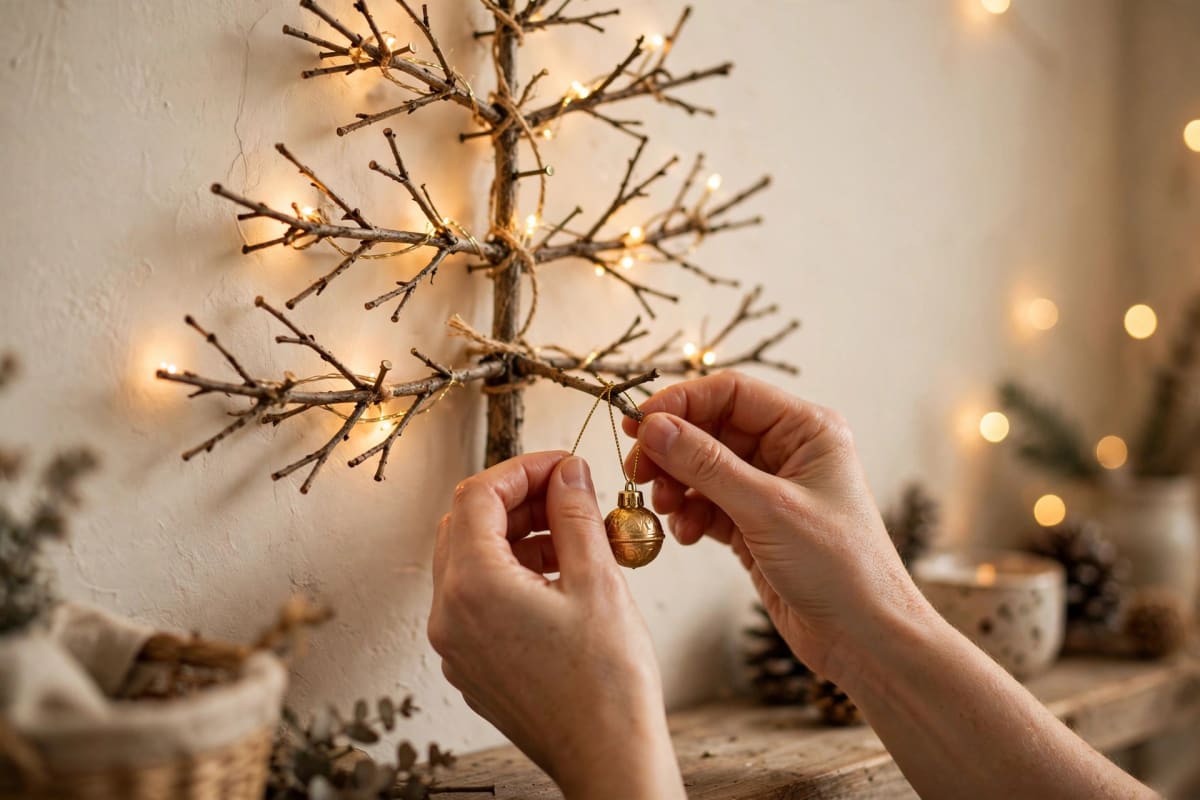
Branches (foraged or $5–$8 for a bundle) hung horizontally on the wall in descending lengths — longest at the bottom, shortest at the top — forming a tree silhouette. String lights woven through, a few lightweight ornaments.
Footprint: zero floor space; needs 100–120 cm of wall width. Cost: $0–$12. Time: 1 hour.
Best for: studios and anyone whose floor space is fully claimed. This is the smallest-footprint real "tree" that exists.
Elevation trick: use branches with some structure — bare birch or curly willow reads sculptural; random twigs read as yard waste. And keep ornaments to 8–10 lightweight ones; heavy glass pulls the strings crooked.
Mistake to avoid: hanging it with tape. Branches + ornaments are heavier than they look — use 2–3 removable adhesive hooks rated for 1 kg each, or one small nail if your lease allows.
2. The pencil tree
A slim artificial tree, 150–180 cm tall but only 45–55 cm in diameter — roughly the footprint of a floor lamp. It gives you a genuine full-height tree in the space of a side table.
Footprint: 50 cm diameter circle. Cost: $25–$45 (the priciest option here, but reusable for a decade). Time: 20 minutes to assemble and fluff.
Best for: anyone who wants a REAL tree experience — star on top, presents underneath — without the square meter.
Elevation trick: fluffing. A pencil tree straight from the box looks like a green bottle brush. Spend 20 minutes pulling every branch tip outward and slightly up — this single step is the difference between sad and stunning.
Mistake to avoid: buying the 210 cm version "for drama." In a 240 cm ceiling apartment it leaves no visual breathing room and dominates the whole room. 150–180 cm is the sweet spot.

3. The tabletop mini
A 60–90 cm faux or real mini tree on a table, dresser, or counter you already own. Decorate it fully — mini ornaments, a tiny topper, a tree skirt made from a cloth napkin.
Footprint: zero new floor space (lives on existing furniture). Cost: $10–$20. Time: 30 minutes to decorate.
Best for: renters, desks, and anyone who wants Christmas in every room without committing floor space anywhere.
Elevation trick: raise it. Put the tree on a stack of books or a small crate so its base sits 15–20 cm above the table — the added height makes a 60 cm tree read like a 90 cm one. And a real tree skirt (even a 30 cm one) beats a bare pot every time.
Mistake to avoid: full-size ornaments on a mini tree. They'll swallow it. Use 3–4 cm mini ornaments only — or make your own from our Dollar Tree Christmas DIYs.
4. The corner half-tree
A half-profile artificial tree designed to sit flat against the wall — full tree from the front, half the depth. The cleverest space hack in this list.
Footprint: 40–45 cm deep against the wall (vs 90+ for a full tree). Cost: $30–$60. Time: 20 minutes.
Best for: corners and narrow walls where a full tree would jut into the walkway.
Elevation trick: pull it 5 cm off the wall, not flush. The small shadow gap gives it depth and stops it looking like a flat decoration. String lights around the front edge only — no wasted lights against the wall.
Mistake to avoid: placing it where you'll see the flat back — like in front of a window or glass door. Half-trees have one viewing angle; give them a solid wall.
5. The ladder tree
A wooden stepladder or leaning shelf ladder ($15–$25, or one you own) wrapped with a light strand and draped with a garland, ornaments hung from the rungs. Rustic, charming, and useful the other 11 months.
Footprint: 40–50 cm deep leaning against the wall. Cost: $0 (own a ladder) to $25. Time: 30 minutes.
Best for: farmhouse/rustic styles and anyone who hates storing a fake tree — the ladder just goes back to the closet in January.
Elevation trick: wrap the lights FIRST, then hang ornaments from the rungs at varying heights with ribbon (not hooks — ribbon ties look intentional, hooks look improvised). A small wreath on the top rung finishes it.
Mistake to avoid: overloading the rungs. Five to seven ornaments total. A ladder groaning under 20 ornaments looks like storage, not decor.
6. The branch in a vase
One beautiful bare branch (foraged free) in a tall heavy vase you own, hung with 6–10 lightweight ornaments and a light strand. Minimalist, sculptural, nearly free.
Footprint: the vase's footprint — 20–25 cm diameter. Cost: $0–$5. Time: 15 minutes.
Best for: minimalists, Scandinavian styles, and the "I want Christmas but make it subtle" crowd.
Elevation trick: the branch matters enormously. Look for one with interesting structure — twists, forks, buds. A straight stick with three twigs looks like you gave up; a gnarled branch looks like art. Take 10 minutes to find a good one.
Mistake to avoid: a lightweight vase. Ornaments + lights make it top-heavy — use your heaviest vase, or add a bag of pebbles at the bottom. A toppled branch on hardwood at 2 AM is a memorable Christmas for the wrong reasons.
7. The felt tree (kids and cats)
A large felt tree shape ($12–$18) hung on the wall with Velcro-attached felt ornaments. Toddlers redecorate it daily, cats can't kill it, and it packs flat in January.
Footprint: zero floor space; ~90×120 cm of wall. Cost: $12–$18. Time: 10 minutes to hang.
Best for: homes with toddlers, cats, or anyone who's lost an ornament to a tail.
Elevation trick: buy the plain green one, not the pre-decorated cartoon version — then add your own felt ornaments in YOUR color story. The plain base + curated ornaments looks intentional; the character-print version looks like a classroom.
Mistake to avoid: hanging it where the cat treats it as a scratching post anyway. Felt survives batting; it doesn't survive climbing. Hallway walls beat living-room walls if your cat is athletic.
Which one should you pick?
- Almost no space: wall branch tree (#1) or branch in vase (#6)
- Want a real tree feel: pencil tree (#2)
- Tight budget: branch in vase (#6) or ladder tree (#5)
- Kids/cats: felt tree (#7), no contest
- Corner spot: half-tree (#4)
- Every room: tabletop minis (#3) — buy two
The takeaway
The best Christmas tree alternative isn't the one that looks most like a tree — it's the one that fits your actual space and gets decorated with confidence. Measure your spot, pick from the list, and give it the full treatment: lights, a topper or focal ornament, and something at the base. A fully-decorated alternative beats a sad full-size tree squeezed where it doesn't fit, every single time.
Frequently asked questions
What can I use instead of a Christmas tree in a small apartment? The 7 best options: wall-mounted branch tree (zero floor space), pencil tree (50 cm diameter), tabletop mini (no new footprint), corner half-tree (45 cm deep), ladder tree, branch in a vase (25 cm), and felt wall tree (kids/cats). Each is detailed above with exact footprints.
How big a tree fits in a small living room? Measure your corner's depth — most small apartments offer 60–80 cm. A pencil tree (50 cm diameter) or half-tree (45 cm deep) fits; a standard 7-foot tree (110+ cm diameter) doesn't. When in doubt, go smaller — an uncrowded tree looks better than a squeezed one.
Are pencil Christmas trees worth it? Yes for small spaces — you get full 150–180 cm height (star, presence, presents underneath) in a 50 cm footprint. Spend 20 minutes fluffing; unfluffed pencil trees are the #1 disappointment in this category.
What is the cheapest Christmas tree alternative? A foraged branch in a vase you own: $0. The wall-mounted branch tree is next at $0–$12. Both look genuinely stylish, not cheap, when done with intention.
How do I make a small Christmas tree look full? Three tricks: fluff every branch tip outward, use 30–50% more lights than feels necessary (light density reads as fullness), and fill interior gaps with 4–5 cm ornaments before hanging showpieces on the tips.