The living room is where Christmas actually happens — the tree, the gifts, the long evenings. But most Christmas living rooms end up as a tree in a corner plus some scattered decorations that never quite gel. The difference between "we put up decorations" and "it feels like Christmas" is cohesion: one palette, layered light, and texture everywhere. These 10 ideas work in any size living room, most cost little or nothing, and none require design skills.
Doing Christmas on a tight budget overall? Start with our budget Christmas decor guide — 10 ideas under $50 total — then come back here for the living-room-specific styling.
Key Takeaways
- The formula: one color palette + three layers of light + texture on every surface = instant cozy
- Budget: $0–$60 total if you shop your home first and thrift the rest
- Biggest impact: tree lighting done right (deep in the branches, warm white) beats any ornament
- Small rooms: go vertical and use our Christmas tree alternatives — a full-size tree isn't mandatory
- Timeline: one afternoon for the tree + mantel, one evening for textiles and lighting
Table of Contents
- Idea 1: Light the tree from the inside out
- Idea 2: Style the mantel in layers
- Idea 3: Build three layers of light
- Idea 4: Swap in seasonal textiles
- Idea 5: Create a coffee table vignette
- Idea 6: Dress the windows
- Idea 7: Go big on greenery, small on ornaments
- Idea 8: Add a scent layer
- Idea 9: Make stockings the personal touch
- Idea 10: Tie the room together with one palette
- The takeaway
- Frequently asked questions
Idea 1: Light the tree from the inside out
Cost: $0–$15 (if you need new lights). Time: 45–60 minutes.
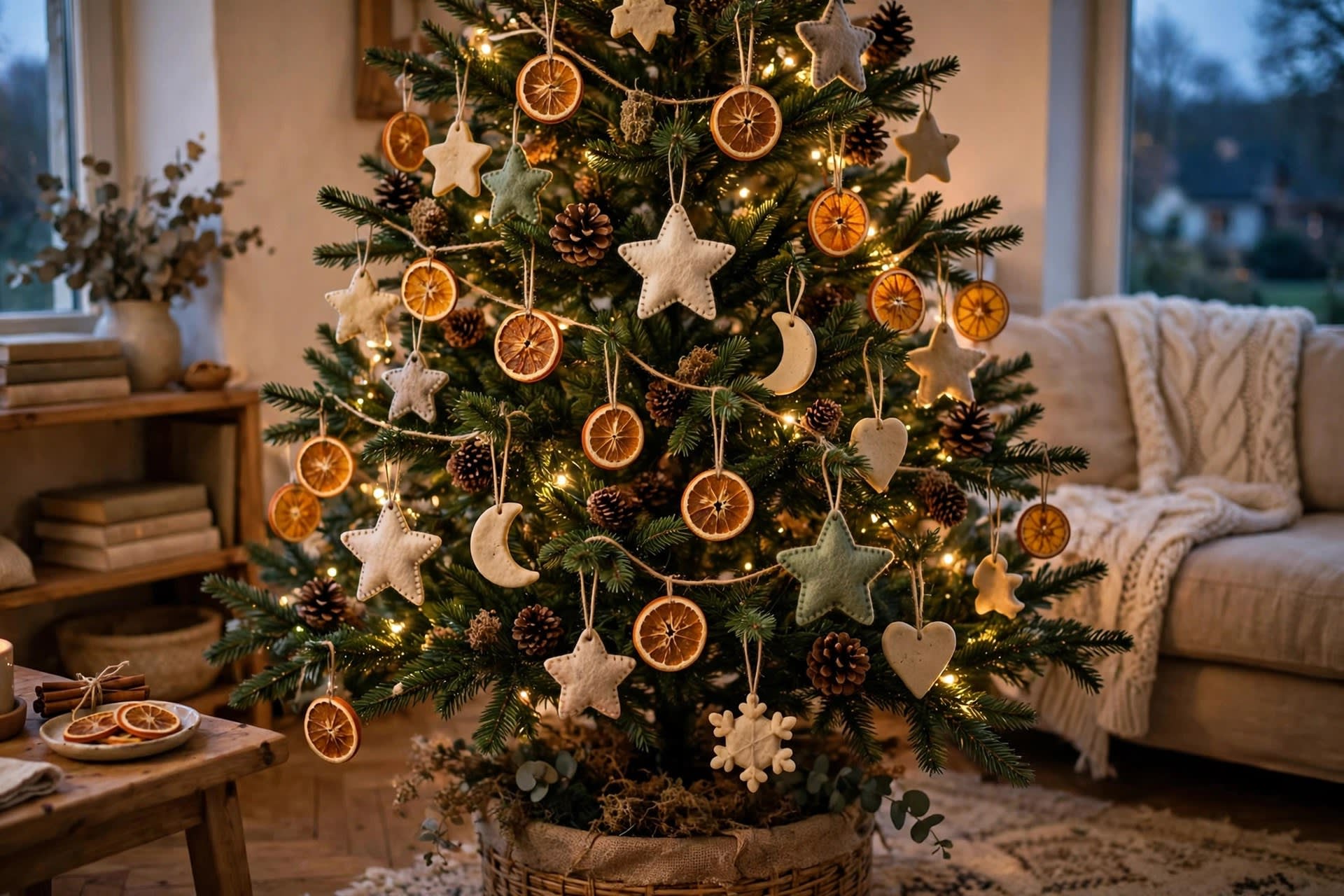
The single biggest tree upgrade costs nothing: push lights deep into the branches, not draped on the tips. Start at the trunk, wind outward, 100 mini lights per 30 cm of tree height. Warm white (2700K) only — multicolor reads chaotic in a living room.

Fluff every branch first (30 minutes nobody wants to spend, everybody notices when skipped). Then ornaments: hang the largest deepest, medium in the middle, small and special at the tips where they're seen. Step back 3 meters after every dozen ornaments — the tree is viewed from the sofa, not from 30 cm away.
Mistake to avoid: the "light necklace" — one strand spiraled around the outside. It lights the room, not the tree. Depth is everything.
Idea 2: Style the mantel in layers
Cost: $0–$20. Time: 30–45 minutes.
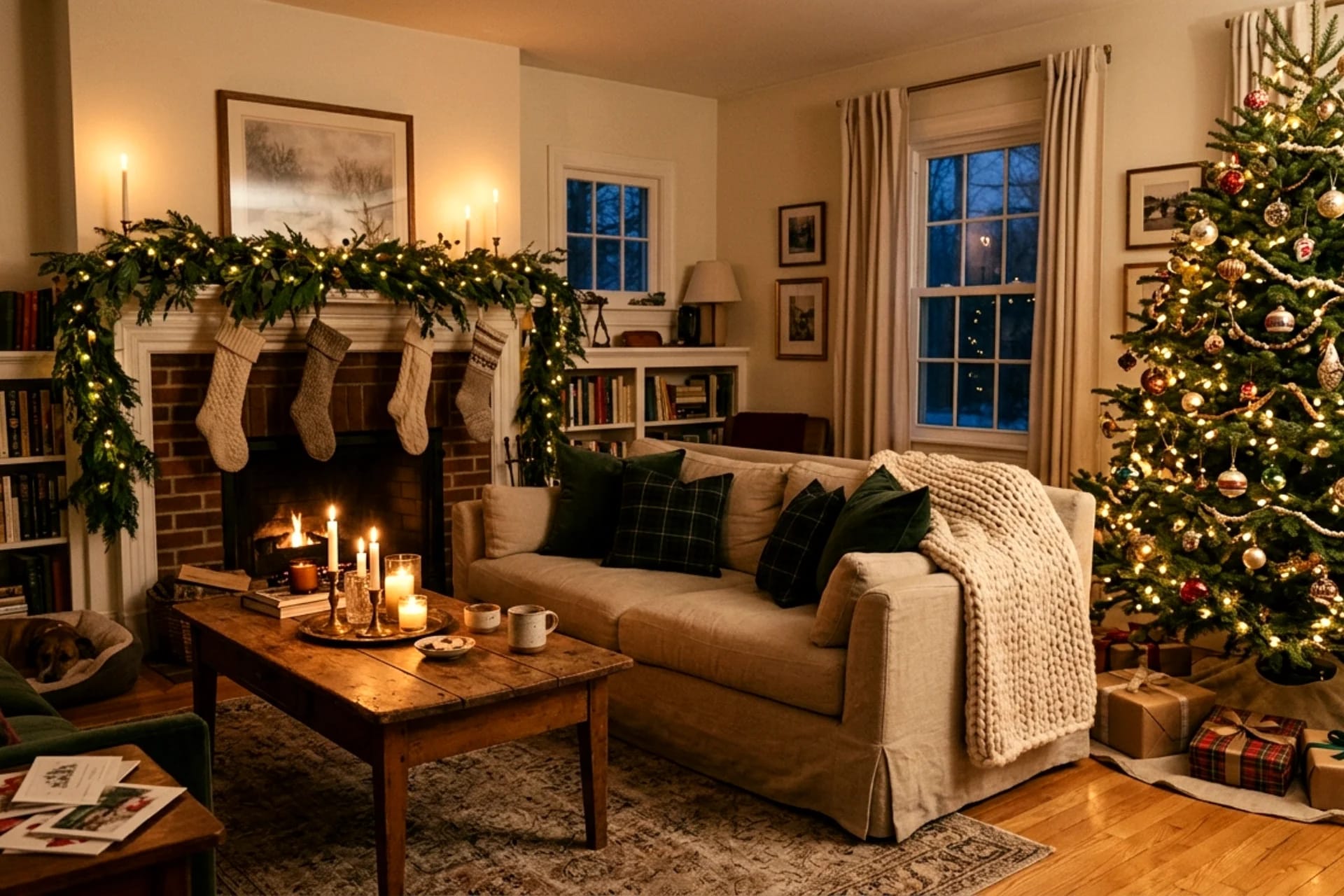
A mantel styled in three depths — garland base, candle/mid-height objects, one tall anchor (mirror, art, or wreath) — looks professional with almost any materials. Foraged evergreen branches (free) + $5–$10 of candles + stockings you already own = done.
Our Christmas mantel decor guide has 3 complete looks under $20 each with exact styling formulas. No mantel? A console table, bookshelf top, or even a wide windowsill takes the same layered treatment.
Mistake to avoid: lining objects in a straight row like soldiers. Cluster in odd numbers, vary heights, let the garland drape asymmetrically — symmetry is the enemy of cozy.
Idea 3: Build three layers of light
Cost: $10–$25. Time: 30 minutes.
Overhead lights off after dark — that's the whole trick. Christmas coziness comes from light at three levels: tree lights (low/mid), candles or fairy lights on surfaces (mid), and one warm lamp or string lights up high (shelf tops, curtain rod).
Real candles where safe (never near the tree or garland), LED pillars elsewhere — $10–$15 for a set of three with timers. A $8–$12 warm-white fairy light strand woven through the mantel garland ties the tree and mantel together visually. Everything on the same warm 2700K temperature or it clashes.
Idea 4: Swap in seasonal textiles
Cost: $20–$40. Time: 20 minutes.
Textiles are the fastest seasonal transformation in any room: two cushion covers in deep green, rust, or warm plaid ($6–$10 each), one chunky knit throw draped over the sofa arm ($12–$20), and you're 70% there. Store them in a labeled box January–November; they last years.
Pick ONE seasonal color to add to your existing palette — your year-round neutrals + one Christmas color (deep red, forest green, or gold) reads sophisticated; three new colors reads chaotic. Faux fur or cable knit textures photograph beautifully and feel luxurious for the price.
Idea 5: Create a coffee table vignette
Cost: $0–$15. Time: 15 minutes.
Clear the coffee table completely, then build one Christmas vignette on a tray: small evergreen sprigs in a jar, a candle, a stack of two books with a pinecone on top. That's it — restraint is what makes it look styled rather than decorated.

Rotate the vignette weekly through December (swap the pinecone for an ornament, add dried orange slices) and it stays fresh all season for zero extra cost. Keep one side of the table clear for actual use — a vignette that blocks the remote controls gets dismantled by day three.
Idea 6: Dress the windows
Cost: $5–$15. Time: 30 minutes.
Windows are the most underused Christmas surface in living rooms. A simple evergreen swag across the curtain rod ($0 foraged, $5–$10 store-bought garland), a candle or LED light in each window ($3–$5 each), or paper stars hung at varying heights ($0–$5 for paper).
From outside, lit windows are the entire neighborhood impression of your home; from inside, they frame the dark December evenings beautifully. Keep treatments simple — the window's job is to glow, not to compete with the tree.
Idea 7: Go big on greenery, small on ornaments
Cost: $0–$20. Time: 1 hour foraging + arranging.
Fresh greenery is the cheapest luxury in Christmas decor: foraged pine, cedar, and eucalyptus branches (free from parks, with permission, or $10–$20 for bundles) arranged in vases, draped on shelves, tucked behind picture frames. Greenery everywhere + restrained ornaments beats ornament overload every time.
Keep cut branches fresh 3–4 weeks: recut stems at an angle, keep water topped up, mist every few days, keep away from heating vents. Our budget Christmas guide covers foraging spots and the $0 greenery sources most people walk past.
Mistake to avoid: buying 6 small $5 decorations instead of one $30 bundle of greenery. Volume of one natural material always beats scattered small purchases.
Idea 8: Add a scent layer
Cost: $0–$10. Time: 10 minutes.
Smell is half of "it feels like Christmas" and it's nearly free: simmer orange slices, cinnamon sticks, and cloves in water on the stove ($3–$5 of ingredients, hours of scent), bake something spiced, or put a few drops of pine essential oil on pinecones ($5–$8 for the oil, lasts years).
Scented candles work too, but one strong candle beats three competing ones. Pick pine, cinnamon, or balsam — never "Christmas cookie" plus pine plus cinnamon together. The nose, like the eye, wants one clear note.
Idea 9: Make stockings the personal touch
Cost: $0–$15. Time: 20 minutes.
Hung stockings — even empty, even mismatched — signal "family Christmas" instantly. Hang them on the mantel, a bookshelf, stair railing, or a stocking holder ($10–$15) if you have no mantel. Personalize with simple kraft-paper tags tied with twine ($2–$3 for the whole set).
The stockings don't need to match; they need to look loved. A child's handmade stocking next to a simple knit one is more charming than a matched set from a catalog.
Idea 10: Tie the room together with one palette
Cost: $0. Time: 15 minutes of editing.
Walk the room and remove anything that fights your chosen palette. That random blue ornament, the silver tinsel from 2019, the neon "Merry Christmas" sign — box them. One palette (your neutrals + one Christmas color + metallic accent) across tree, mantel, textiles, and vignettes is what separates styled from scattered.
Photograph the room from the doorway. If any single object screams for attention, it's the one breaking the palette. Edit ruthlessly — what you remove matters as much as what you add.
The takeaway
A cozy Christmas living room isn't about more decorations — it's about cohesion. One palette, light in three warm layers, greenery for volume, and texture you want to touch. Do the tree and mantel one afternoon, textiles and lighting one evening, and the room will feel like December should feel.
Frequently asked questions
How do I decorate my living room for Christmas on a budget? Shop your home first, then forage greenery (free), then buy only what fills gaps: warm-white lights ($10–$15), candles ($10–$15), and 2–3 cushion covers ($20–$30). A $50–$60 total covers most living rooms when the palette is tight and greenery does the heavy lifting.
What colors are trending for Christmas living room decor 2026? Warm, natural palettes dominate: deep forest green + cream + brass; rust/terracotta + warm white + wood tones; classic red + natural greenery + gold. The common thread is nature-inspired warmth over icy or neon schemes. Pick one palette and carry it through tree, mantel, and textiles.
How do I make a small living room feel Christmassy without clutter? Go vertical (tall slim tree or wall-mounted alternative), keep decorations to tree + mantel + one vignette, and use our Christmas tree alternatives if a full tree overwhelms the space. One tight color palette prevents visual chaos.
How many lights do I need on a Christmas tree? 100 mini lights per 30 cm of tree height, pushed deep into the branches starting at the trunk — not draped on the tips. A 180 cm tree needs about 600 lights. Warm white (2700K) only for a cozy living room feel.
Should Christmas decor match the living room's existing style? Yes — add ONE seasonal color to your existing palette rather than redecorating. Your year-round neutrals + deep green (or red, or gold) + one metallic reads intentional. Fighting your room's existing style with clashing Christmas colors is the fastest way to a chaotic look.
When should I put up Christmas living room decorations? The weekend after Thanksgiving is traditional in the US; many decorators start mid-November to enjoy the full season. Fresh greenery lasts 3–4 weeks indoors, so time foraged branches for early December if you want them fresh through Christmas.