The Christmas table is where your decorating gets judged up close. Guests don't study your mantel from across the room — they sit inches from the centerpiece for two hours. That is why so many Christmas tables feel wrong: the centerpiece is too tall to talk across, too wide to fit the serving dishes, or so fussy that nobody dares move it when the turkey arrives.
The good news is that a beautiful Christmas table costs almost nothing. Every centerpiece below is under $25, most use things you already own, and all of them follow one rule that matters more than any styling trick.
If your mantel still needs work too, our Christmas mantel decor guide covers three complete looks under $20 each.
Key Takeaways
- The height rule: keep the centerpiece under 12 inches tall, or use tall, thin pieces (tapers, bare branches) that eyes can see past — anything wide and tall blocks faces.
- The tray trick: build the centerpiece on a tray or board so the whole thing lifts off in one move when food arrives.
- Budget: all 9 centerpieces below cost under $25; four cost under $15.
- Candle safety: keep flames 12 inches from anything flammable, and use LED candles inside greenery garlands.
- Small tables: a single candle cluster beats a runner you don't have room for — small-table solutions are at the end.
Table of Contents
- The one rule before you buy anything
- 9 centerpieces under $25
- The place setting that makes it look expensive
- Small tables, coffee tables and buffets
- Candle safety at the table
- Mistakes that ruin a Christmas table
- FAQ
The one rule before you buy anything
Sit down at your table and look at the person opposite you. That sightline is the whole design brief. A centerpiece that sits below eye level — roughly under 12 inches tall — never interrupts a conversation. A tall, thin taper or a bare branch works too, because eyes pass right by it. What fails is the wide, tall arrangement: the big floral mound, the tall lantern flanked by two chunky candle clusters, the miniature village that sprawls across the middle. All of them turn dinner into a shouting match around an obstacle.
Test every centerpiece before the guests arrive: set it out, sit down, and check you can see the face across from you. If you can't, the centerpiece is too big, no matter how pretty it looked in the shop.
The second rule is almost as important: the centerpiece must move. Christmas dinner needs the middle of the table for serving dishes, and no arrangement survives contact with a roasting pan. Build on a tray, a board, or a runner you can roll up, so the whole display lifts off in one motion and goes to the sideboard until dessert.
9 centerpieces under $25
1. The candle-and-greenery tray ($18)
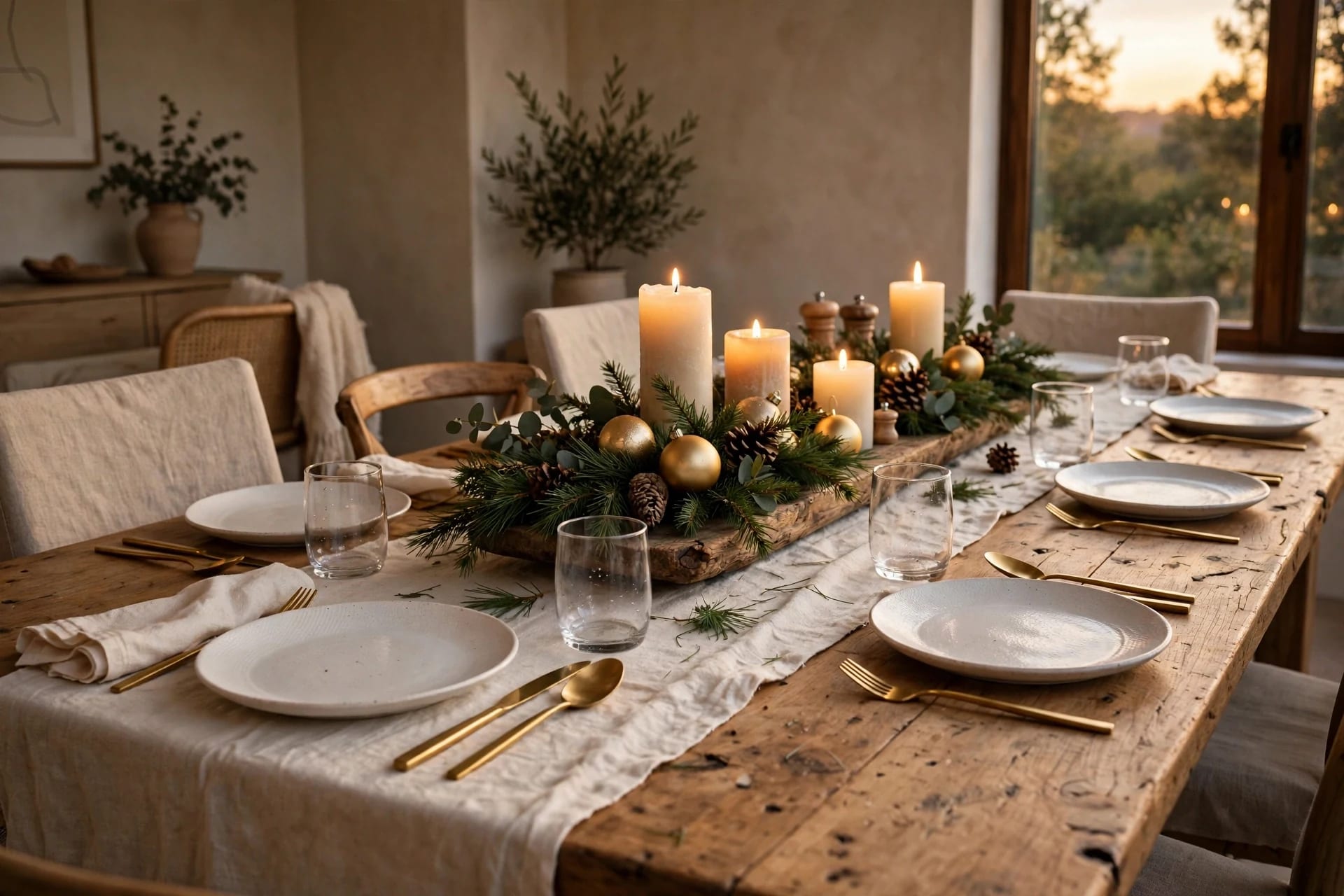
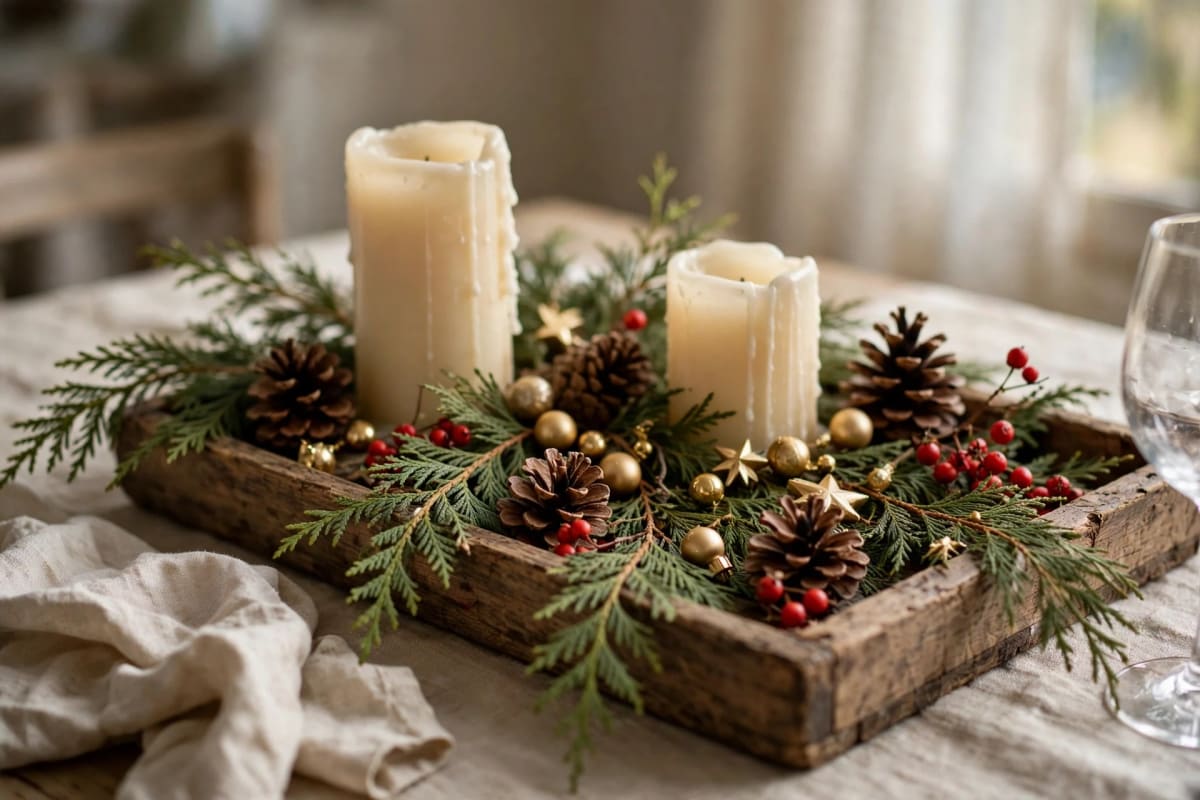
A wooden tray or serving board, three pillar candles at different heights, and a loose handful of fresh evergreen branches tucked around them. Add five or six small gold ornaments for sparkle. The tray is the point: when dinner is served, the whole thing moves to the sideboard in one lift. Cost: tray from your kitchen ($0), three pillar candles ($9), a bunch of fresh cedar or fir from a florist or garden ($5), ornaments from your existing box ($0), battery tea lights if you prefer ($4).
2. The greenery runner ($12)
Lay a faux garland straight down the middle of the table — no tray, no container — and weave in a string of warm-white fairy lights and a few pinecones. This is the easiest high-impact look there is, and it works on long tables where a single centerpiece would look lost. Keep the garland narrow (about 6 inches wide) so plates still fit, and use LED lights only: real flames and loose garland do not mix. Cost: 6-foot faux garland ($8), fairy lights ($4).
3. The ornament vase ($10)
Fill a tall glass vase or hurricane jar with ornaments in one color — all gold, all red, all silver — and set it on a small stack of books or a cake stand for height. One color reads expensive; a rainbow reads like the ornament box exploded. This is the fastest centerpiece on the list: five minutes, one vase, done. Cost: vase from your cupboard ($0), a bag of shatterproof ornaments ($8), a cake stand you own ($0).
4. The mini-tree row ($22)
Line up four to six small potted evergreen trees (frosted or plain) down the center of a runner, with red berries tucked at their bases. Each guest can take one home, which makes it a favor and a centerpiece at once. Keep the trees under 10 inches tall or the sightline rule breaks. Cost: six mini trees ($18), berry picks ($4).
5. Mason jars with fairy lights ($15)
Three mason jars in a row: one with fairy lights, one with evergreen sprigs and berries, one with candy canes or cinnamon sticks. Tie twine around the necks. This is the look that dominates Pinterest for a reason — it is cheap, it photographs beautifully, and every piece comes from a kitchen cupboard or a dollar store. Cost: three jars ($3), fairy lights ($4), sprigs and berries ($5), twine ($3).
6. Fruit and candles ($8)
A bowl of clementines or lemons, three taper candles in simple holders, and a few sprigs of rosemary scattered between them. Grocery-store produce is the most underrated Christmas decor there is: it smells good, it costs almost nothing, and it looks deliberately styled rather than thrown together. Eat the fruit after dinner and the centerpiece costs you nothing at all. Cost: a bag of clementines ($4), taper candles ($4).
7. The candle terrace ($20)
Cover a serving board with candles of every height you own — tea lights, votives, pillars, one or two tapers — and tuck rosemary and eucalyptus sprigs between them. The mix of heights is what makes it look designed rather than random: vary the heights by at least 2 inches between neighbors. This is the best centerpiece for a dark dining room, because candlelight does most of the decorating for you. Cost: candles you own ($0) plus a few new ones ($10), sprigs ($5), board ($0), LED tea lights for the tight spots ($5).
8. The hot-chocolate tray ($15)
A tray with four mugs, a jar of cocoa mix, marshmallows, and a few candy canes — a centerpiece that doubles as dessert. Set it on the sideboard if the table is full, or in the middle for a casual family dinner. Kids love it, adults use it, and nothing on it is purely decorative. Cost: cocoa and marshmallows ($10), candy canes ($5), tray and mugs from your cupboard ($0).
9. The neutral table ($20)
No red, no green: cream candles, a linen runner in natural flax, dried orange slices, and one metallic accent (brass candlesticks or a silver tray). Repeat one seasonal cue three times — dried citrus in the centerpiece, on the napkins, and on the sideboard — and the table reads as Christmas without a single traditional color. This is the look for people who find red-and-green exhausting. Cost: dried orange slices ($6), cream candles ($8), runner you own or a length of linen ($6).
For the rest of the room, our budget Christmas decor guide stretches the same approach across the whole house for under $50 total.
The place setting that makes it look expensive
A centerpiece can't rescue a sloppy place setting, and a good place setting makes a $10 centerpiece look like $100. The layout is simple once you learn it:
- Charger or dinner plate: centered at each seat, roughly an inch in from the edge, lined up evenly at every seat. Skip chargers on a small table — they eat 2 inches per side you don't have.
- Forks left, knife right: blade facing the plate, spoon to the right of the knife only if you need it. Line up the bottoms of the handles.
- Bread plate top left, glasses top right: bread goes left, drinks go right — hold both hands up with thumbs and index fingers touching, and the shapes you see read as b on the left and d on the right.
- Napkin: on the plate for a formal look, left of the forks for a casual one. Tie a sprig of rosemary or a small ornament into the fold and the whole setting looks intentional.
- Place cards: handwritten names on kraft card or on a small ornament. They cost almost nothing and make guests feel expected rather than accommodated.
Stop at two glasses per seat — water plus one wine glass — and the table keeps its breathing room. A third glass is where tables start to look like a restaurant supply shelf.
Small tables, coffee tables and buffets
Small round table (seats 4): skip the runner and the charger. One candle cluster in the center — three candles at different heights on a small tray — and everything else stays the same. The tray matters more here, because a small table needs its center back the moment food arrives.
Coffee-table dinner: lay a tablecloth over the coffee table, add floor cushions, and set everything on trays. It is relaxed, it seats two to four comfortably, and it is the best answer to "we don't have a dining table." Keep the centerpiece to one tray and keep drinks on a separate tray so nothing gets knocked.
Buffet on a sideboard or island: roll each set of flatware inside a napkin, tie with ribbon, and stand the bundles upright in a jar or basket. Stack plates at one end, put the centerpiece — the tray arrangement from idea 1 works perfectly — at the other end, and let people serve themselves. If you must seat more people than the table fits, move the centerpiece to the sideboard for the meal and bring it back for dessert.

Candle safety at the table
Candlelight is the cheapest luxury at a Christmas table, and it is also the one thing that can ruin the evening. The rules are short:
- 12 inches clear: keep every open flame at least 12 inches from anything that can burn — greenery, paper stars, napkins, sleeves, and especially dried garland, which catches fast.
- LED inside garlands: never put a real flame inside or under a greenery garland. Battery candles look identical from two feet away and can't set the table on fire.
- Stable holders: tapers need holders that grip them, not decorative cups they wobble in. Keep tapers out of reach of sleeves and children.
- Blow them out: before you leave the room, before bed, before the last guest leaves. Every time, no exceptions.
If you have kids or pets at the table, use LED pillars for everything and keep one or two real tapers only where adults sit. Nobody can tell the difference in a dim room.
Mistakes that ruin a Christmas table
- Too tall to talk across. The most common failure. If you can't see the face opposite you, the centerpiece is wrong, however beautiful.
- Too wide for the food. Leave at least 12 inches of clear table on each side of the centerpiece for serving dishes, or the centerpiece ends up on the floor.
- One flat height. Everything at the same level reads as a display shelf. Vary heights by 2 inches or more between neighbors.
- Scented candles competing with dinner. A strongly scented candle next to roast dinner is a headache, not an atmosphere. Use unscented candles at the table and save scented ones for the living room.
- Matching everything. A table where every ornament, napkin, and candle is the same shade of red looks like a showroom. Two colors plus one metallic is the limit.
Our Christmas garland ideas use the same height-and-safety rules for mantels and staircases, and the DIY Christmas wreath guide covers the front door to match.
FAQ
How tall should a Christmas table centerpiece be?
Under 12 inches tall is the safe rule — low enough that guests can see each other across the table. Tall, thin pieces like tapers or bare branches are the exception, because eyes pass right by them. Anything wide and tall blocks faces and should be moved to the sideboard.
How much should I spend on a Christmas table centerpiece?
Nothing is wrong with $0 — greenery from the garden, candles you own, and a tray from the kitchen make a complete centerpiece. If you buy, $15–$25 covers every idea in this guide. Spend on the base (tray or runner) and the candles first; they do most of the work.
Are real or LED candles better for a Christmas table?
Real candles look and smell better, but LED candles are safer inside greenery and around kids. The practical answer is both: real tapers in stable holders where adults sit, LED pillars and tea lights inside garlands and tight spots. From two feet away in a dim room, nobody can tell.
What if I don't have a dining table?
Use a coffee table with floor cushions, or set a buffet on a sideboard or kitchen island and let people serve themselves. A single candle cluster on a tray is a complete centerpiece at any of these — the table matters less than the light and the one repeated seasonal detail.
How do I keep fresh greenery looking good through dinner?
Buy or cut it no more than two days before, keep it cool and out of direct heat, and mist it lightly the morning of the meal. Cedar and fir hold up indoors for a week or more; soft spruce sheds faster. If the greenery starts dropping needles on the plates, swap it for the faux garland next year.
Can I reuse my Thanksgiving table decor for Christmas?
Yes, and it is the smartest shortcut on this page. The tray, the candles, and the linen runner all carry over — swap pumpkins and gourds for ornaments and pine, add a string of fairy lights, and the table reads as Christmas without buying anything new.