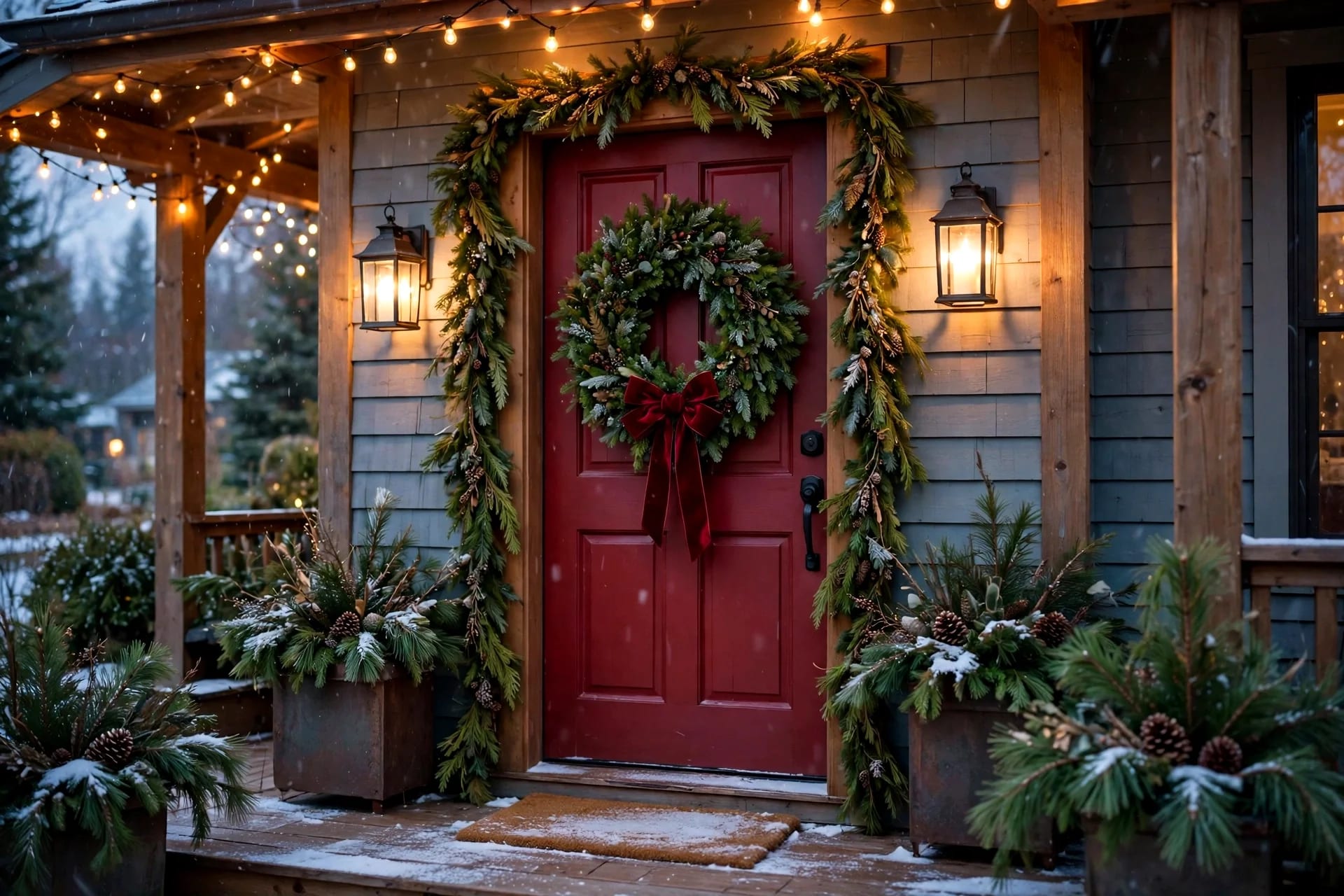

The mantel gets all the attention, but the biggest Christmas surface in your home is the wall behind the sofa — and most years it sits there blank while the tree does all the work. Wall decor fixes that, and it has one huge advantage over almost everything else seasonal: it comes down in January leaving nothing behind, if you hang it right.
Here are nine wall-specific ideas, the sizing that makes each one look intentional, and the hanging rules that keep garlands off the floor by week two.
Key Takeaways
- Budget: most ideas land between $5 and $40; the frame swap is nearly free
- Time needed: 30–90 minutes per wall
- Skill level: beginner — everything hangs on removable hooks
- The rule that saves the season: hooks every 24–30 inches, loaded only after a full hour's cure
Table of Contents
- 1. Garland swag over the sofa or doorway
- 2. A wreath trio instead of one wreath
- 3. Paper stars, staggered
- 4. The frame swap: Christmas inside your gallery wall
- 5. A Christmas card garland
- 6. Stockings without a mantel
- 7. A string-light wall tree
- 8. An ornament cluster in the corner
- 9. Peel-and-stick decals for kids' rooms and entries
- The hanging rules (read before the ladder comes out)
- FAQ
1. Garland swag over the sofa or doorway
The classic, because it works: a greenery garland draped in one or two soft swags across the wall above the sofa, or framing a doorway. Buy more length than the span — a swag that dips 10–12 inches needs roughly 1.5× the straight distance in garland (a 6-foot span with two side drops takes about 9 feet). Thin garlands look scrawny alone; layer two together and fluff the branches outward before hanging. Add ornaments and ribbon after it's up, concentrated toward the ends and the swag's low point.
2. A wreath trio instead of one wreath
A single small wreath alone on a big wall reads as an afterthought. Three slim wreaths (12–16 inches each) hung in a row or a loose triangle reads as a designed installation. Keep one ribbon color across all three, space them about one wreath-diameter apart, and hang the group's center near eye level (~57 inches). Faux greenery stores flat and repeats yearly; real wreaths smell wonderful and look tired by week three indoors — plan accordingly. It pairs naturally with the rest of your Christmas living room decor.
3. Paper stars, staggered
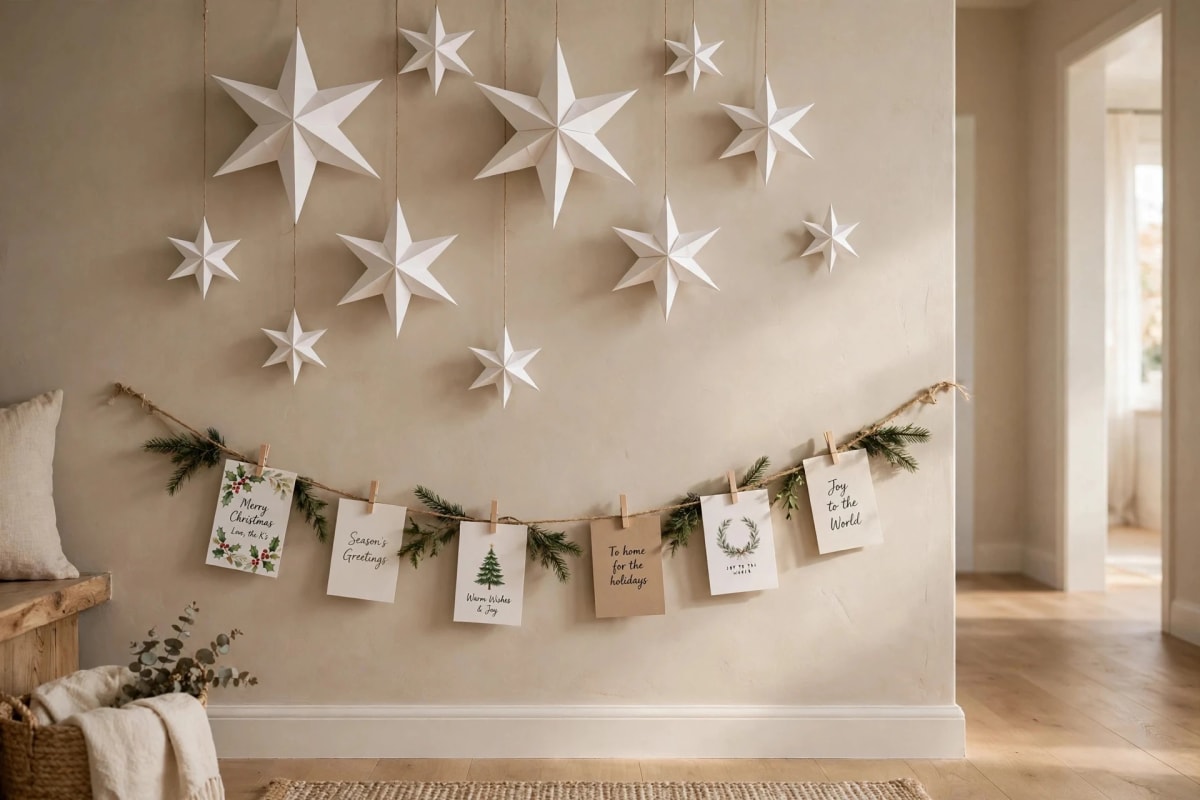
Folded 3D paper stars (the paper-bag version costs about $5 total) hung at staggered heights on clear thread or thin ribbon. Three to five stars, odd count, largest around 18–24 inches. They weigh almost nothing — a single small adhesive hook carries a whole cluster — and they store flat in an envelope for next year. Keep them on LED-adjacent walls only if lights are involved, and away from heat vents: paper plus dry heat is a short friendship.
4. The frame swap: Christmas inside your gallery wall
The cheapest idea here, because the frames already exist. Take down your everyday gallery prints and replace the contents with Christmas: wrapping paper offcuts, last year's cards, a printable, fabric scraps, even a page of sheet music. The wall transforms in 20 minutes, costs nearly nothing, and reverses completely in January when the originals go back. If you don't have a gallery wall yet, our gallery wall layout guide gets one up — this swap is the reason to finally do it.

5. A Christmas card garland
String twine or thin ribbon between two hooks and clip incoming cards along it with mini clothespins. It grows all December, costs almost nothing, and solves the annual "cards on every horizontal surface" problem by giving them a wall. Start the string in mid-December if your mail is slow — an empty string looks like laundry infrastructure; five cards in, it looks like a tradition.
6. Stockings without a mantel
No fireplace is not a stocking disqualification. A row of stockings hung from hooks on a wall strip, a shelf edge, or a decorative ladder against the wall works fine — and if you do have the mantel, our Christmas mantel decor guide covers it properly. Wall-hung stockings need hooks rated for the filled weight, not the empty one; a loaded stocking is 2–5 lbs of enthusiasm.
7. A string-light wall tree
For small spaces and tree-less rooms: outline a tree shape on the wall with a string of warm LED lights on small clear hooks, zig-zagging down in widening rows, then hang a few lightweight ornaments on the "branches." It's flat, it's free of pine needles, and it stores in a shoebox. More flat-tree thinking in our Christmas tree alternatives guide.
8. An ornament cluster in the corner
Tie 5–9 shatterproof ornaments at varied ribbon lengths (12–30 inches) and hang the bundle from one ceiling-corner hook or a curtain rod end, so the cluster floats in the corner at different heights. It fills the dead corner every room has, reflects light beautifully, and takes ten minutes. Shatterproof matters: corner clusters live exactly at head-and-vacuum height.
9. Peel-and-stick decals for kids' rooms and entries
Removable vinyl decals — snowflakes, a reindeer, a countdown — go on smooth walls in minutes and peel off in January. The honest limits: they dislike textured walls, they can lift paint that was already failing, and they're single-season if removed carelessly (peel slow, warm with a hairdryer). A solid zero-hole option from the same family as the rest of our damage-free wall decor guide.
Which wall first? Start with the wall you see the moment you walk into the room — usually the one facing the door, often the sofa wall. Decorate that one properly and the room reads as "done," even if every other wall stays bare. The second-best candidate is the entryway: it's small, so one idea covers it completely, and it's the first and last thing guests see. Bedrooms get what's left over — a paper-star cluster or a card garland — because seasonal decor there is for you, and a little goes a long way.
The hanging rules (read before the ladder comes out)
- Adhesive hooks: clean, press, wait. Wipe the spot with rubbing alcohol, press the hook firmly for 30 seconds, then wait a full hour before hanging anything. Skipping the cure hour is the #1 reason December decor lands on the floor — and on freshly painted walls (under a week cured), skip adhesive entirely.
- Spacing: every 24–30 inches for a light garland; every 12–16 inches for a heavy, ornament-loaded one. When in doubt, add a hook — garlands fail in the sag between hooks, not at them.
- Weigh before you hang. Total hook capacity should comfortably exceed the garland's actual weight; a bathroom scale settles arguments.
- Renters: everything here is reversible by design — hooks, tension, and gravity do the work. The full no-damage toolkit is in our renter-friendly wall decor guide.
- Heat discipline: real greenery away from vents and radiators (it dries to kindling), paper away from heat sources, and string lights LED-only near anything flammable.
- Budget check: paper stars ~$5, card garland ~$3, frame swap ~$0, a good faux garland $15–$35 that serves for years — and the dollar-store route is covered in our dollar tree Christmas DIY guide.
FAQ
When should Christmas wall decor go up? Whenever you like, but practically: faux and paper anytime from mid-November; real greenery no earlier than early December if you want it alive at Christmas — indoor heat gives fresh garland about 2–3 good weeks.
How high should a wreath or swag hang above a sofa? The arrangement's bottom edge 6–12 inches above the sofa back, with the visual center around eye level (~57 inches). Higher reads as floating; lower gets bumped by heads.
Will adhesive hooks hold a real garland? A fresh garland is heavier and damp — weigh it, double the hooks, and re-check at day three as it dries and lightens. Faux is the safer adhesive-hook load.
How do I hide string-light cords on a wall? Run the cord down a corner or behind the furniture edge, use clear clips that match the wall color, and start the shape at the outlet side so the slack lives somewhere invisible.
Can I mix several of these ideas on one wall? Yes — a swag plus a wreath trio is a classic pairing. Keep one palette (same greenery family, one ribbon color, one metal) and let one idea lead; two competing focal points make December noise.
Pick one wall, pick one idea, hang it after the cure hour. The wall behind the sofa has been waiting all year for its moment.