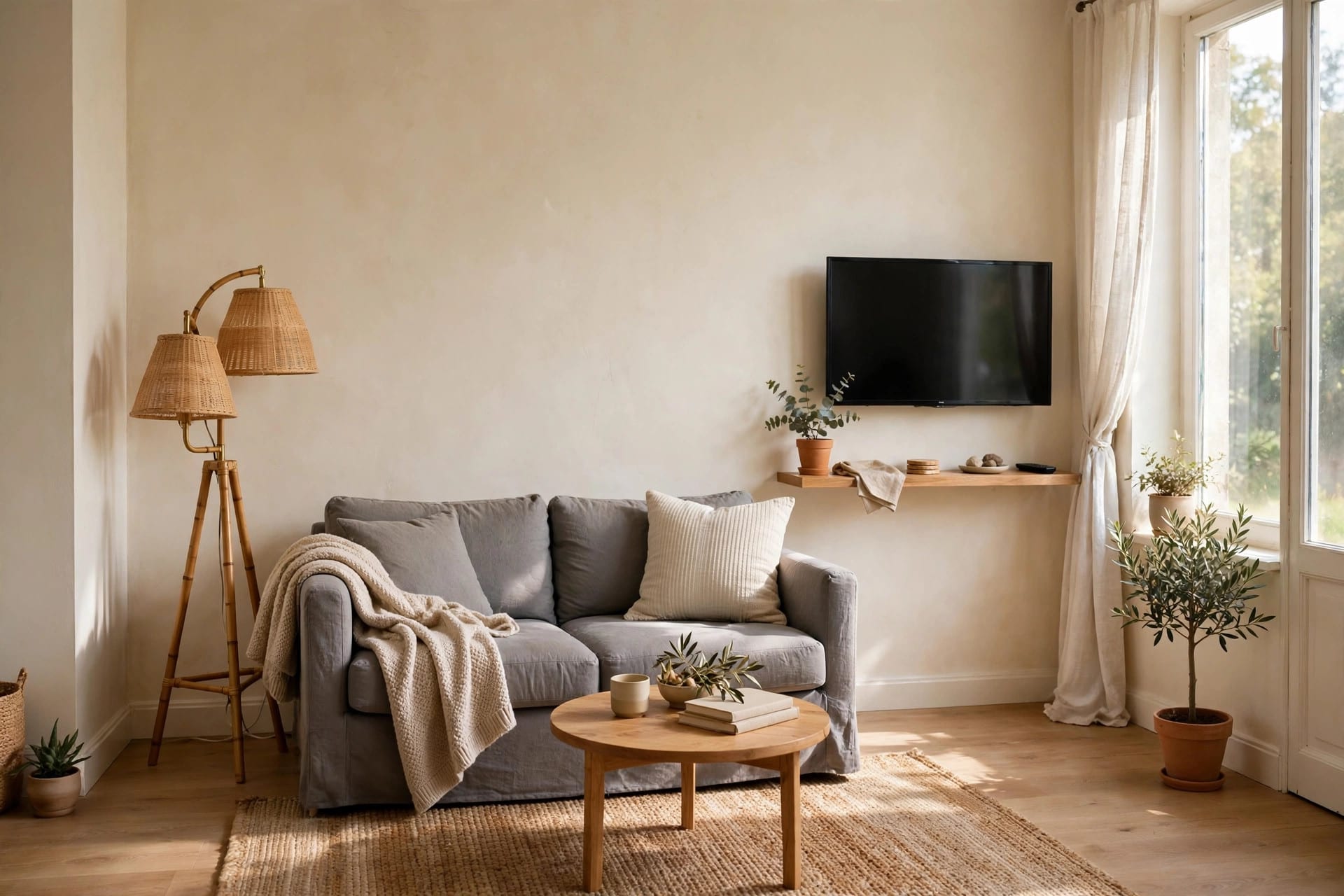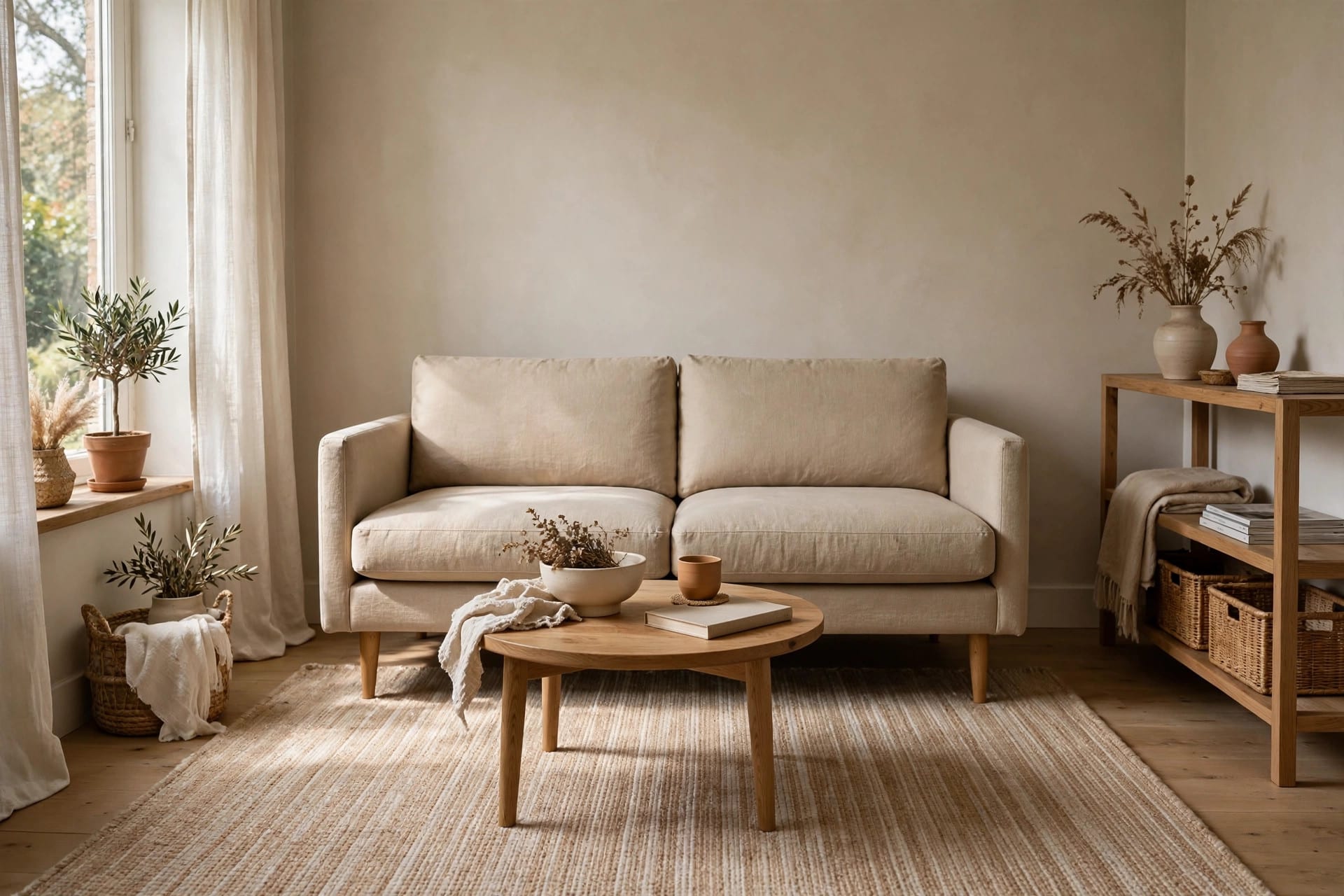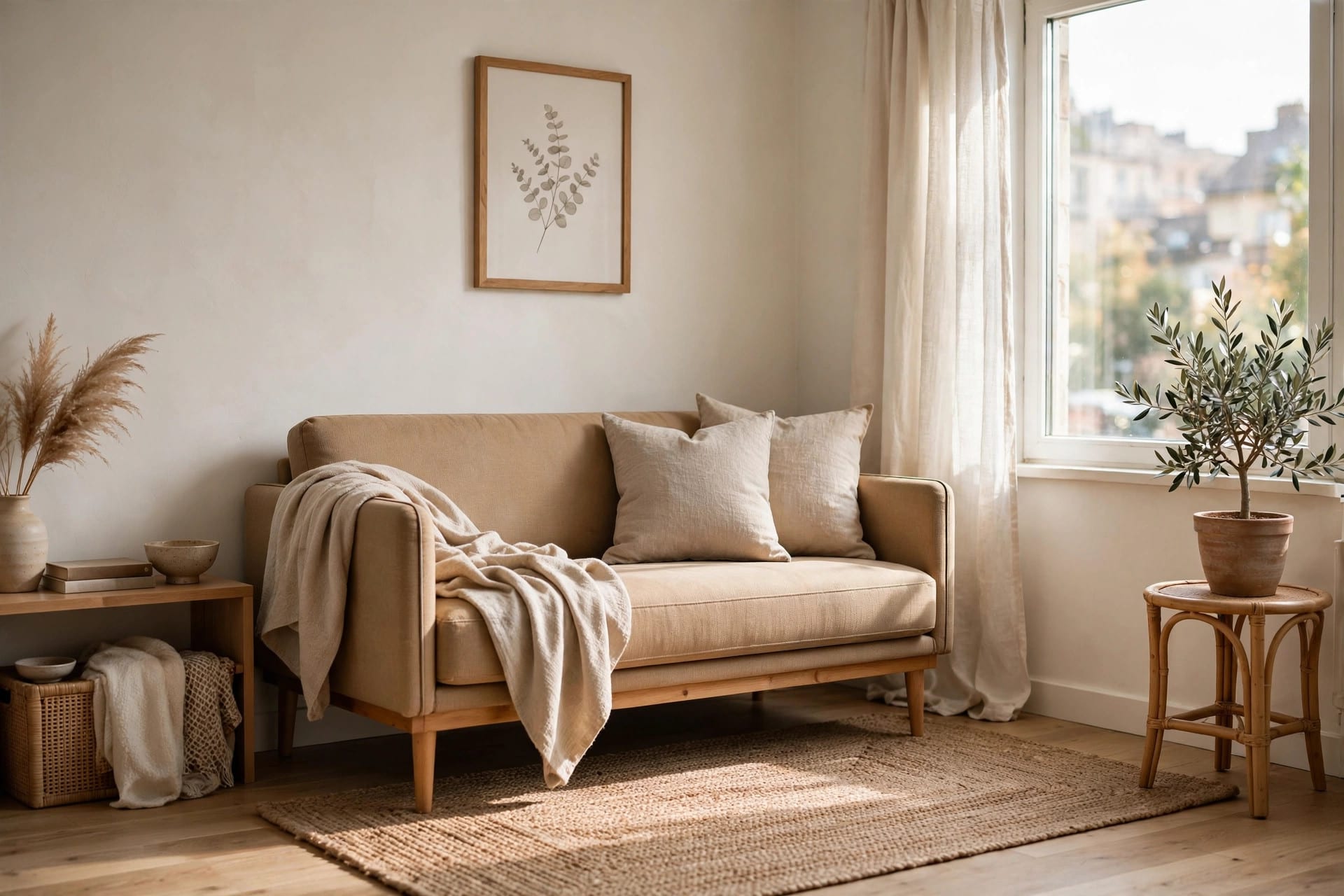
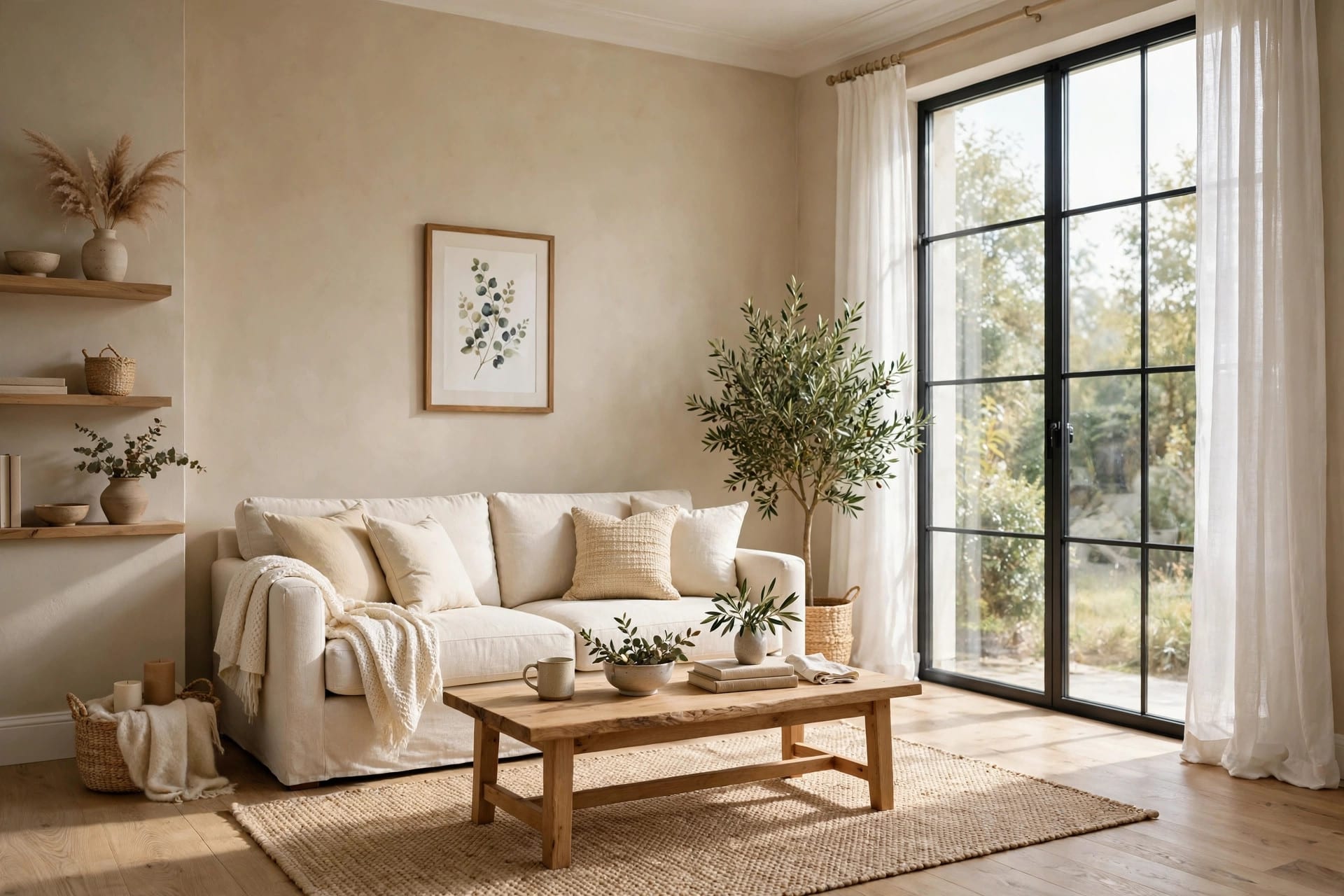
"Just paint it white" is the most repeated and least helpful advice in small-space decorating. Pure white in a small living room often looks flat, cold, and — perversely — smaller, because it exaggerates every shadow into a hard edge. The real answer is more interesting: specific shades with specific light-reflectance values, matched to your room's direction.
Here are 7 best paint colors for small living rooms — real named shades with real codes, LRV numbers, and honest notes on where each one shines and where it fails. This is the color companion to our small living room ideas guide.
Key Takeaways
- LRV target: 60–75 (Light Reflectance Value) — bright enough to bounce light, not so bright it goes clinical
- The 7 shades: warm white, greige, pale sage, dusty blue-gray, light sand, soft taupe, warm off-white — all with real paint codes below
- North vs south matters more than the shade: north-facing rooms need warm undertones; south-facing can handle cooler ones
- Finish: eggshell on walls — the single most underrated choice in this whole guide
In this guide:
- How to read this guide (LRV + undertones)
- 1. Warm White — Benjamin Moore White Dove OC-17
- 2. Greige — Sherwin-Williams Agreeable Gray SW 7029
- 3. Pale Sage — Benjamin Moore Saybrook Sage HC-114 (at 50%)
- 4. Dusty Blue-Gray — Sherwin-Williams Rainwashed SW 6211
- 5. Light Sand — Benjamin Moore Manchester Tan HC-81
- 6. Soft Taupe — Sherwin-Williams Accessible Beige SW 7036
- 7. Warm Off-White — Benjamin Moore Swiss Coffee OC-45
- North-facing vs south-facing: the rule
- The finish nobody talks about
- The takeaway
- Frequently asked questions
How to read this guide (LRV + undertones)
LRV (Light Reflectance Value) runs 0 (black) to 100 (white). For small living rooms, aim for 60–75: reflective enough to bounce daylight around, muted enough to avoid the operating-room look. Every shade below lists its LRV.
Undertone is the hidden color inside the color — the thing that makes a "gray" look purple at 6 PM. Undertone mismatches cause more repaint jobs than wrong color families. Each shade below names its undertone so you can match it to your light.
1. Warm White — Benjamin Moore White Dove OC-17
LRV: 85 (use at 50% strength in very small rooms). Undertone: creamy yellow.
The white that isn't white. White Dove has enough cream to kill the blue-gray cast that makes pure whites look like a dentist's office, while staying light enough to maximize every photon. It's the most-used designer white in America for a reason.
Best for: rooms with decent daylight that just need brightening. Avoid if: your room gets almost no natural light — in a dark room, White Dove can read dingy yellow. Go darker and cozier instead (see #6).
2. Greige — Sherwin-Williams Agreeable Gray SW 7029
LRV: 60. Undertone: warm beige-gray.
The peacekeeper of paint colors — it gets along with warm woods AND cool grays, which is exactly the mixed furniture situation most small living rooms have. At LRV 60 it's the darkest shade on this list, but it earns its place: it adds depth without weight, and depth is what stops a small room feeling like a box.
Best for: rooms with mixed warm/cool furniture. The most forgiving choice here — if you can only pick one shade blind, pick this.
Mistake to avoid: pairing it with cool-white bulbs. Agreeable Gray under 5000K lighting goes flat and lifeless. Warm 2700–3000K bulbs keep it glowing.
3. Pale Sage — Benjamin Moore Saybrook Sage HC-114 (at 50%)
LRV: ~65 at half strength. Undertone: green-gray.
Sage at full strength is a commitment; at 50% it's a whisper of green that behaves like a neutral. It does something no beige can: it makes white trim and natural wood look intentional instead of default. Small rooms need that little bit of personality or they feel like rentals.
Best for: rooms with plants (obviously) and anyone bored of beige. Avoid if: your sofa is green — matchy-matchy green-on-green shrinks a room visually.

4. Dusty Blue-Gray — Sherwin-Williams Rainwashed SW 6211
LRV: 59. Undertone: green-blue.
The cool option that actually works in small rooms — because it's muted, not icy. Rainwashed recedes visually (cool colors push walls back), which is genuine spatial trickery, not wishful thinking. It pairs beautifully with the warm woods and brass that are everywhere right now.
Best for: south or west-facing rooms with warm afternoon light — the cool paint balances the warm sun. Avoid if: north-facing with cool light — double-cool goes arctic. See the direction rule below.
5. Light Sand — Benjamin Moore Manchester Tan HC-81
LRV: 58. Undertone: warm tan.
For rooms that get limited natural light, fighting the darkness with white is a losing battle — the white just shows you exactly how dark it is. Manchester Tan surrenders strategically: a warm mid-tone that makes a dim room feel cozy and intentional instead of failed-bright.
Best for: basement-adjacent living rooms, north-facing rooms with one small window. Pair with: the brightest white trim you can stand (this is the one case where high-contrast trim helps — it gives the eye a crisp edge to read the room's shape).
6. Soft Taupe — Sherwin-Williams Accessible Beige SW 7036
LRV: 58. Undertone: greige-beige, remarkably neutral.
The "I don't want to think about undertones" shade. Accessible Beige is famous among designers precisely because it doesn't go pink, yellow, or gray on you — it stays politely itself in almost any light. In a small room, that reliability is worth more than a more exciting color that might betray you at dusk.
Best for: open-plan spaces where the living room flows into a kitchen or hallway — it won't clash with whatever's next door.
7. Warm Off-White — Benjamin Moore Swiss Coffee OC-45
LRV: 84. Undertone: warm cream-beige.
Softer than White Dove, creamier, almost buttery in warm light. Swiss Coffee is the shade for people who want white walls but find white walls depressing. It wraps a small room in warmth while keeping the LRV high enough to bounce light.
Best for: cozy-style small living rooms — the reading-nook, soft-textile, warm-lamp aesthetic. Avoid if: you have a lot of orange-toned wood (oak, pine) — cream + orange wood can go pumpkin. White Dove (#1) is safer there.
North-facing vs south-facing: the rule
This matters more than which shade you pick:
- North-facing (cool, indirect light): go WARM — White Dove, Swiss Coffee, Manchester Tan, Accessible Beige. Cool light + cool paint = gray cave.
- South-facing (warm, direct light): you can go COOL — Rainwashed, pale sage, even Agreeable Gray. The warm sun balances the cool paint.
- East/west: morning-cool/afternoon-warm — pick a neutral-undertone shade (Accessible Beige, Agreeable Gray) that won't swing wildly through the day.
Always: paint a 60×60 cm test patch on TWO walls (one sunlit, one shaded) and live with it 48 hours. The $8 sample pot is the cheapest insurance in decorating.

The finish nobody talks about
Eggshell on the walls. Always. Here's why: flat finish shows every wall imperfection (and small rooms put you close enough to see them) but absorbs light; satin/semigloss bounces light but highlights every bump. Eggshell is the sweet spot — soft glow, forgiving surface, scrubbable enough for real life.
Ceiling: flat white, one shade brighter than the walls (or the same white at full strength while walls go 50%). Trim: satin, same color family as walls but 1–2 shades lighter — low contrast keeps the room's edges soft and the space feeling continuous.
The takeaway
Stop asking "what color makes a room look bigger" and start asking "what's my LRV, my undertone, and my light direction." Pick from the seven above using the north/south rule, test a real patch, and finish in eggshell. That's the whole system — and it beats "just paint it white" every single time.
Frequently asked questions
What paint color makes a small living room look bigger? Light neutrals with LRV 60–75: warm whites (White Dove OC-17), greige (Agreeable Gray SW 7029), pale sage, dusty blue-gray (Rainwashed SW 6211). Low contrast between walls, trim, and ceiling matters as much as the shade.
Is white or beige better for a small living room? Warm white beats stark white (which can look clinical and exaggerate shadows); beige/greige beats both if your room has mixed warm and cool furniture. The undertone matters more than the family — test patches in your actual light.
What is the best paint finish for a small living room? Eggshell on walls — it reflects light softly without highlighting imperfections like satin does. Flat white on the ceiling, satin on trim.
Can I use dark colors in a small living room? Yes, on ONE wall or below a chair rail — a dark accent adds depth that can paradoxically make the room feel larger. Keep the other walls light (LRV 65+) and the ceiling bright. Dark on all four walls in a small room is the one thing that reliably shrinks it.
Should the ceiling be white in a small living room? Almost always yes — a white or very light ceiling visually lifts the room's height. The one exception: rooms with very high ceilings (3m+) where a slightly tinted ceiling adds coziness without penalty.