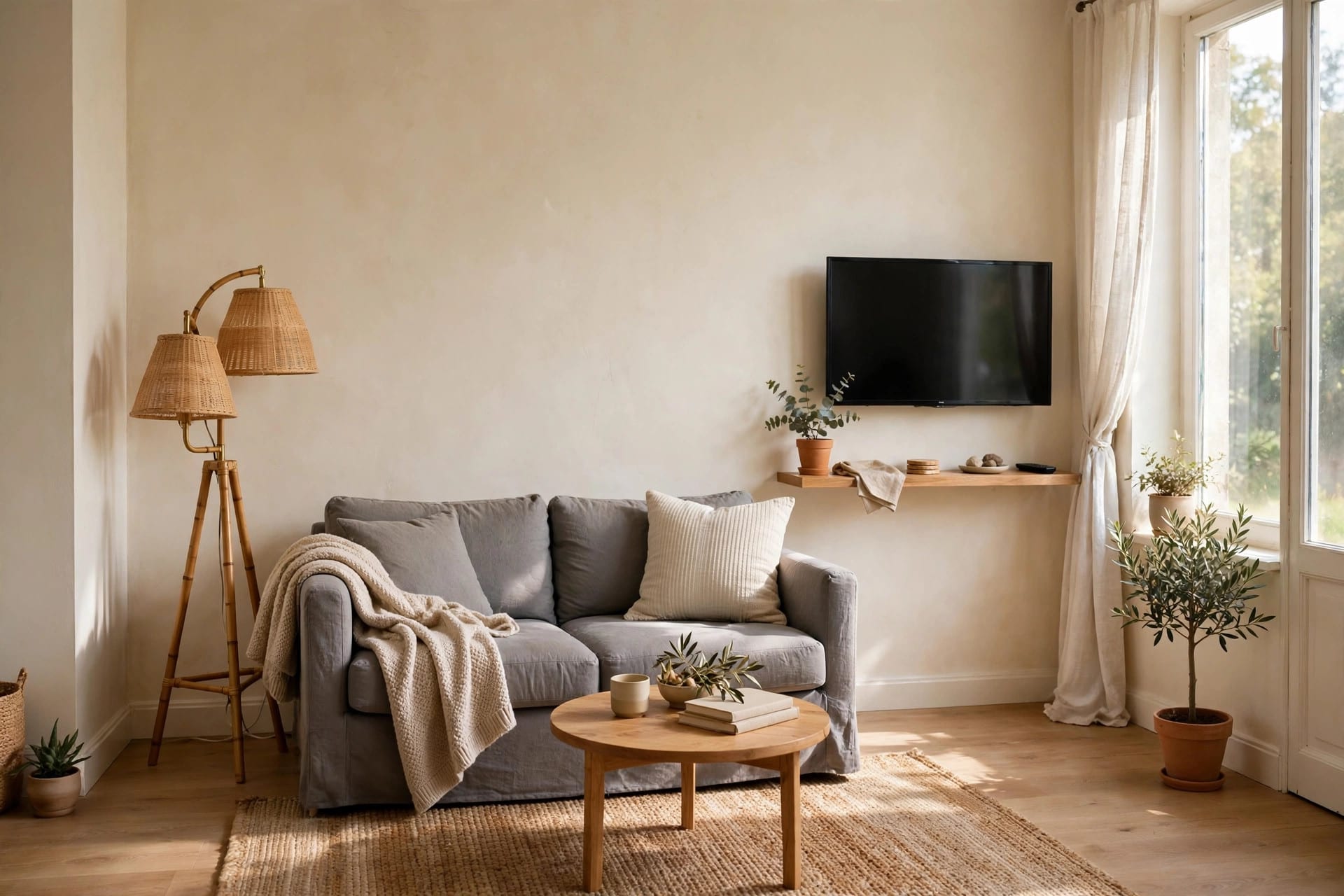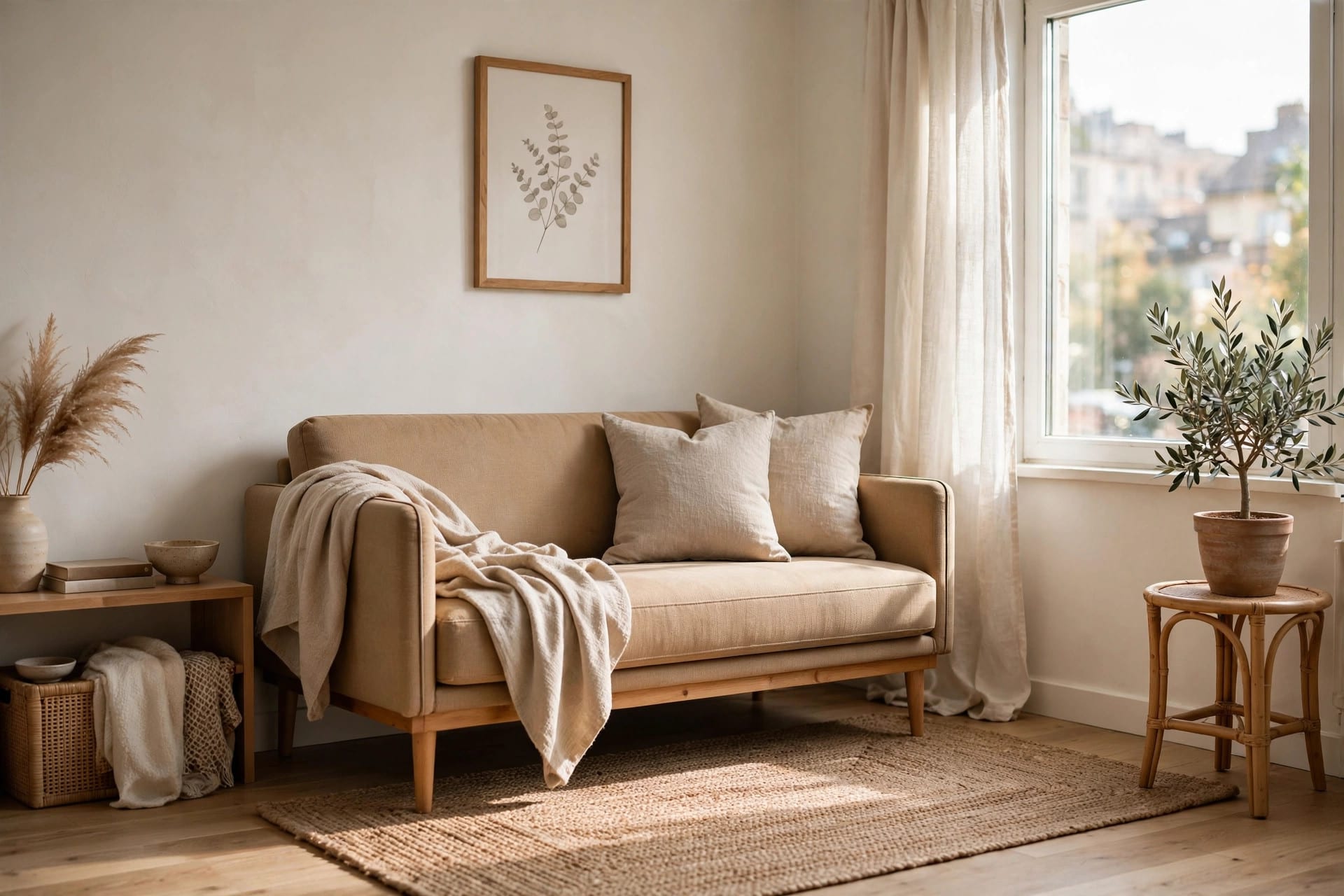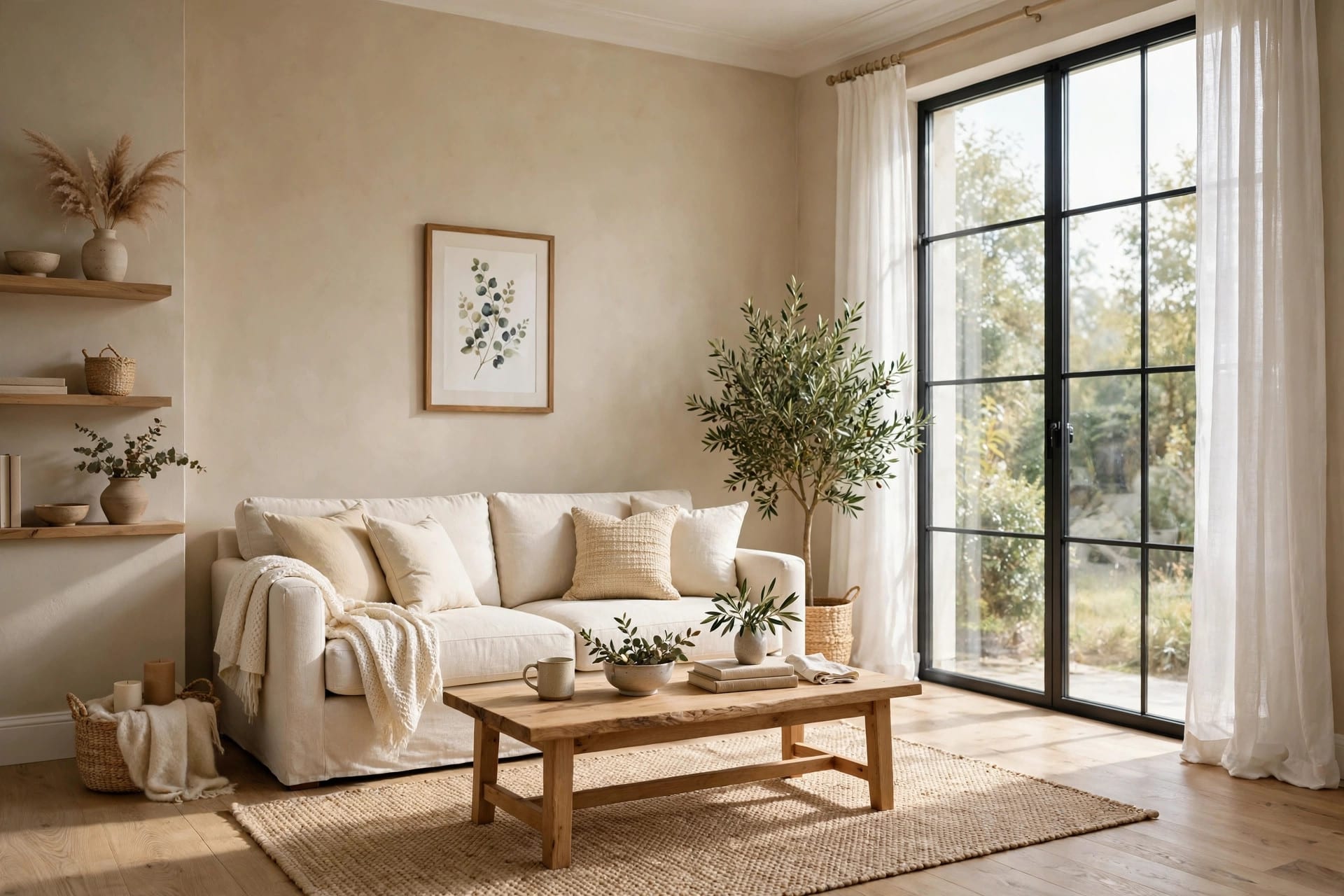
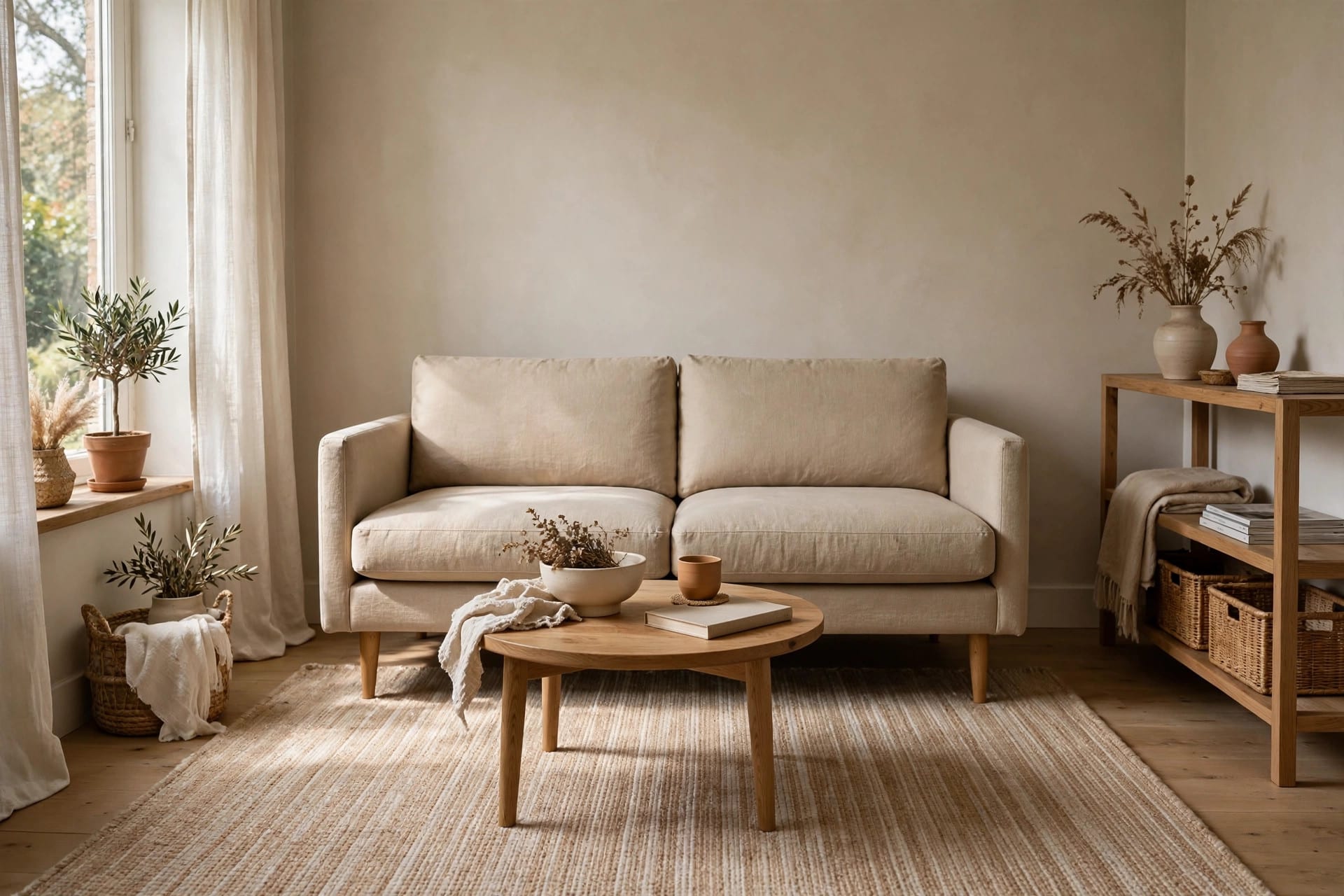
The most common rug mistake in small living rooms isn't buying the wrong color or pattern. It's buying too small. A rug that floats in the middle of the seating area like an island — touching nothing — visually shrinks the room and makes the furniture look like it's drifting. Designers call it the "bathmat effect," and it's the first thing to fix.
This guide gives you the 3 measurements that decide what size rug for a small living room actually works, exact size recipes for the standard small-room layouts, and the placement rules that make it look intentional. Pair it with our small living room ideas guide for the full room.
Key Takeaways
- The 3 measurements: sofa width + 30 cm, 30–45 cm of bare floor at the edges, 75 cm walkway clearance
- Small-room sweet spots: 150×210 cm (5×7 ft) for compact setups, 180×270 cm (6×9 ft) when front legs must sit on the rug
- The rule: front legs of the sofa and chairs ON the rug — always
- Test free: painter's tape outline on the floor before you buy
- When in doubt: size up, not down — a slightly big rug beats a slightly small one every time
In this guide:
- The 3 measurements that matter
- Size recipe 1: the compact 5x7 (150x210 cm)
- Size recipe 2: the versatile 6x9 (180x270 cm)
- When an 8x10 works in a small room
- Round rugs: the small-room secret
- Pile height and material: the practical half
- 5 rug mistakes that shrink your room
- The takeaway
- Frequently asked questions
The 3 measurements that matter
Forget "measure your room." Measure your seating zone — the rug serves the furniture, not the floor plan.
- Sofa width + 30 cm. The rug should extend 15–20 cm beyond each side of your sofa. A 200 cm sofa wants a rug at least 230 cm wide. This is the measurement that kills most "too small" rugs — people size to the coffee table instead of the sofa.
- 30–45 cm of bare floor at the edges. Between the rug's edge and the wall, leave a border of visible flooring. Less than 30 cm and the rug looks wall-to-wall (defeats the purpose); more than 45 cm in a small room and the seating area floats disconnected.
- 75 cm walkway clearance. The rug must not eat your walkways (see our TV layout guide for why 75 cm is the magic number). If the ideal rug size leaves less than 75 cm for the path past it, drop a size.
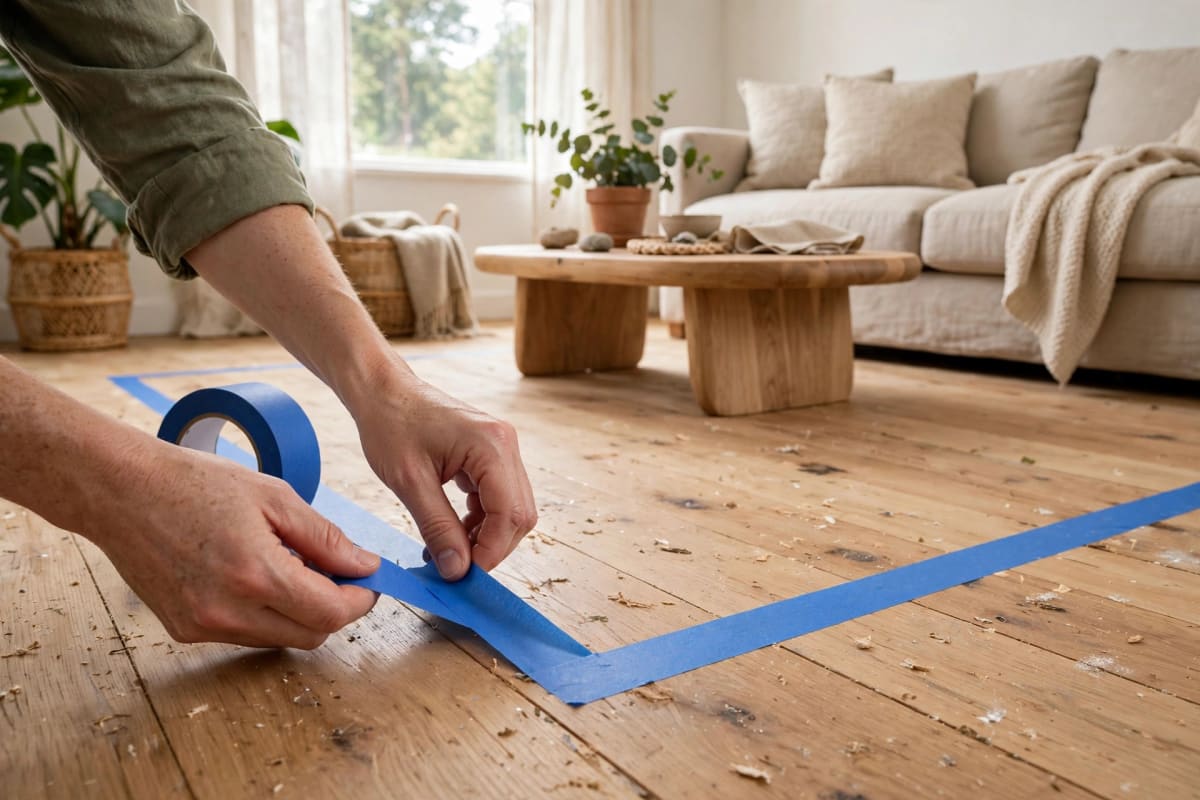
The free test: outline the candidate dimensions on your floor with painter's tape. Live with it for a day — walk around it, sit, look at it from the doorway. This 10-minute test prevents more rug regret than any guide ever will.
Size recipe 1: the compact 5x7 (150x210 cm)
Fits: loveseat or small sofa (under 180 cm) + coffee table, in rooms around 3×3.5 m.
The 5×7 is the smallest rug that can still anchor a seating area properly. Position it so the coffee table sits fully on it and the sofa's front legs touch the edge. In a truly compact setup, "front legs on" is the minimum viable placement — it connects the pieces visually without demanding floor space you don't have.
Works when: your sofa is 180 cm or narrower. Fails when: the sofa is wider than the rug — a 210 cm sofa spilling over a 150 cm-wide rug looks underdressed, like a jacket that won't button.
Size recipe 2: the versatile 6x9 (180x270 cm)
Fits: standard 200 cm sofa + one armchair + coffee table, in rooms around 3.5×4 m.
This is the small-living-room sweet spot. Wide enough to extend past a standard sofa on both sides (measurement #1: 200 + 30 = 230 cm needed; 270 gives you margin), long enough to catch the front legs of an armchair angled nearby. If you can only remember one size from this guide, remember 6×9.
Placement: center the rug on the sofa (not the room). The sofa is the anchor; the rug follows it. Then pull the armchair's front legs onto the rug's edge.
When an 8x10 works in a small room
Fits: rooms 4×4.5 m and up where the seating floats off the walls.
An 8×10 (200×290 cm) in a "small" living room sounds extravagant, but if your layout floats the sofa (our small living room guide explains when floating helps), the larger rug is what makes floating look deliberate. All front legs on, generous border, and suddenly the room reads as "designed" rather than "cramped."
The test: tape it out. If measurement #3 (75 cm walkway) still holds on all sides, the 8×10 is not too big — it's right.
Round rugs: the small-room secret
Nobody talks about round rugs for living rooms, but in a small square room with a round coffee table, a 180–200 cm round rug is magic. It softens all the room's hard corners, needs no "beyond the sofa" math on the sides, and makes the seating area feel like a deliberate circle rather than a squeezed rectangle.
Best for: square rooms, round coffee tables, and anyone whose rectangular rug always looks slightly wrong. Avoid if: your sofa is very long (over 200 cm) — the geometry stops working and the sofa dwarfs the circle.
Pile height and material: the practical half
Size gets the attention, but pile height decides whether you love the rug after month three:
- Low pile (under 1 cm): the small-room default. Doors clear it, chairs slide easily, crumbs don't vanish into it, and it visually keeps the floor flat (high pile eats visual space). Flatweave and dhurrie rugs are the classic picks.
- Medium pile (1–2 cm): fine if no doors swing over it and you don't mind vacuuming more. Adds the coziness low pile lacks.
- High pile/shag: avoid in small living rooms. It swallows the room's proportions, traps everything, and makes furniture sit unevenly.
Material quick picks: wool (durable, naturally stain-resistant, expensive), polypropylene (cheap, washable, the practical family choice), jute (great texture, rough underfoot — layer a soft rug on top if you go jute). For rentals and first apartments, a washable low-pile polypropylene rug in the right size beats an expensive wool rug in the wrong size, every time.
5 rug mistakes that shrink your room
- The floating island. Rug touches no furniture. Fix: minimum front-legs-on placement, always.
- Sizing to the coffee table. The coffee table is the smallest piece — size to the sofa (measurement #1).
- Rug under the walkway. If the rug's edge sits in the traffic path, it bunches, curls, and trips. Keep walkways rug-free or drop a size.
- The wrong border. Rug edge 10 cm from the wall looks like wall-to-wall carpet that gave up. Keep 30–45 cm of floor visible.
- Ignoring the door swing. A rug that catches the door bottom will curl within a week. Measure the door's arc before taping your outline.

The takeaway
Rug sizing is three measurements and one free test: sofa width + 30 cm, 30–45 cm floor border, 75 cm walkways — then tape it out and live with it for a day. In small rooms the recipes are simple: 5×7 for compact setups, 6×9 as the sweet spot, 8×10 when the layout floats. And when torn between two sizes, go bigger. A slightly large rug grounds the room; a slightly small one shrinks it.
Frequently asked questions
What size rug do I need for a small living room? 150×210 cm (5×7 ft) for compact loveseat setups; 180×270 cm (6×9 ft) for a standard sofa + chair — the small-room sweet spot. The rug should extend 15–20 cm beyond each side of the sofa with front legs on it.
Should a rug go under the sofa in a small living room? At least the front legs — always. Fully under is luxurious but demands an 8×10; front-legs-on achieves the visual connection in a 6×9. Nothing-on (floating island) is the #1 rug mistake in small rooms.
How far should a rug extend beyond the couch? 15–20 cm on each side minimum. This frames the sofa instead of letting it overhang the rug's edges, which is what makes a rug look "too small" even when the length is right.
Can you put a large rug in a small living room? Yes — a larger rug often makes a small room feel BIGGER by unifying the seating area. The limit is walkway clearance: keep 75 cm paths and 30–45 cm of visible floor at the edges. Tape-test before buying.
Should the rug be lighter or darker than the sofa? Neither matters as much as contrast with the FLOOR. A rug that blends into the floor color disappears (wasted money); one with clear but not jarring contrast defines the zone. In small rooms, low-contrast rugs (tone-on-tone with the floor, one shade deeper) keep the space feeling open.