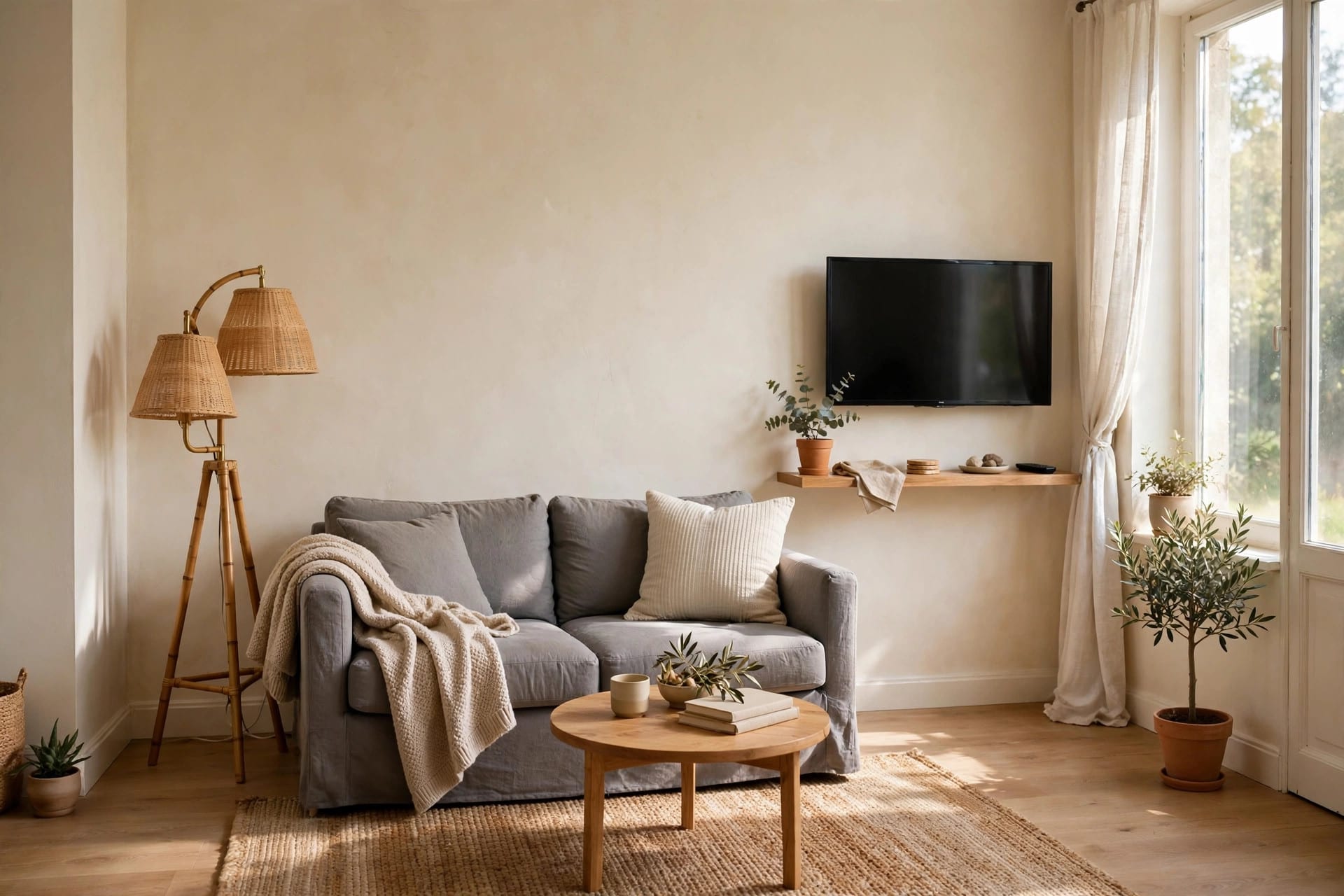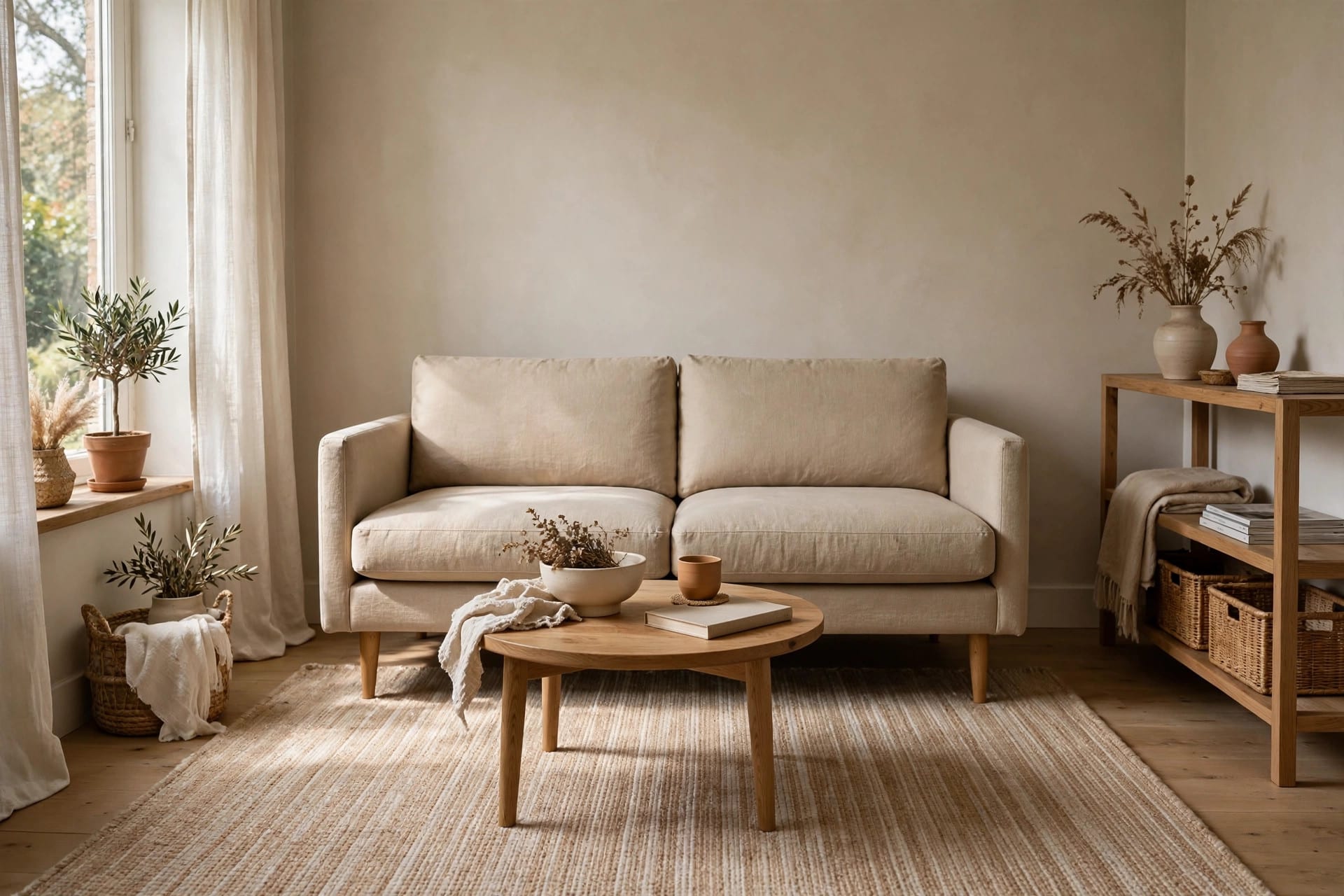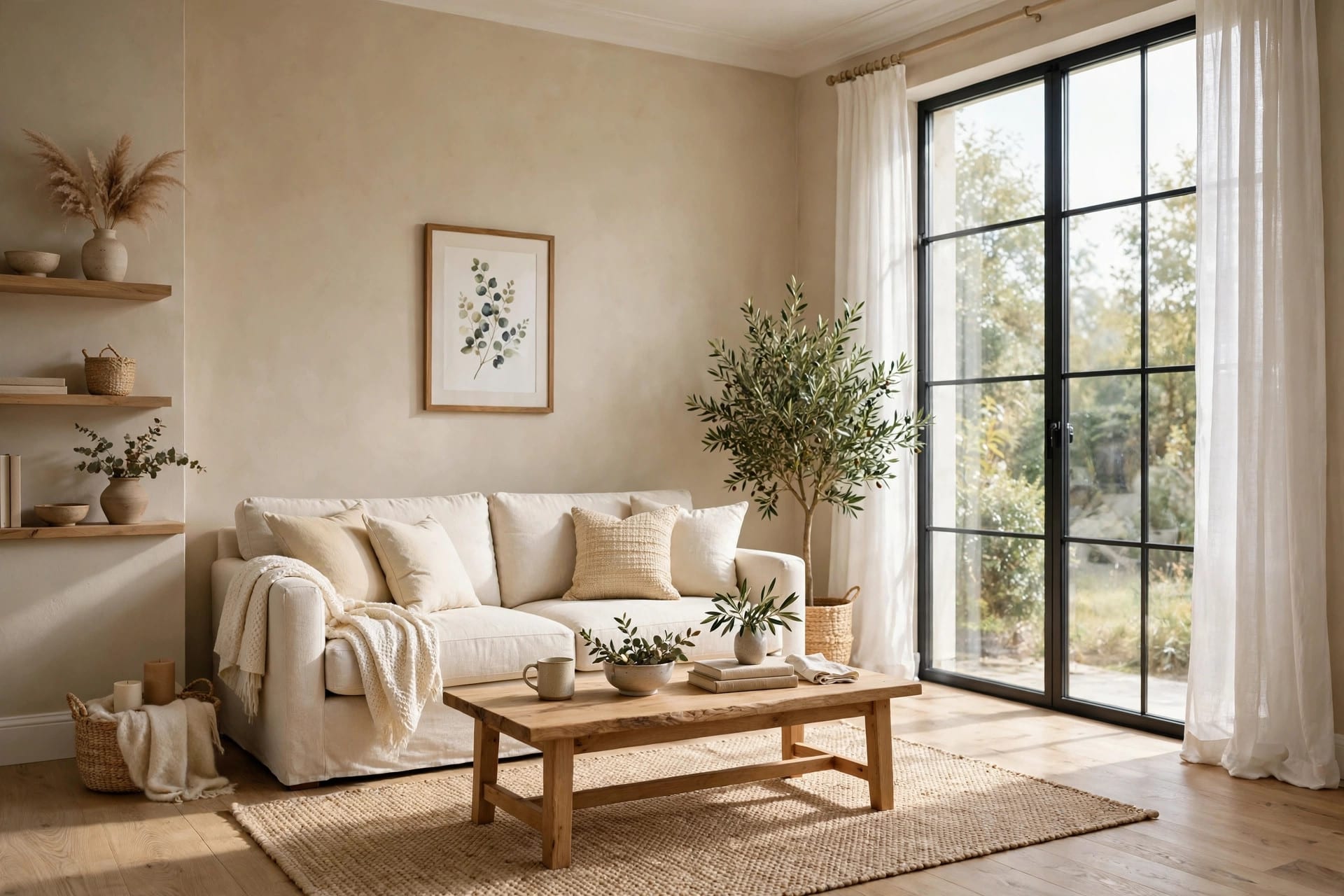
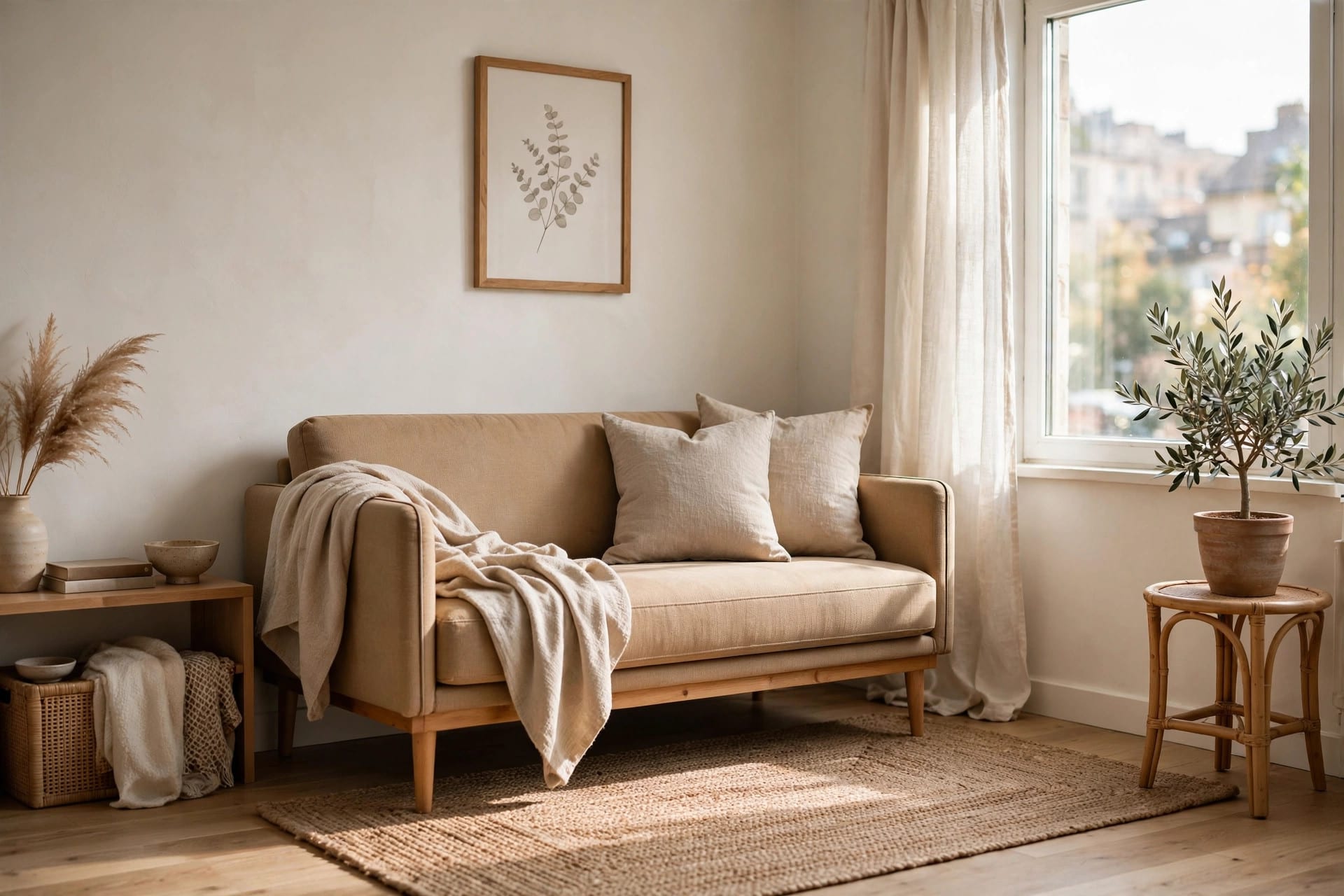
The sofa is the biggest object in a small living room and the hardest to return. Get it wrong and the room is broken for years; get it right and everything else falls into place. Yet most sofa advice is vibes ("choose something cozy!") instead of dimensions.
Here are the 5 best sofa types for a small living room, ranked, with exact dimensions for each — width, depth, and the clearance they demand. No brand recommendations (models change; dimensions don't). This is the furniture companion to our small living room ideas guide.
Key Takeaways
- The 5 types, ranked: apartment sofa, loveseat, chaise-end, sleeper, modular — each with exact dimensions below
- Target dimensions: 170–200 cm wide, 85–95 cm deep, slim arms (under 15 cm), visible legs
- The forgotten measurement: diagonal depth vs your doorway — measure BEFORE ordering
- Biggest mistake: buying a standard 220 cm three-seater "because it was on sale"
- Small-room sofa rule: legs you can see under beat skirts every time
In this guide:
- The dimensions that matter (read before shopping)
- 1. The apartment sofa (best overall)
- 2. The loveseat (best for tiny rooms)
- 3. The chaise-end sofa (best for loungers)
- 4. The sleeper sofa (best for guests)
- 5. The modular sofa (best for changers)
- The delivery measurement everyone forgets
- What to avoid (the no-buy list)
- The takeaway
- Frequently asked questions
The dimensions that matter (read before shopping)
Four numbers decide whether a sofa fits your small room:
- Width: 170–200 cm for most small living rooms. Under 170 and two adults can't sit comfortably; over 200 and walkways die.
- Depth: 85–95 cm overall. Over 95 cm the sofa eats the room; under 85 cm most adults can't sit back comfortably. Seat depth (cushion front to backrest) of 50–55 cm suits most bodies.
- Arm width: under 15 cm per arm. Chunky 25 cm rolled arms steal 20 cm of seating for pure decoration — in a small room, that's a tax you can't afford.
- Back height: under 85 cm. Low backs preserve sightlines across the room (critical in small spaces); high backs wall off the seating area visually.
And the visual rule: visible legs (10–15 cm clearance underneath) beat a skirt or block base every time. Seeing floor under the sofa tells the eye the room continues — it's the single biggest "looks smaller/looks bigger" lever in sofa choice.
1. The apartment sofa (best overall)
Dimensions: 170–190 cm wide, 85–90 cm deep, slim arms.
The apartment sofa is a standard three-seater scaled down about 15% — same proportions, smaller footprint. It's the best overall because it seats three (or two sprawled) without demanding the 220 cm wall a standard sofa needs. If your wall is 240–280 cm, this is your sofa.
Why it wins: real three-person seating in a small-room footprint, widely available, and it doesn't scream "small furniture" — it just looks like a sofa.
Watch for: "apartment" in the name doesn't guarantee small dimensions — always check the spec sheet. Some brands slap the label on a 205 cm sofa.
2. The loveseat (best for tiny rooms)
Dimensions: 140–165 cm wide, 85–90 cm deep.
For rooms under 3×3.5 m, or as the second piece alongside an armchair. A loveseat plus one good armchair often seats three more comfortably than a cramped three-seater — and the two-piece arrangement gives you layout flexibility a single sofa can't.
Why it wins: fits walls as short as 180 cm, leaves room for a side table and a walkway, and pairs beautifully with an accent chair.
Watch for: the "loveseat trap" — buying a loveseat for a room that could fit an apartment sofa, then wishing you had the extra seat every movie night. If the wall allows 190 cm, take the apartment sofa (#1).
3. The chaise-end sofa (best for loungers)
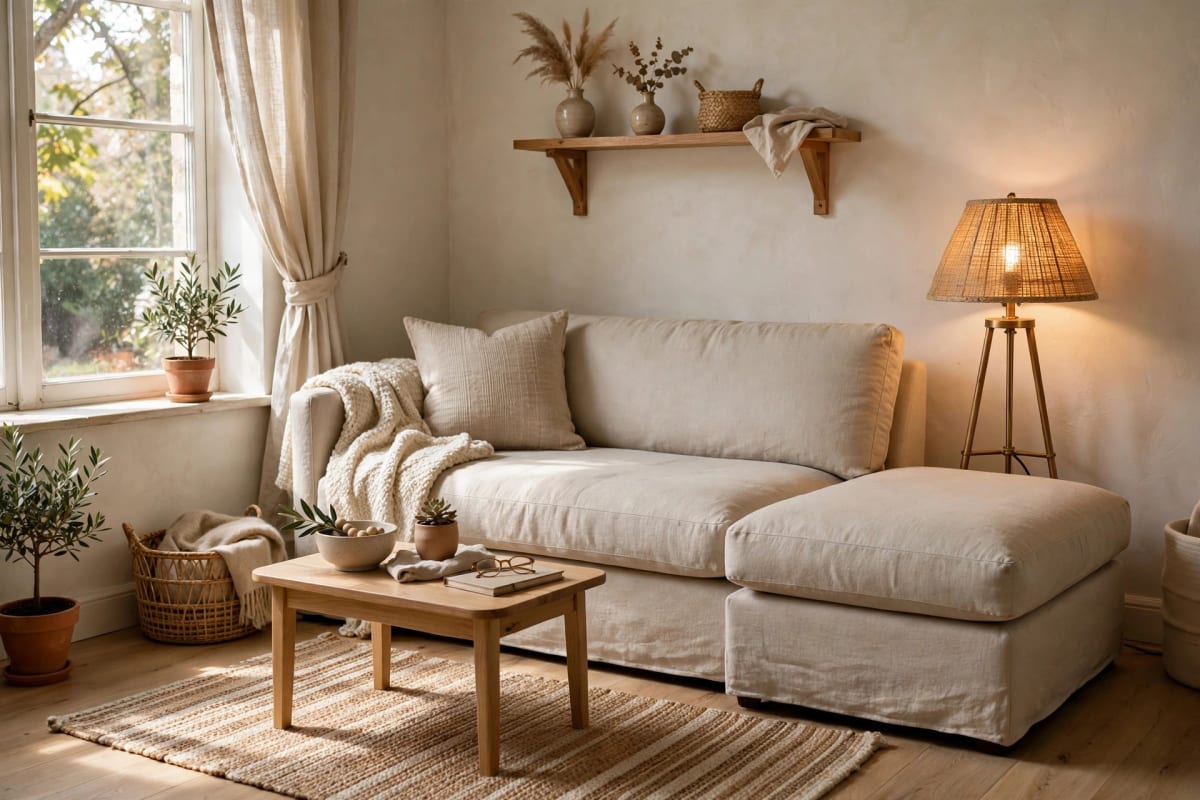
Dimensions: 170–190 cm wide, 85–90 cm deep on the sofa side, 140–160 cm deep on the chaise side.
One end extends into a chaise — a full stretch-out lounge spot without the footprint (or commitment) of a sectional. In a small room, it gives you the sectional's best feature (the lounge seat) at two-thirds the floor cost.
Why it wins: the chaise is the most-used seat in any house — it will be fought over. And unlike a sectional's corner, the chaise end doesn't block a walkway or window.
Watch for: chaise orientation (left vs right) is permanent on most models — tape out BOTH orientations in your room before ordering. A chaise blocking the balcony door is a daily annoyance. Reversible-chassis models exist and are worth the small premium.
4. The sleeper sofa (best for guests)
Dimensions: 170–200 cm wide as a sofa; needs 200–230 cm clear in FRONT to open.
The honest trade-off: sleepers are heavier, firmer, and more expensive than equivalent regular sofas — you're paying for the mechanism. But if guests sleep over more than ~6 times a year and you have no guest room, it's cheaper than a decade of hotels for your visitors (and kinder than an air mattress).
Why it wins: genuine guest bed without a guest room. Modern mechanisms (especially click-clack and trifold) are vastly better than the bar-in-your-back pullouts of the past.
Watch for: measure the OPEN footprint, not just the sofa — the bed extends 200+ cm into the room. Tape it out. And sit on it first if you can: some sleepers sacrifice daily comfort for the mechanism. Our rug size guide will help you plan the floor space around it.
5. The modular sofa (best for changers)
Dimensions: per-module, typically 70–90 cm square seats; configure 2–4 modules.
Individual seat modules you arrange and rearrange — loveseat today, chaise tomorrow, separate chairs when guests come. For renters and restless rearrangers, it's the only sofa that adapts when the room (or apartment) changes.
Why it wins: moves in pieces (solves the delivery problem below), reconfigures endlessly, and single damaged modules can be replaced.
Watch for: modules drift apart on hard floors — look for connecting clips, or budget for a large rug to anchor them (see our rug guide). And per-module pricing adds up fast; a 3-module setup often costs more than an equivalent regular sofa.
The delivery measurement everyone forgets
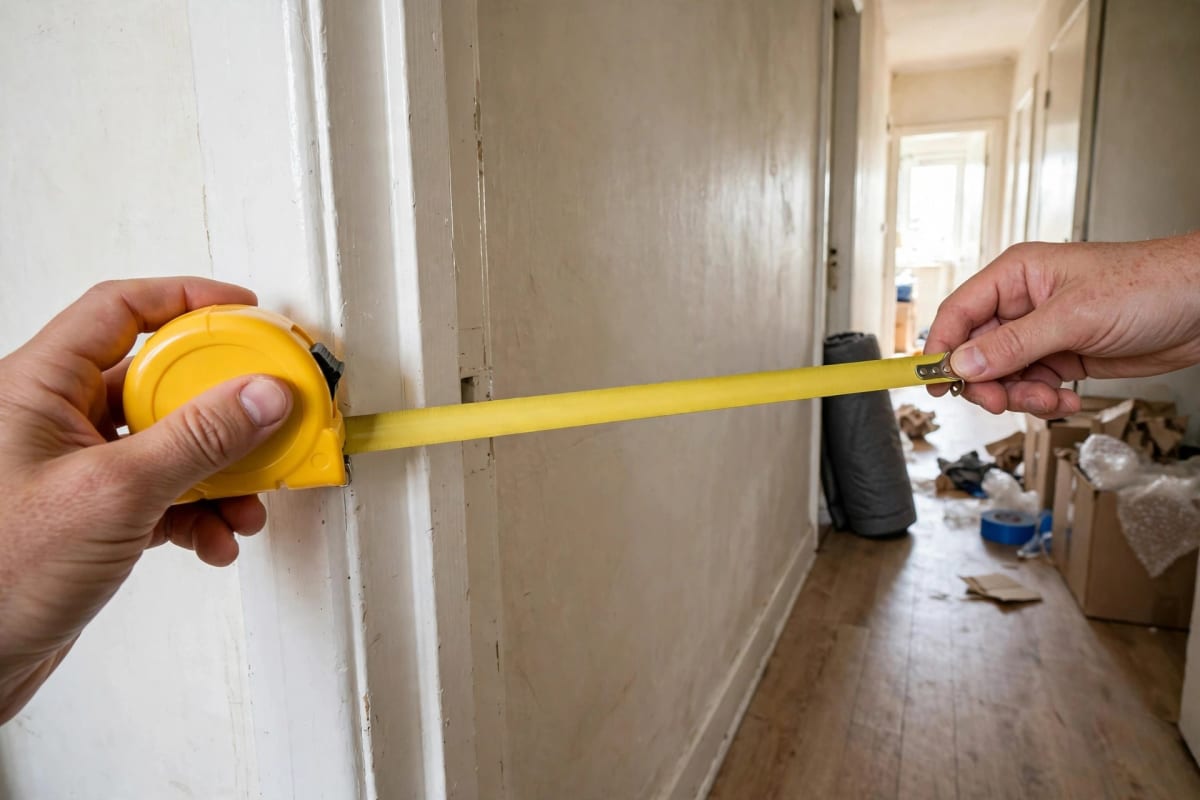
Before ordering ANY sofa, measure:
- Doorway width (and every hallway/turn between the street and the room)
- The sofa's diagonal depth — from the top-back corner to the bottom-front corner. This is the number that must clear the doorway when angled through, and it's always smaller than you'd guess.
- Elevator dimensions, if applicable — the number one sofa-delivery killer in apartment buildings.
If the diagonal depth exceeds the narrowest doorway, you need: removable legs (buys you 10–15 cm), a modular sofa (#5, arrives in pieces), or a different sofa. Discovering this on delivery day — with the truck idling outside — is an expensive, sweaty lesson. Ask any furniture delivery driver; they've seen it weekly.
What to avoid (the no-buy list)
- Standard 220 cm three-seaters. Built for 4-meter walls. In a small room they leave no walkway and no side table.
- Recliners and reclining sofas. The mechanism adds 15–20 cm of depth and needs 60 cm behind to recline. A manual armchair reclines better in less space.
- Skirted bases. They hide the floor and visually anchor the sofa like a boulder. Legs, always legs.
- Oversized rolled arms. Each 25 cm arm is 25 cm you're not sitting on. Track arms or slim slopes only.
- Deep "cloud" sofas (110 cm+). Glorious to sink into, devastating to small rooms — and hard to get out of, which matters more than you'd think.
The takeaway
Rank your needs: everyday seating → apartment sofa; tiny room → loveseat + chair; lounger → chaise-end; guests → sleeper; mover/rearranger → modular. Then apply the filters: 170–200 cm wide, under 95 cm deep, slim arms, visible legs, low back — and measure the delivery path before you fall in love. Do that and the biggest object in the room becomes its best asset instead of its biggest regret.
Frequently asked questions
What size sofa is best for a small living room? 170–200 cm wide and 85–95 cm deep, with slim arms (under 15 cm) and visible legs. This "apartment sofa" scale seats three without killing walkways. Standard 220 cm three-seaters are too big for most small rooms.
Is a sectional too big for a small living room? Usually yes — but a chaise-end sofa (#3) gives you the sectional's best seat at two-thirds the footprint. If you must have a sectional, keep it under 230 cm on the long side and skip the corner unit.
Loveseat or apartment sofa for a small room? If your wall fits 190 cm, take the apartment sofa — you'll use the third seat constantly. Choose the loveseat only when the wall is under 185 cm or you specifically want the loveseat + armchair arrangement.
How do I know if a sofa will fit through my door? Measure the sofa's diagonal depth (top-back to bottom-front corner) — it must be smaller than your narrowest doorway width. Also measure hallways, turns, and elevators. Removable legs buy 10–15 cm; modular sofas arrive in pieces.
What sofa color makes a small living room look bigger? Mid-tone neutrals (greige, warm gray, oatmeal) recede best — very dark sofas become visual boulders, very white ones show everything. Match the sofa's undertone to your wall color (see our paint guide) for a cohesive, larger-feeling room.