A painted accent wall is the cheapest dramatic change you can make to a room, and the easiest to get wrong. The colour is rarely the problem — the wall is: the wrong wall painted beautifully still looks like a mistake, while the right wall in an ordinary colour looks intentional.
This guide fixes the decision first and the colour second: how to choose the wall, how much paint it needs, and fifteen paint-only ideas — with a weekend plan for the most popular one.
Key Takeaways
- Paint the wall your eye lands on first when you enter — usually behind the bed, sofa or fireplace — never a wall broken up by doors and windows.
- Go three to five shades deeper than the other walls on the same paint strip, or pick a saturated colour with an LRV of 10 to 30 against walls at 60 to 80.
- One gallon covers roughly 350 square feet per coat, so a standard 12 by 8 foot wall needs two gallons for two coats plus touch-ups.
- Eggshell is the safest all-round finish for living spaces; flat hides flaws but marks easily, satin suits kitchens and halls.
- Seal tape edges with the base colour first for a crisp, professional line.
Table of Contents
- Choose the wall before you choose the colour
- 15 DIY accent wall paint ideas
- How much paint do you actually need
- Step by step: a two-tone accent wall in a weekend
- Sheen, light and the colour that changes
- Common mistakes and fixes
- Renter-friendly paint accent walls
- FAQ
Choose the wall before you choose the colour
Stand in the doorway and notice where your eye goes. That is your accent wall. In a bedroom it is almost always the headboard wall; in a living room, the wall behind the sofa or fireplace; in a dining room, the wall the table faces. An accent wall anchors the room's focal point, so painting a side wall the eye slides past wastes the effect.
Reject any wall that is more opening than wall: two doors, a large window and a radiator leave no continuous field of colour. Reject the television wall too, unless the television is small — a dark wall behind a glowing screen tires the eyes in the evening.
Check the light before you commit. A north-facing wall gets cool light that deepens colours; a south-facing wall gets warm light that washes colour out by midday. Paint a test patch at least 60 by 60 centimetres and look at it in morning, afternoon and lamplight first.
15 DIY accent wall paint ideas
1. One deep, saturated colour
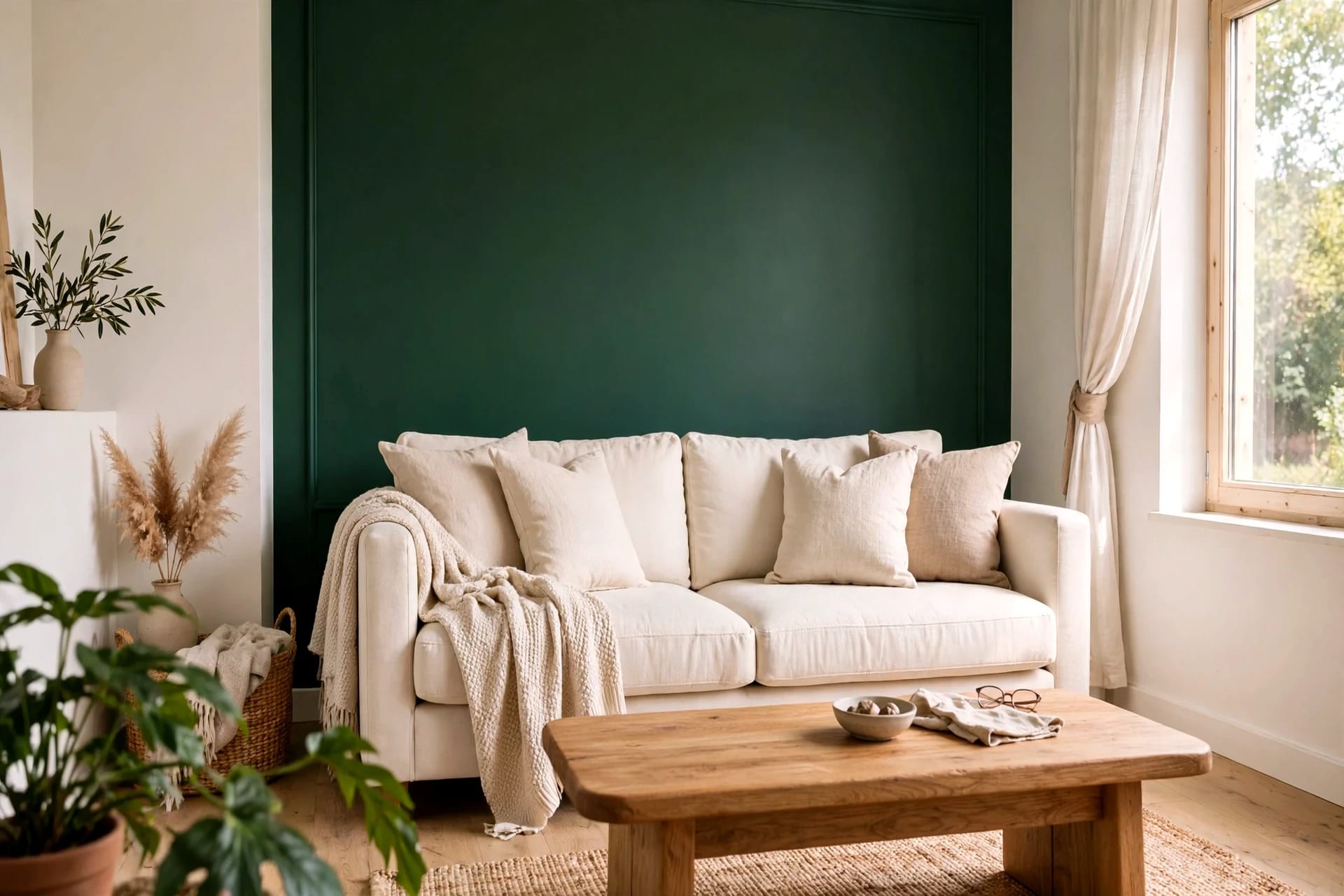
The classic, done properly: one wall in deep green, navy, charcoal or terracotta, with the other walls in warm white. Keep ceiling and skirting white so the colour reads as a deliberate panel.
2. Two-tone split with a crisp line
Paint the lower third in a deep colour and the upper two-thirds in the base colour, with the split at a real architectural height — about 90 centimetres — never at a random midpoint.
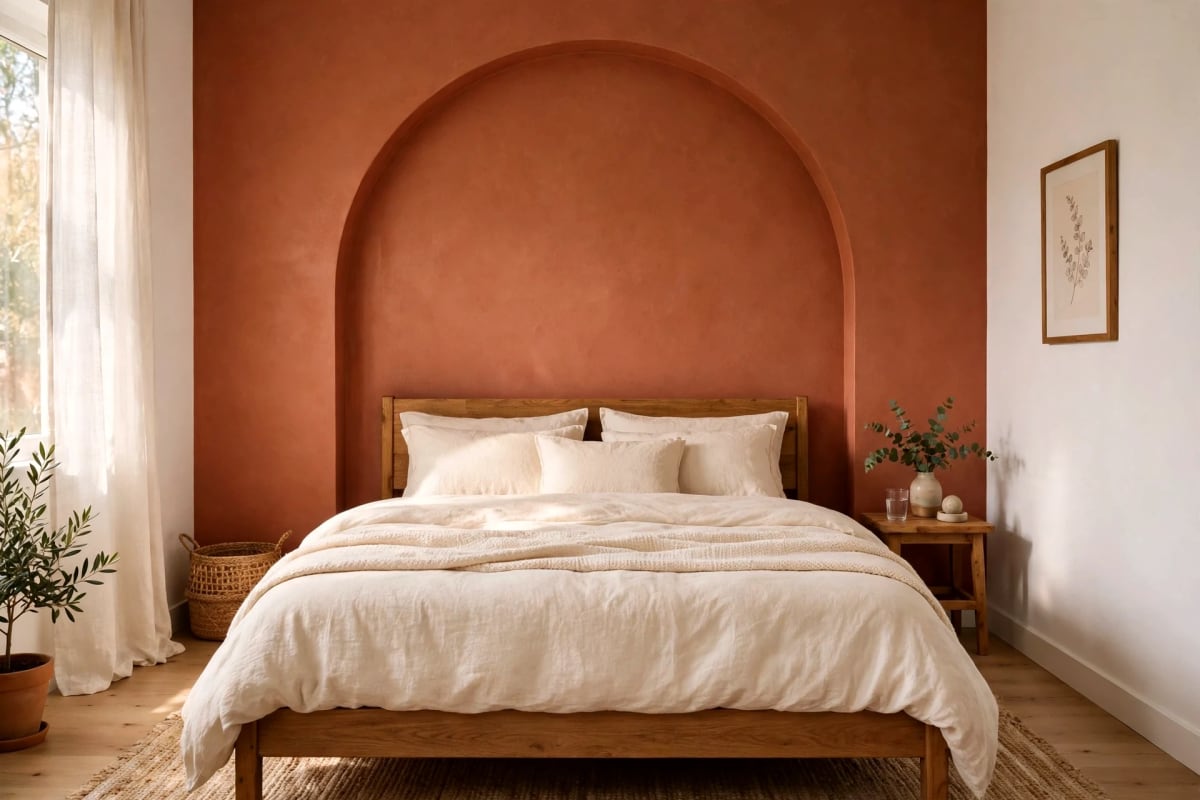
3. A painted arch behind the bed
A large arch in warm clay or sage frames the bed like a headboard and costs one small tin of paint. Mark it with a pin, string and pencil, 20 to 30 centimetres wider than the bed on each side. See the painted arch accent wall guide.
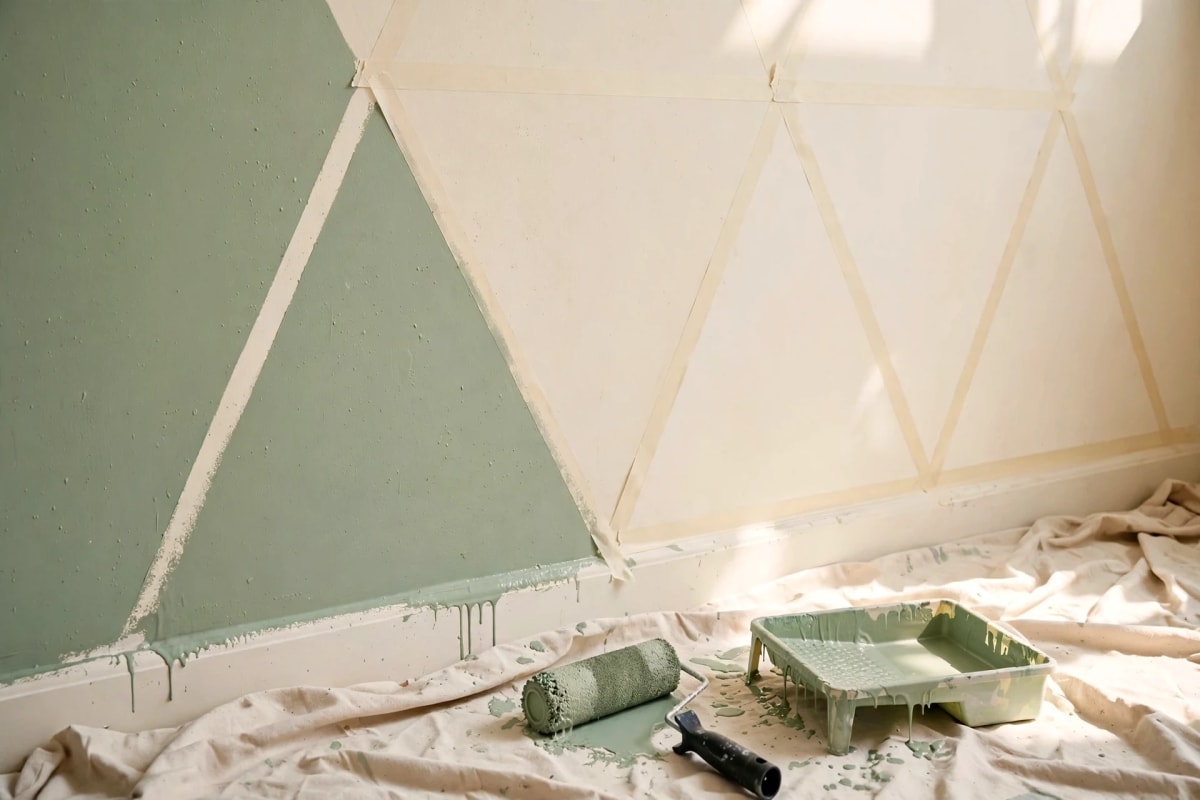
4. Tape geometric shapes
Painter's tape turns a flat wall into triangles, diamonds, a grid or a sunburst. Plan on paper first, seal tape edges with the base colour, then paint. Two colours from the same family look sophisticated; three contrasting colours suit a child's room.
5. Colour blocking with a bold rectangle
Paint one large rectangle of colour behind a console, desk or bed, like a framed panel without the frame — roughly the furniture's width plus 15 to 20 centimetres on each side.
6. A half-wall band of colour
A horizontal band at chair-rail height on the focal wall adds interest at eye level without darkening the room — good for hallways and dining rooms.
7. Ombré fade from dark to light
Blend one colour from deep at the bottom to pale at the top by mixing the paint in stages up the wall. Work in horizontal bands while each band is still wet, or the joins will show.
8. Vertical stripes in two tones
Two shades of the same colour in vertical stripes add height to a low room — but use a level and tape for every stripe, since freehand stripes wobble visibly.
9. A dark wall with a painted stripe
Paint the wall dark, then add one horizontal or vertical stripe of a lighter colour or a stencilled border. The stripe breaks up the dark field and gives the eye a path, which is why this works on very large walls.
10. Limewash-style cloudy texture
Limewash paint applied with a large brush in loose, crossing strokes gives a cloudy, mineral texture flat paint cannot. It dries 30 to 40 percent lighter than it looks wet, so choose one shade deeper. See the limewash walls guide.
11. A chalkboard accent section
Paint one section — a kitchen wall, a child's room, a home-office nook — in chalkboard paint, framed with a painted border in a contrasting colour. The border is what makes it look like design.
12. Sponge or rag texture over a base colour
A rag-rolled or sponged glaze over a base coat adds depth without pattern. Keep the glaze close to the base colour for a subtle plaster effect. This is the most forgiving technique for imperfect walls.
13. A painted ceiling accent
Paint the ceiling of a small room — a powder room, a reading nook, a hallway — in the accent colour and keep the walls pale. A coloured ceiling in a small space feels like a canopy rather than a lid.
14. Colour-drench the wall and trim
Paint the wall, skirting and door frame on that wall in the same colour, so the wall reads as one continuous block. It looks expensive because it removes the white outlines that chop a wall into pieces.
15. A painted panel grid
Use thin painted strips or tape lines to divide the wall into large rectangles, then paint alternate rectangles in two tones — a panelled look without woodwork. For the wood version, compare the board and batten wall build.
How much paint do you actually need
Coverage is roughly 350 square feet per gallon per coat. Measure width times height, and round up — running out mid-wall is worse than a spare tin.
| Wall size | Area per coat | Paint for two coats | | --- | --- | --- | | 10 by 8 ft (3.0 by 2.4 m) | 80 sq ft | 1 gallon total | | 12 by 8 ft (3.7 by 2.4 m) | 96 sq ft | 1 gallon, plus a quart for touch-ups | | 14 by 9 ft (4.3 by 2.7 m) | 126 sq ft | 2 gallons | | 18 by 9 ft (5.5 by 2.7 m) | 162 sq ft | 2 gallons |
Two coats are not optional for a colour change: one coat over white always shows through patchily. Buy both tins at the same time, from the same batch if possible — a different batch of the "same" colour can differ visibly. Keep a labelled jar of leftover paint for touch-ups.
Primer matters when going dark over light, or light over dark. A primer tinted towards your final colour cuts the job to two finish coats instead of three or four — the single biggest time saving in the project. Skip primer only when repainting a similar colour on a wall in good condition.
Step by step: a two-tone accent wall in a weekend
Start Saturday morning with a clean, filled and sanded wall: wash with sugar soap, fill holes and cracks, sand smooth when dry, wipe dust off, then tape the ceiling edge, skirting and adjoining walls and lay a drop cloth.
Mark the split line with a pencil and spirit level — 90 centimetres is the safest default. Run painter's tape along the line, then seal the tape edge with one thin coat of the base wall colour and let it dry. This seals any gap under the tape, so the accent colour cannot bleed through — the step most guides skip.
Paint the upper section first if it is lighter, then the lower section, rolling in a W pattern and cutting in at the edges. Two coats, with the drying time on the tin between them — usually two to four hours. Remove the tape while the final coat is still slightly tacky, pulling at 45 degrees away from the line.
Sunday is for the second look: touch up thin spots, refit switch plates and hang the art — only after the paint has cured for at least 24 hours, or frames will stick. Total cost for a 12 by 8 foot wall: roughly £45 to £80 if you already own brushes.
Sheen, light and the colour that changes
Flat paint absorbs light and makes a colour look deeper, but it marks when touched and cannot be scrubbed. Eggshell has a faint glow, hides small flaws, and survives a damp cloth — the right default for bedrooms and living rooms. Satin brightens a dark colour but shows every bump in the plaster, so reserve it for kitchens, halls and children's rooms.
Light changes colour through the day, which is why the test patch matters. A green that looks calm in morning light can look muddy under warm evening lamps; a navy that looks rich by day can look black at night. Judge the colour under the room's actual lamps if it is used mostly in the evening.
A dark accent wall needs something light against it, or it becomes a void: a cream sofa, pale bedding or a mirror gives the eye a place to rest.
Common mistakes and fixes
Painting the first wall you see is the most common mistake: the entry wall is usually broken up by doors and rarely the focal wall. The fix is free — stand in the doorway first, and only then open the tin.
Skipping the test patch is the most expensive mistake, because repainting a whole wall costs another weekend. A 60-centimetre test patch and one day of looking at it in different lights prevents it.
Painting over a dirty or glossy wall without preparation shows up months later, when the paint peels in sheets. Wash, sand glossy surfaces lightly so the new paint can grip, and prime over stains.
Hanging art too high is the finishing mistake: the centre of the arrangement should sit at 145 to 155 centimetres from the floor, not near the ceiling.
Renter-friendly paint accent walls
If your lease forbids painting, three routes still give you a painted look. Peel-and-stick wallpaper in a solid colour reads as paint from across the room and removes cleanly; see the peel and stick wallpaper accent wall guide. A large painted canvas or painted panels leaned against the wall give you a colour block with zero wall contact. And a painted plywood panel on removable hooks works as a movable accent wall that goes with you when you move. For the wider renter toolkit, see renter-friendly wall decor and damage-free wall decor.
If painting is allowed with repainting on exit, keep one unopened tin of the original wall colour and repaint before you leave.
FAQ
What is the best colour for an accent wall?
The colour three to five shades deeper than your other walls, or a saturated shade sharing their undertone. Warm rooms take terracotta, olive or warm charcoal; cool rooms take navy, slate or deep green.
How do I choose which wall to paint?
Stand in the doorway and paint the wall your eye lands on first — behind the bed, sofa or fireplace. Avoid walls broken up by doors and windows, and the television wall.
How many coats does an accent wall need?
Two finish coats over primer, or two coats over a similar existing colour. One coat always looks patchy on a colour change.
Do I need primer for an accent wall?
Yes, when changing colour significantly or painting over stains or glossy paint. A primer tinted towards the final colour saves a whole coat.
Can I paint an accent wall in a small room?
Yes, if you choose the right wall and keep the other walls pale. A dark wall behind the bed or sofa adds depth; a dark wall on the window wall shrinks it. A painted arch or lower band is safest.
How do I get a crisp line between two paint colours?
Tape the line, seal the tape edge with one thin coat of the base colour and let it dry before painting the accent colour. Remove the tape while the final coat is still slightly tacky, pulling at 45 degrees.
Will a dark accent wall make my room look smaller?
Only if it is the wrong wall or the room has poor light. A dark focal wall with pale furniture against it adds depth; a dark wall facing the window closes the room in.