A large blank wall is intimidating for one reason: scale. Small art gets lost on it, random clusters look cluttered, and once the holes are drilled, the mistake is hard to undo. The fix is not more decor. It is the right size of decor, chosen by formula rather than guesswork.
This guide gives you the size rules first — the formulas designers use for width, height and coverage — then fifteen ideas for walls over three metres wide or taller than 2.7 metres, plus the hanging hardware that keeps oversized pieces safely on the wall.
Key Takeaways
- A large wall is any wall over 3 metres wide or taller than 2.7 metres; standard art sizes fail on it because they cover too little of the field.
- Art above furniture should span 60 to 75 percent of the furniture's width, and a full-wall arrangement should cover 60 to 75 percent of the wall's width.
- Hang the centre of the arrangement at 145 to 155 centimetres from the floor, or 15 to 20 centimetres above the furniture below it.
- Pieces over 10 kilograms need a stud, a masonry fixing or a French cleat — never a single picture hook or adhesive strip.
- One oversized piece usually beats a scattered cluster on a very large wall: it gives the eye one place to land.
Table of Contents
- The scale rules for large walls
- 15 large wall decor ideas
- Size tables: what fits which wall
- Hanging big pieces safely
- Budget DIY oversized art
- Common mistakes and fixes
- FAQ
The scale rules for large walls
Measure the wall before you shop for anything. A wall's decorating field is its width minus the furniture zone: for a sofa wall, that is the sofa's width plus the breathing room on each side. The two-thirds rule follows from it: art above furniture should span roughly two-thirds of the furniture's width. A 210-centimetre sofa takes a 140-centimetre arrangement; a 120-centimetre sideboard takes an 80-centimetre piece. Below two-thirds, the art looks like an afterthought; above three-quarters, it crowds the furniture.
For a wall with no furniture, use the wall itself: the arrangement should cover 60 to 75 percent of the wall's width. A 4-metre wall needs 2.4 to 3 metres of art, mirror or panelling — which is why one small frame on a big wall looks wrong no matter how beautiful it is. The centre of the arrangement sits at 145 to 155 centimetres from the floor, the average standing eye level. On a double-height wall, centre it on the lower two-thirds, not the middle of the whole height, or it floats above the furniture. For the wider principles, the DIY wall decor guide sets out the sizing rules every room guide on this site builds on.
One more rule: leave the wall's edges alone. An arrangement should stop at least 15 centimetres short of corners, ceilings and door frames. Art that runs into a corner looks like it ran out of wall, while a bordered arrangement looks placed.
15 large wall decor ideas
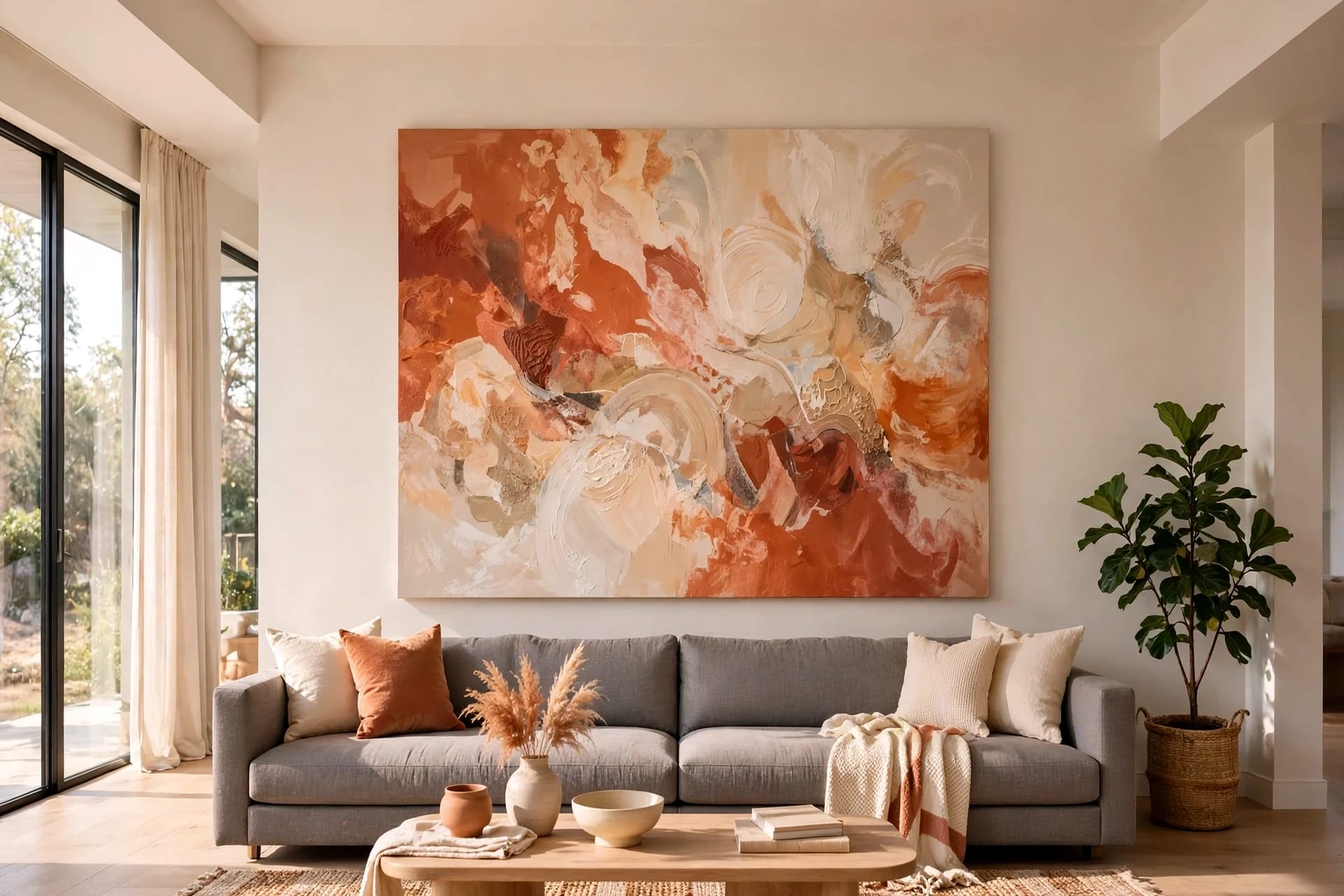
1. One oversized canvas
A single canvas 120 to 180 centimetres wide above a sofa or bed. Abstract colour fields, large-scale photography and painterly neutrals all work at this size. Buy the largest size your budget allows — slightly too big looks bold, slightly too small looks lost.
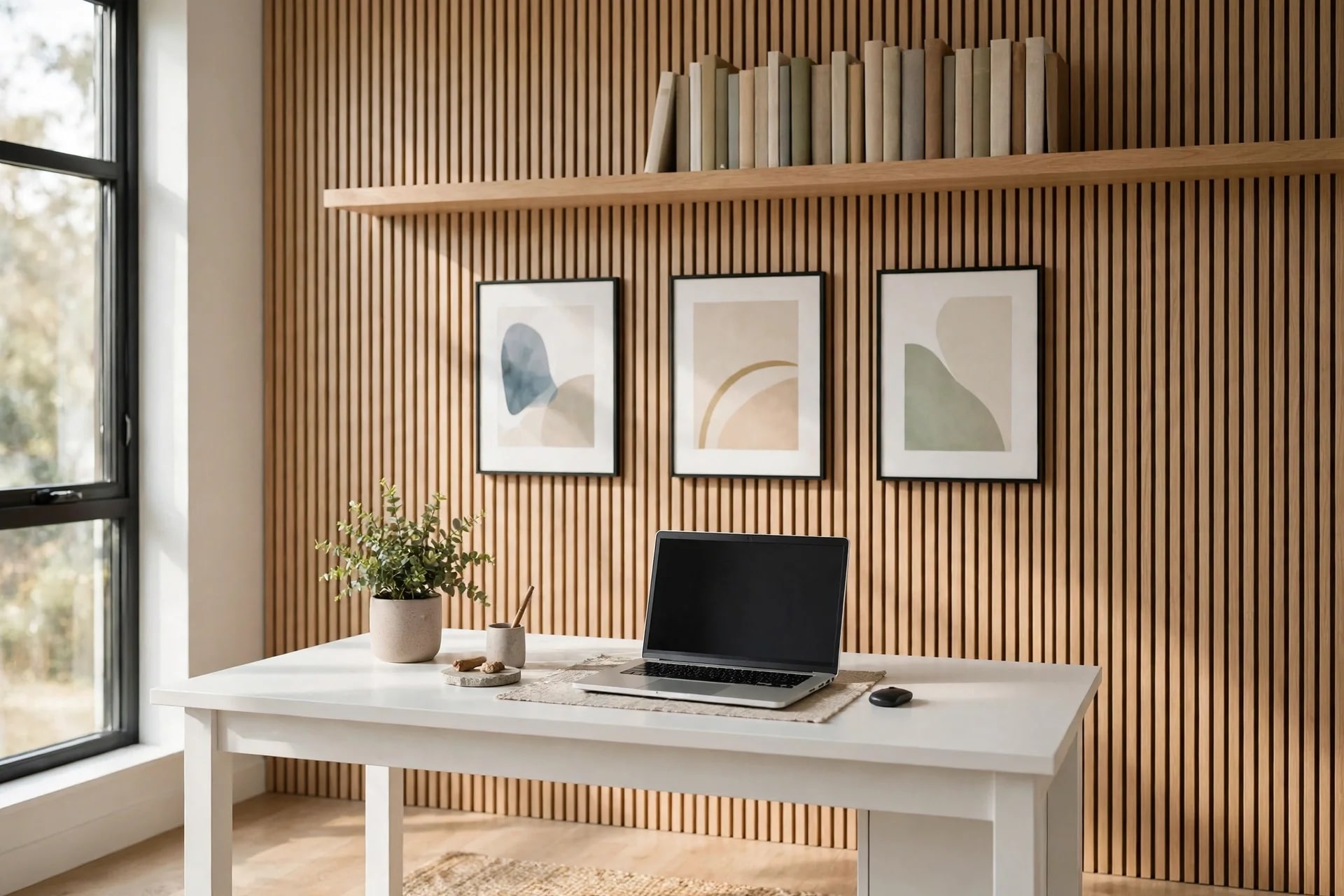
2. A triptych or multi-panel set
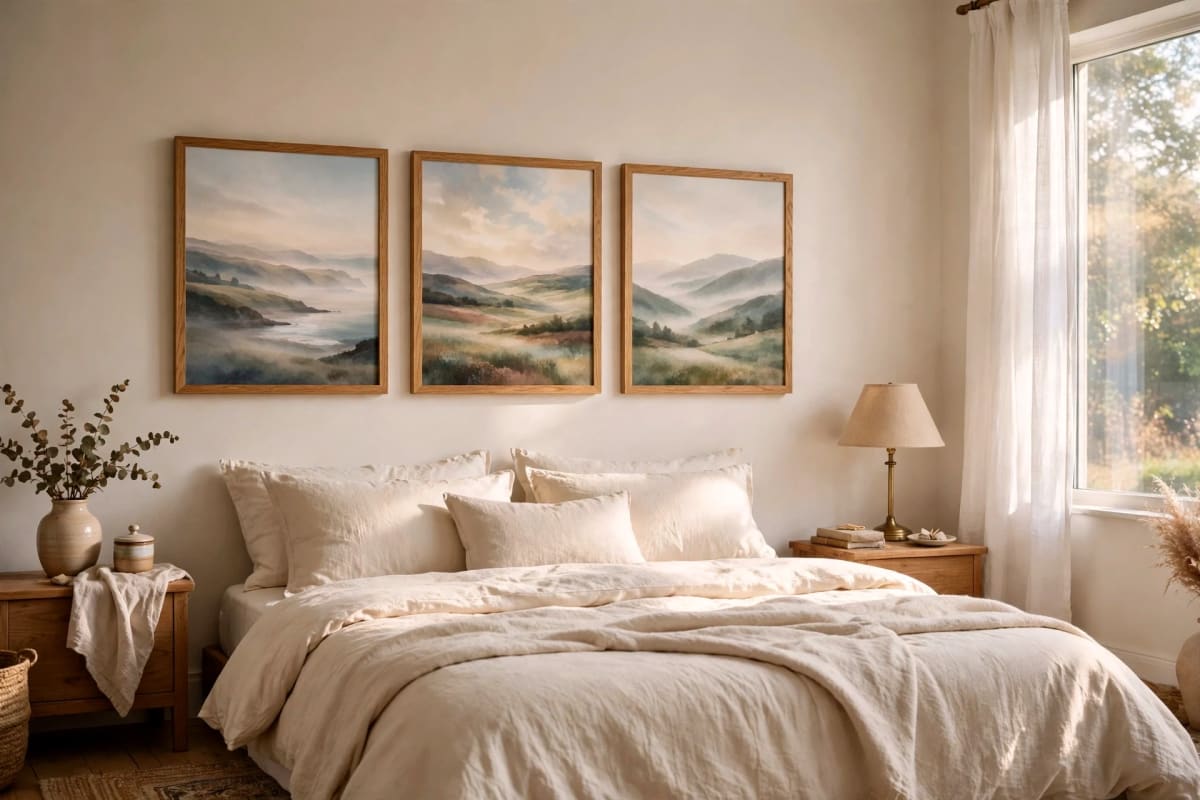
Three panels hung as one composition, with 5 to 8 centimetres between panels. Triptychs spread visual weight evenly across a wide wall and suit sofas and beds. The outer edges of the set, not each panel, should follow the two-thirds rule.
3. A full gallery wall
Nine to fifteen frames in a controlled grid or salon arrangement, covering the 60 to 75 percent width target. Galleries work on large walls only when planned: use paper templates on the wall first, and keep frame finishes to two at most. See gallery wall layouts for templates.
4. An oversized mirror
A mirror 100 to 150 centimetres wide doubles the light and the perceived space. Lean it against the wall for a relaxed look, or hang it 15 centimetres above a console. For sizing by room, see mirror wall decor ideas.
5. A painted mural
A hand-painted or stencilled mural turns the whole wall into the art. Soft botanicals, horizon abstracts and oversized tonal patterns hold up best over time; detailed scenes date faster. For the technique, see DIY wall mural ideas.
6. Floor-to-ceiling picture ledges
Two or three long ledges, stacked vertically, holding layered frames, prints and small objects. Ledges solve the large-wall problem flexibly: you can swap pieces without new holes, and layering adds the depth a flat arrangement lacks.
7. A textile wall hanging
A large woven tapestry, macramé piece or framed textile softens a big wall in a way framed prints cannot. Textiles suit bedrooms and living rooms, where they also absorb sound — a real benefit on a large, hard wall.
8. A rug hung as art
A flatweave rug or kilim, hung from a rod or clips, covers a large area for less than a comparable canvas. Choose a rug with a bold but simple pattern; intricate patterns turn to visual noise at wall scale.
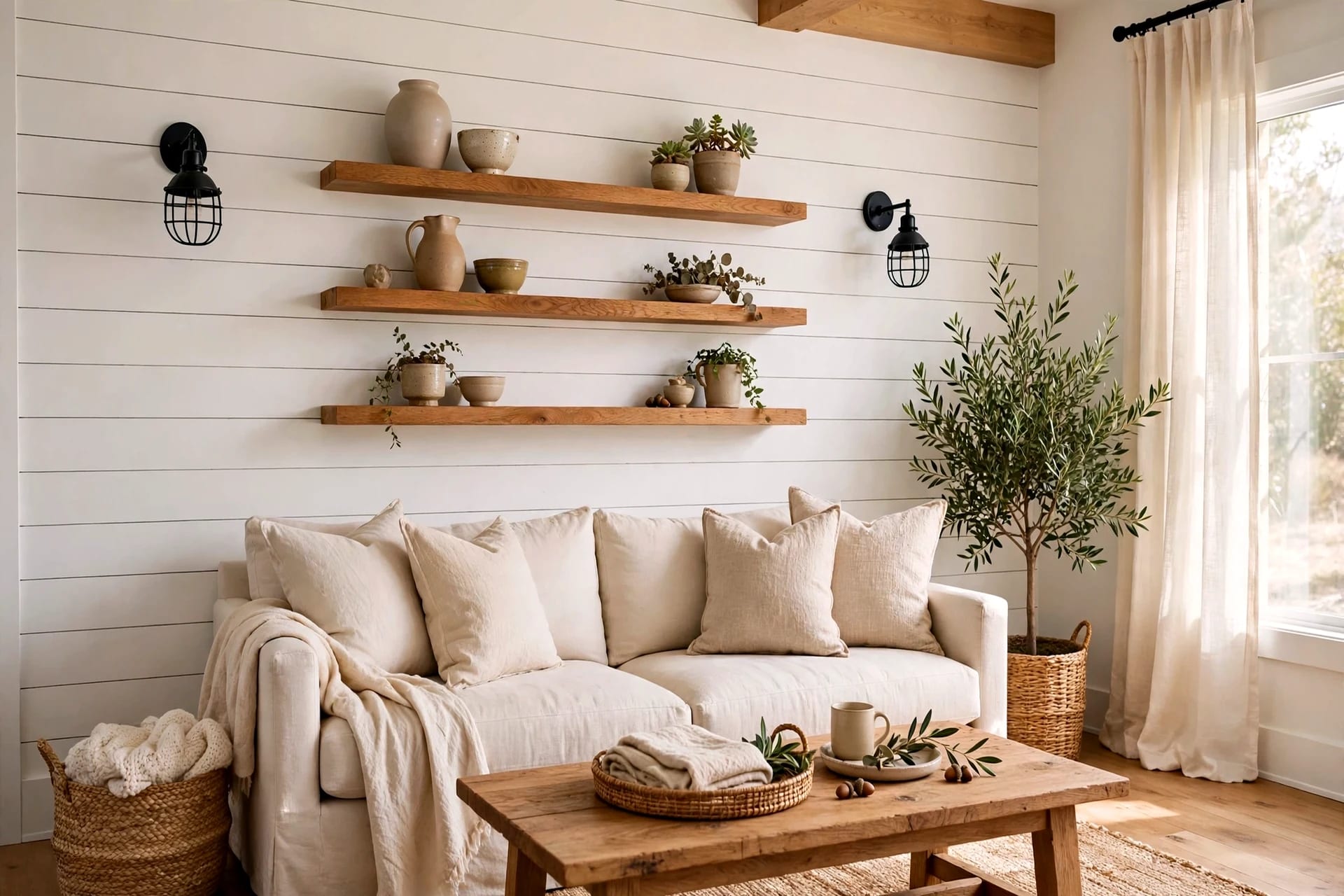
9. Floating shelves as a display wall
Three or four long floating shelves, styled with art, books, plants and ceramics. Shelves turn a wall into useful display and storage, which suits family rooms where a pure art wall would feel precious. Check limits in floating shelf weight capacity.
10. Panel moulding across the wall
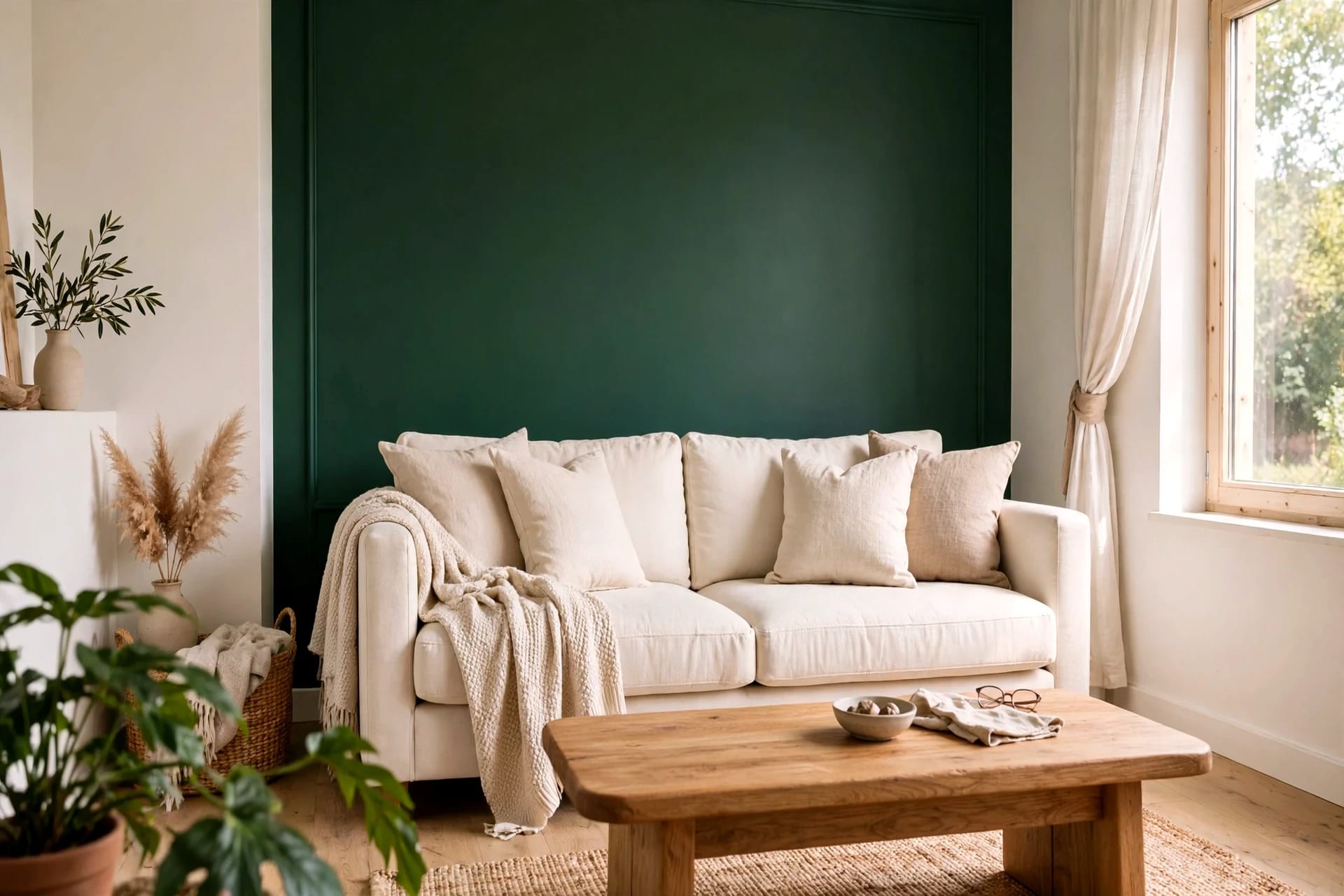
Painted picture-frame moulding applied in large rectangles gives a plain wall architectural structure before a single picture is hung. It is the cheapest way to make a big wall look finished, and it suits hallways and dining rooms particularly well.
11. A large wall clock
A clock 60 to 90 centimetres in diameter fills a kitchen or dining wall with one functional object. It works best on walls where art would compete with the room's activity — above a sideboard, beside a doorway, over a bench.
12. A statement bookcase or display unit
A tall, open bookcase against the wall fills it with books, objects and plants instead of art. Open shelving reads lighter than a closed cabinet and lets the wall's colour show through the gaps.
13. A grid of identical frames
Nine or twelve identical frames in a strict grid, holding botanical prints, maps or family photos. Repetition at scale looks deliberate, while mixed sizes at scale look accidental.
14. A living plant wall
Wall-mounted planters or a felt pocket system with trailing plants turn a large wall into a green feature. It suits bright rooms with a window nearby; in a dark room, the plants struggle and the wall looks neglected within months.
15. A DIY oversized abstract canvas
A 150 by 100 centimetre canvas painted yourself with a roller, a sponge and two or three colours. Abstract work at this size is forgiving — there is no subject to get wrong — and the cost is under £50 against hundreds for a bought piece.
Size tables: what fits which wall
| Furniture below | Arrangement width | Piece height guide | | --- | --- | --- | | 180 cm sofa | 120 to 135 cm | 60 to 90 cm, centre at 150 cm | | 210 cm sofa | 140 to 160 cm | 70 to 100 cm, centre at 150 cm | | 150 cm bed (queen) | 100 to 115 cm | 60 to 90 cm, centre at 150 cm | | 120 cm sideboard | 80 to 90 cm | 60 to 80 cm, 15 cm above the top | | 90 cm console | 60 to 70 cm | 50 to 70 cm, 15 cm above the top |
For a bare wall, multiply the wall width by 0.6 and 0.75 to get your target range. A 3.6-metre wall needs 2.2 to 2.7 metres of arrangement; a 4.5-metre wall needs 2.7 to 3.4 metres. If your pieces fall short, add a second element — a sconce pair, a shelf below, a plant beside — rather than stretching the spacing, which looks thin.
Height follows the same logic. On a standard 2.4-metre ceiling, centre at 150 centimetres. On a wall taller than 3 metres, centre the arrangement on the lower two-thirds: measure from the floor to the furniture top, and place the centre roughly halfway between that and the ceiling's lower third. Art centred on the full height of a double-height wall ends up above everyone's eyeline.

Hanging big pieces safely
Weight decides the hardware. Under 5 kilograms, two picture hooks are enough. From 5 to 10 kilograms, use two fixings spread at least 30 centimetres apart, so the load is shared. Over 10 kilograms, you need a stud, a masonry plug, or a French cleat — a two-piece bracket that spreads the load. Never hang an oversized piece from one hook, and never trust adhesive strips above 5 kilograms: they fail without warning.
Find the studs first with a stud finder or by tapping: a solid thunk means a stud, a hollow sound means plasterboard. Mark both edges and fix into the centre. On brick or block, use a masonry drill and the specified plug size — a plug one size too small is the most common cause of a fallen mirror.
Hang with two people for anything over a metre wide. One person holds the piece against the wall while the other checks the level and marks the fixing points. A large piece hung slightly crooked is more obvious than a small one, because the eye compares it against the ceiling line and the furniture below.
Budget DIY oversized art
The cheapest large art is a canvas you paint yourself. Buy a 150 by 100 centimetre primed canvas, two or three tubes of acrylic in your room's palette, a foam roller and a large brush. Roll the lightest colour over the whole canvas, then add darker colours in broad shapes — arches, blocks, sweeping curves — and soften the edges with the roller while the paint is wet. Stop early: most DIY abstracts fail from overworking.
A second route is the fabric panel: stretch bold fabric over a frame of 4 by 2 centimetre battens, staple at the back, and hang with a French cleat. A 150 by 100 centimetre panel costs roughly £30 to £50, and it can be recovered in an afternoon.
A third route is the photo enlargement: print one of your own photographs at 120 by 80 centimetres, mount it on foam board, and frame it with a simple oak strip frame. Personal photographs at large scale look like gallery work, usually under £80.
Common mistakes and fixes
Hanging art too small is the number one large-wall mistake, and the fix is the formula above: measure the furniture, multiply by two-thirds, and buy to that number, not to the price tag. If you already own a small piece you love, flank it with two sconces or smaller frames to reach the target width.
Hanging art too high is the second mistake, especially on tall walls. The fix is to lower the piece until its centre is at 150 centimetres, even if that leaves empty wall above it — empty wall above art is fine, art floating near the ceiling is not.
Scattering small pieces across a large wall is the third mistake. Ten small frames spread over four metres look like confetti. Group them into one tight arrangement covering 60 to 75 percent of the width, and leave the rest empty.
FAQ
How big should art be on a large wall?
Art above furniture should span 60 to 75 percent of the furniture's width; on a bare wall, the arrangement should cover 60 to 75 percent of the wall's width. A 210-centimetre sofa needs a 140 to 160 centimetre arrangement.
How high should I hang art on a tall wall?
Centre at 145 to 155 centimetres from the floor on standard walls. On walls taller than 3 metres, centre the arrangement on the lower two-thirds of the wall, not the middle of the full height.
Can I use a gallery wall on a very large wall?
Yes, if it is planned as one arrangement covering 60 to 75 percent of the width. Use paper templates first, keep frame finishes to two at most, and spacing consistent at 5 to 8 centimetres.
What is the cheapest way to fill a large wall?
A DIY abstract canvas (under £50), a fabric panel on a timber frame (£30 to £50), or a photo enlargement mounted on foam board (under £80). All three cover 120 centimetres or more for a fraction of bought art.
How do I hang a heavy mirror safely?
Over 10 kilograms, use a French cleat or fixings into studs or masonry — never a single hook or adhesive strip. Hang with two people and confirm the fixings are rated above the piece's weight.
Should a large wall have one piece or many?
One oversized piece usually works best on a very large wall, because it gives the eye one place to land. A gallery works when it reads as one planned arrangement, not as scattered small pieces.