
Minimalism on walls is widely misunderstood. It is not the absence of decoration; it is the discipline of choosing one thing and giving it room. Most minimalist rooms fail in one of two directions: they stay so bare that they feel unfinished, or they accumulate small, well-meaning pieces until the wall is quietly cluttered again. Both failures come from the same cause, which is adding pieces without a rule for when to stop.
This guide gives you that rule, and fifteen ideas that obey it. You will learn how much empty wall to keep, how to use texture instead of objects, what to spend on, and how to edit a wall that has drifted. It ends with a DIY textured canvas that costs little and carries a whole wall on its own.
Key Takeaways
- The one-piece rule: one wall, one hero piece; everything else on that wall is support, not competition.
- Keep at least 40 percent of every wall visibly empty; empty space is the design, not the leftover.
- Texture counts as decor: limewash, plaster, and slim slats add interest without adding objects.
- One large piece, about two thirds of the furniture width, beats six small pieces every time.
- Edit by subtraction: remove one item from a wall before adding any new one.
Table of Contents
- The One-Piece Rule and Negative Space
- Single Statement Pieces
- Texture Instead of Objects
- Quiet Shelves Mirrors and Light
- Costs at a Glance
- Step by Step: A DIY Textured Canvas
- Common Mistakes and Fixes
- FAQ
The One-Piece Rule and Negative Space
Choose one hero piece per wall. That piece can be large art, a mirror, a textile, or a textured finish, but there is only one of them, and it gets the best position: centred over the sofa, the bed, or the console. Everything else on that wall, if anything, stays subordinate: a slim sconce, a small shelf, or nothing at all. The moment a wall has two heroes, it stops being minimalist and starts being a gallery, which is a fine style, but a different one.
Negative space is what makes the hero work. Aim for at least 40 percent of the wall to stay visibly empty, including the space above and beside furniture. That emptiness lets the eye rest, makes a small room feel larger, and makes the single piece feel expensive rather than lonely. Rooms that ignore this rule end up with visual noise: many quiet pieces that together shout.
Colour discipline supports the rule. A minimalist wall palette is two or three colours at most, usually warm white, one neutral, and one natural material such as oak or linen. When every piece shares that palette, even a mixed group reads as calm. When colours multiply, the wall needs far fewer pieces to stay calm, which is why a single colourful painting can carry a white wall while six colourful prints cannot.
Single Statement Pieces
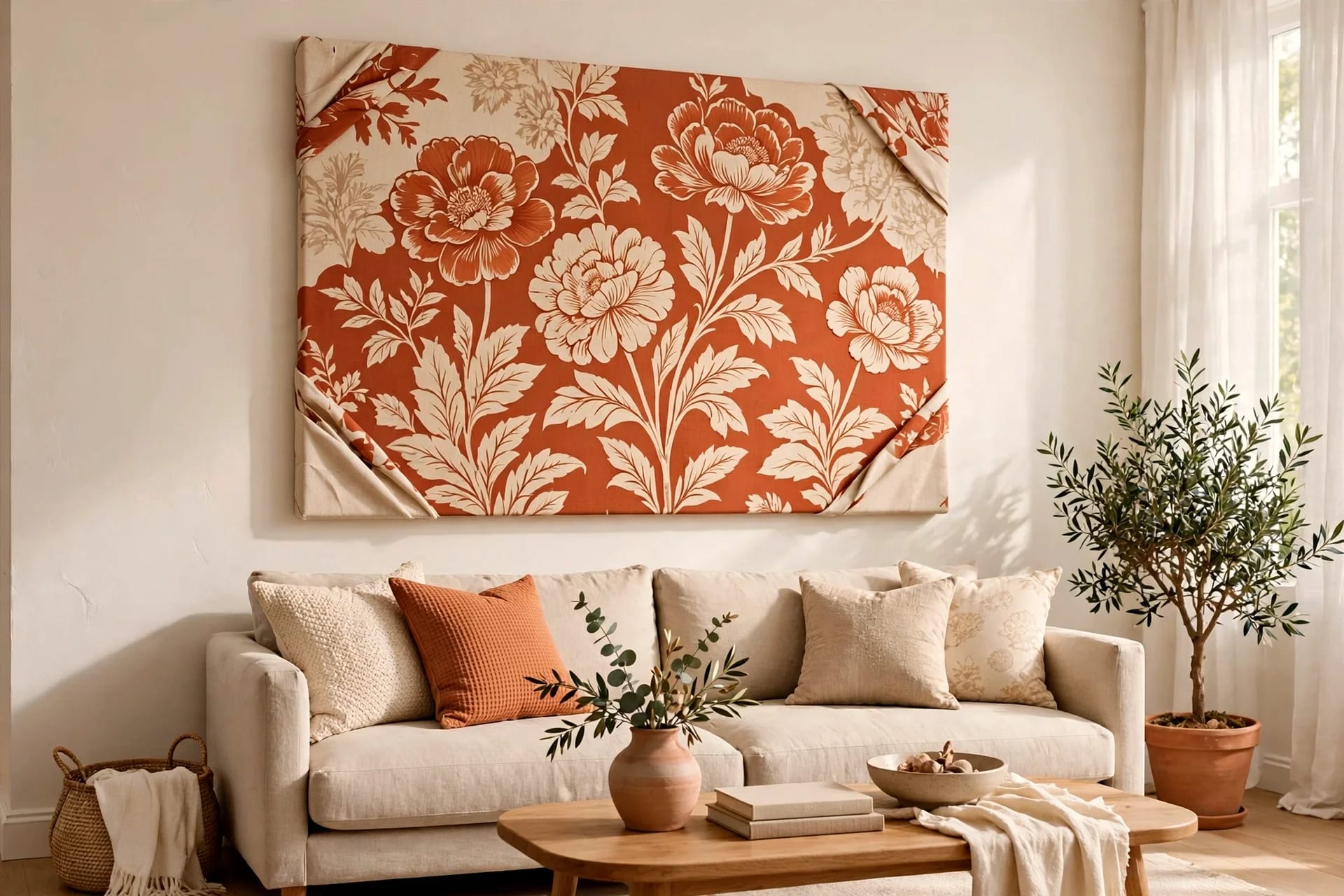
1. One oversized abstract canvas. A canvas 120 to 150 centimetres wide above a sofa, in soft beige, grey, or sage, is the classic minimalist move for a reason: it fills the wall's centre, leaves generous empty space around it, and needs nothing else. Hang its centre at 145 to 150 centimetres from the floor, and keep the frame slim or absent so the art, not the frame, does the work.
2. A single line-art print in a slim frame. Three black lines on white paper, in one thin oak frame, can hold a hallway or bedroom wall entirely on its own. The trick is scale: the print should be at least 70 centimetres wide, because a small line drawing on a large wall looks lost, not minimal. Buy the largest size you can afford and hang it alone.
3. A large-scale photograph, unframed or float-mounted. One landscape or architectural photograph, printed large and mounted without a heavy frame, brings depth to a minimal room without pattern or colour noise. Choose images with large areas of sky, water, or fog, since those calm areas echo the empty wall around them.
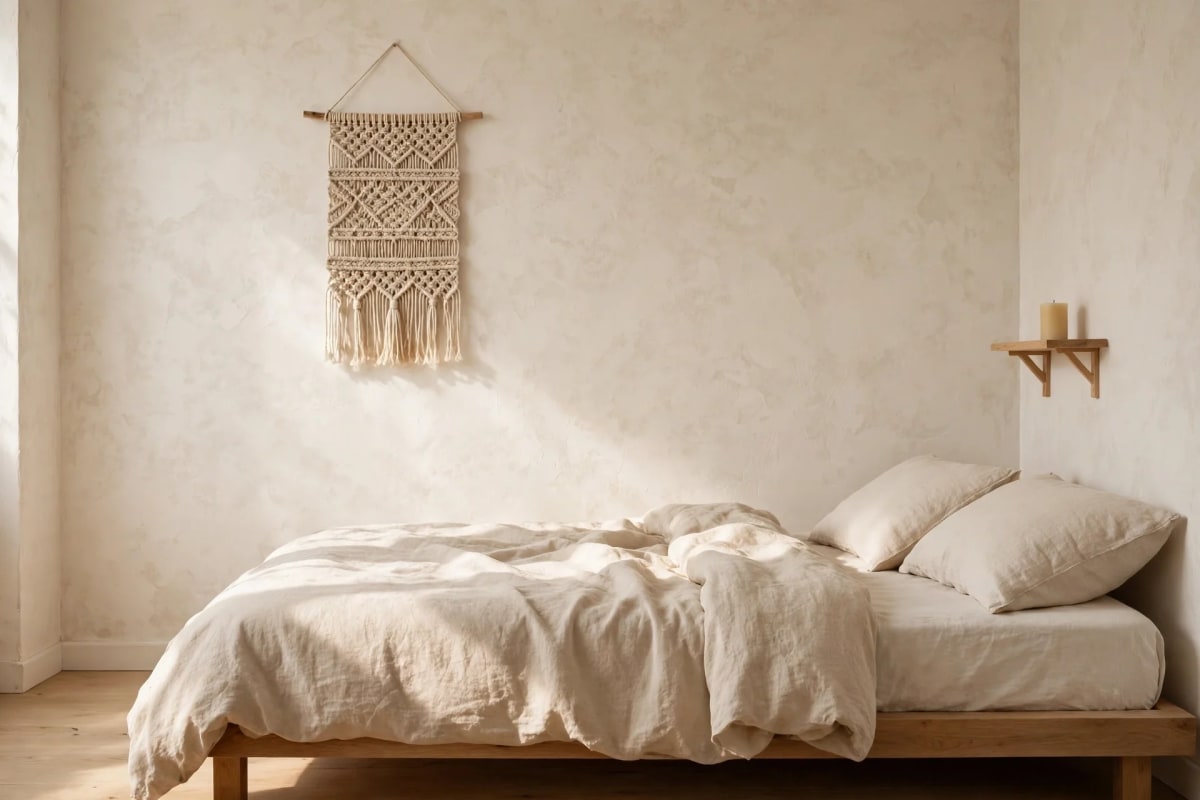
4. A woven textile hanging. A single handwoven piece in undyed wool or cotton adds warmth that flat art cannot, and its texture counts as the room's soft layer. Hang it from a slim wooden dowel, keep it away from direct sun, and let it be the only textile on that wall. For textile options, see our tapestry wall hanging guide.
5. A sculptural wall object. One ceramic disc, a carved wooden panel, or a single metal relief gives a minimal wall a shadow and a tactile quality that flat art lacks. Keep it to one object, hung at eye level, with at least 60 centimetres of empty wall on every side so its shadow has room to play.
Texture Instead of Objects
6. A limewash wall. Limewash gives a flat wall cloudy, hand-worked variation that changes as daylight moves across it. In warm white or pale clay, it adds all the interest a minimal room needs without hanging a single thing. Two coats, applied with a block brush, cover a sofa wall in a weekend. For the method, see our limewash walls guide.
7. A plaster-effect finish. A fine plaster-effect paint or a thin skim of joint compound, combed into soft ridges, gives a tactile surface that suits Japandi and Mediterranean minimalism alike. Keep the colour pale and the texture fine; heavy texture fights minimalism instead of serving it. Our DIY plaster wall art guide covers the small-scale version.
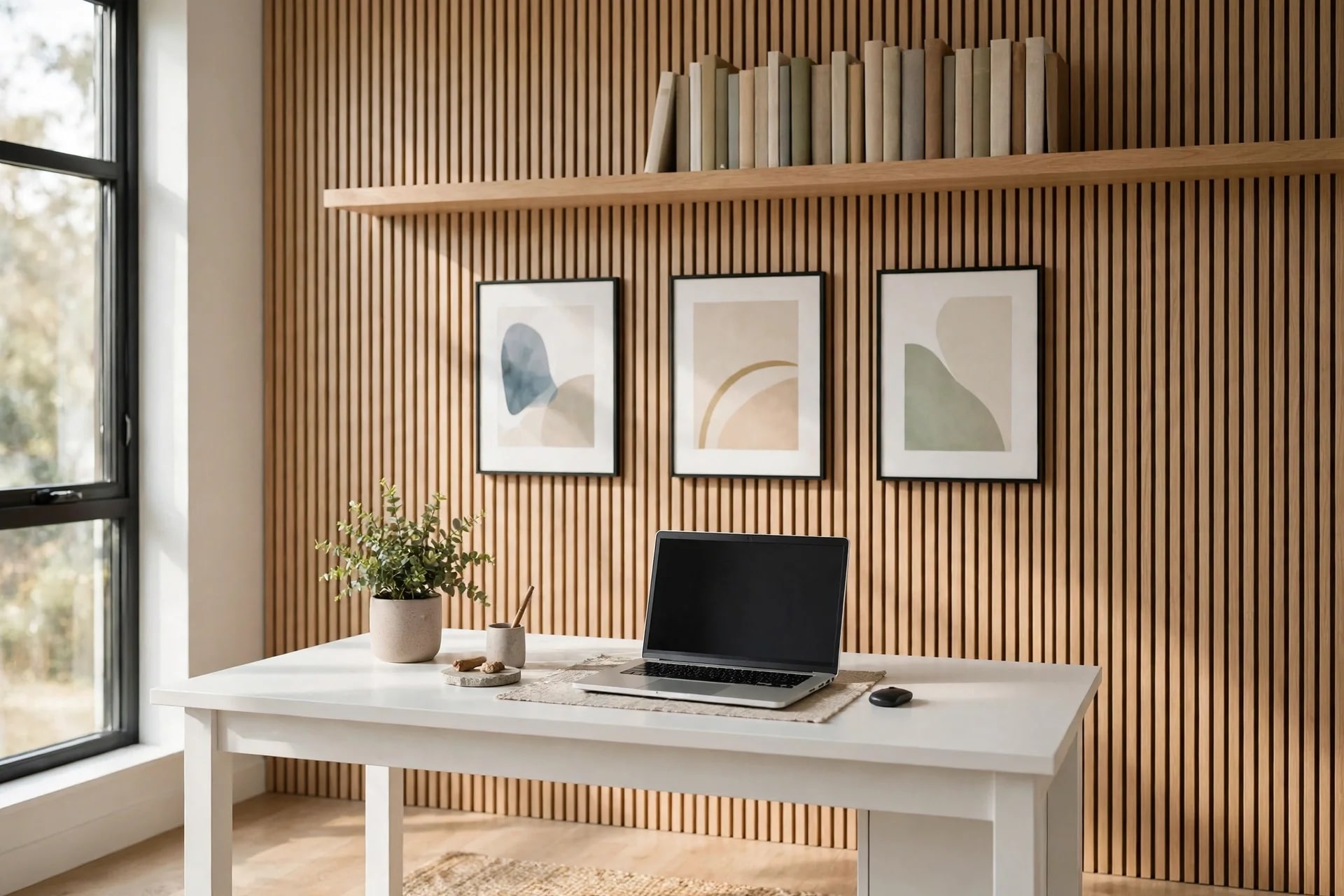
8. Slim vertical wood slats on one wall. Narrow oak slats, floor to ceiling behind a sofa or bed, add rhythm and warmth while keeping the wall's colour calm. The vertical lines draw the eye upward and make ceilings feel taller. For the build, see our wood slat accent wall guide.
9. A microcement or clay panel zone. A single panel of microcement or Roman clay behind a console, roughly 180 centimetres wide, creates a stone-like focal area without the cost of cladding a whole wall. Its matte surface holds light softly and pairs with linen, oak, and unglazed ceramic.
10. A single fluted panel section. Half-round fluted panels, in a colour close to the wall, add shadow lines without contrast. Used on one section, such as the wall behind a reading chair, they define a zone while the rest of the walls stay plain.

Quiet Shelves Mirrors and Light
11. One floating shelf with two objects. A single oak shelf, holding one small vase and one book stack, is the minimalist shelf: it proves the wall is styled without filling it. The shelf should sit at least 30 centimetres above the furniture below it, and at least half its length should stay empty. Two shelves are acceptable only if the second holds even less than the first.
12. A leaning arched mirror. A tall arched mirror, leaned against a side wall, adds light, height, and a soft shape to a minimal room, and it needs no holes at all. Place it where it reflects a window or a plain wall, never a cluttered corner, and keep the floor around it clear so the mirror reads as sculpture. Our mirror wall decor ideas guide covers sizing and placement.
13. A single picture ledge with rotating art. One ledge, holding one large print leaned against the wall, lets a minimal room change its art without new holes or new clutter. Swap the print seasonally and the room feels refreshed for the price of one print. For ledge layouts, see our picture ledge wall decor guide.
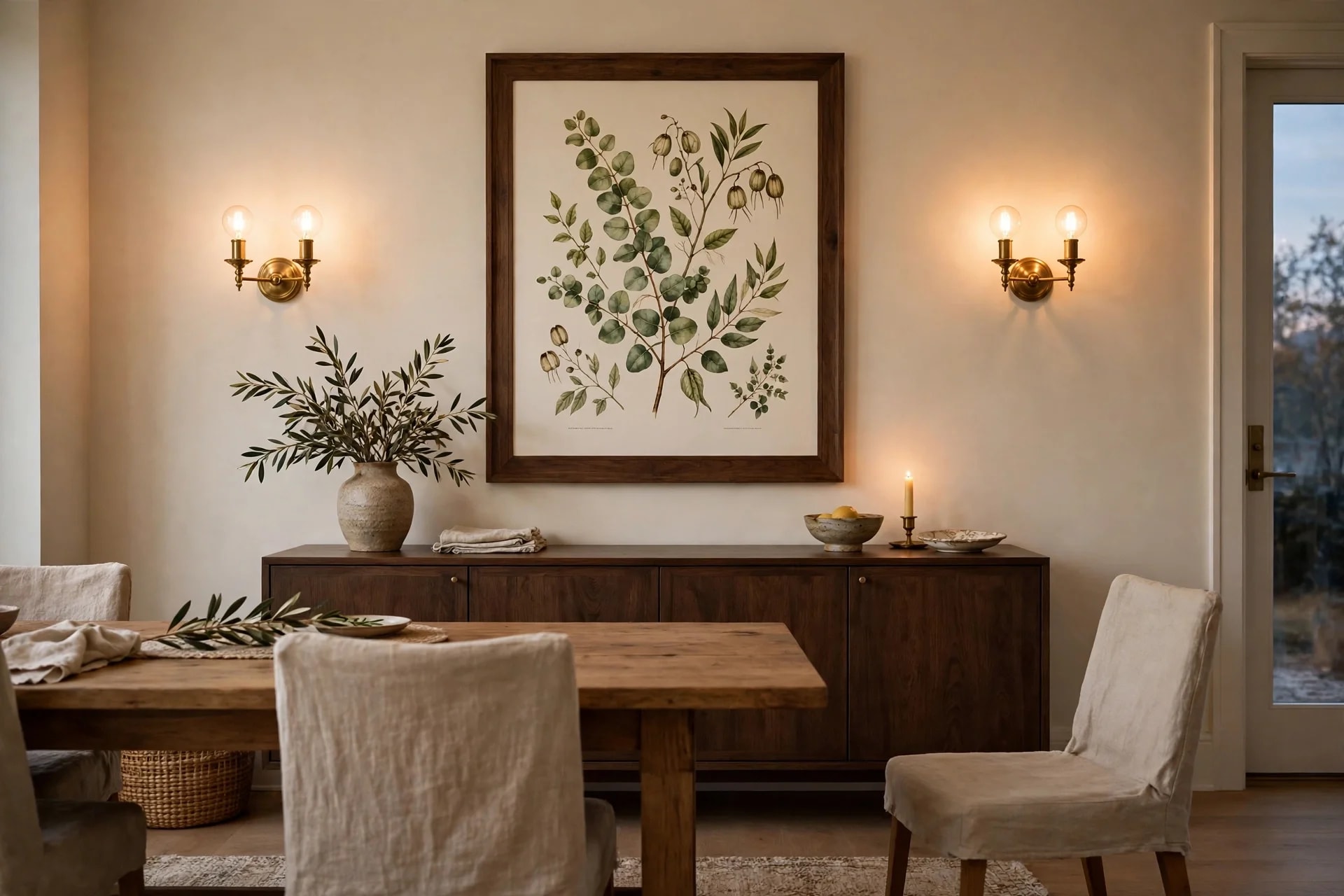
14. A pair of slim sconces, nothing else. Two slim, matching sconces on an otherwise empty wall are a complete minimalist composition: they add light, symmetry, and a vertical rhythm, and they leave the wall itself as the decoration. Choose a simple cylinder or dome shape in one metal finish, on a dimmer, and resist adding art between them.
15. A minimal gallery of three, with generous gaps. If one piece truly feels too bare, allow exactly three pieces: identical frames, one subject family, and gaps of at least 15 centimetres between them, which is wider than a normal gallery. The generous spacing is what keeps three pieces minimal; the same three frames with tight gaps would read as a cluster. For layout maths, see our gallery wall layouts guide.
Costs at a Glance
| Idea | Typical cost | Effort | | --- | --- | --- | | Oversized abstract canvas | $80–$350 | Buy and hang | | Single line-art print, large | $40–$140 | Buy and hang | | Large-scale photograph | $60–$220 | Buy and hang | | Woven textile hanging | $50–$180 | Buy and hang | | Sculptural wall object | $60–$250 | Buy and hang | | Limewash wall | $60–$160 | Weekend | | Plaster-effect finish | $50–$150 | Weekend | | Vertical wood slats | $150–$400 | Moderate | | Microcement panel zone | $200–$500 | Professional | | Fluted panel section | $120–$300 | Moderate | | One floating shelf | $30–$80 | Easy | | Leaning arched mirror | $90–$280 | Buy and lean | | Picture ledge | $30–$80 | Easy | | Slim sconce pair | $60–$180 | Easy | | Minimal gallery of three | $60–$160 | Easy |
Prices assume off-the-shelf pieces and mid-range materials. The cheapest minimalist wall is often a limewash finish plus one print.
Step by Step: A DIY Textured Canvas
This project takes about three hours plus drying time, and costs $40 to $90. It suits the wall above a sofa or bed, where one large piece must carry the room.
You will need: one large blank canvas (at least 90 by 120 centimetres), ready-mixed joint compound or texture paste, a wide putty knife and a small palette knife, painter's tape, a drop cloth, and matte paint in warm white or pale clay.
Step 1 — Protect and plan. Lay the drop cloth, tape the canvas edges, and sketch your design lightly in pencil: broad arcs, soft waves, or a simple arch. Minimalist texture works best as one large gesture, not many small marks.
Step 2 — Apply the compound. Spread joint compound 3 to 5 millimetres thick with the wide knife, working in one direction. Keep the layer even; thick patches crack as they dry.
Step 3 — Shape the texture. Drag the palette knife through the wet compound in long, calm strokes following your sketch. Step back often: the texture should read clearly from two metres away.
Step 4 — Dry fully, then paint. Let the canvas dry for at least 24 hours, longer in humidity. Paint two thin coats of matte paint, letting the first dry fully. Matte paint is essential: gloss would turn texture into glare.
Step 5 — Hang alone. Hang the canvas centred over the furniture, its centre at 145 to 150 centimetres, and add nothing else to that wall for a week.
Common Mistakes and Fixes
Confusing minimal with empty. A wall with nothing on it is not minimalist; it is unfinished. Fix: add one hero piece at the right scale, and let the empty space around it become the design.
Adding small pieces one by one. Six small frames, added over months, quietly become clutter. Fix: remove everything, choose the single largest piece, and rehang only that.
Using too many colours. Four or five accent colours on one wall break minimalism faster than any object count. Fix: return to two or three colours and one natural material.
Hanging art too small. A small print on a large wall looks lost, not refined. Fix: apply the two-thirds rule, or lean a larger piece on a ledge instead.
Forgetting texture. Flat white walls with flat art feel sterile. Fix: add limewash, plaster texture, or one woven piece to give the eye something soft to rest on.
Filling shelves to prove styling. A shelf crowded with objects is the opposite of minimal. Fix: keep half of every shelf empty and limit each shelf to two objects.
FAQ
How many pieces should a minimalist wall have?
One hero piece, ideally. If one feels too bare, allow three identical frames with generous gaps, but never add a fourth piece without removing one first.
How much empty wall should I keep?
At least 40 percent of every wall should stay visibly empty. That empty space is the design: it lets the eye rest and makes the hero piece feel intentional.
Does minimalist wall decor suit small rooms?
Yes, it suits them best. One large piece and generous empty space make a small room feel larger, while a crowded wall makes it feel smaller. Mirrors and vertical lines help further.
Can minimalist walls still feel warm?
Yes. Warmth comes from texture and natural materials, not from quantity: limewash, oak slats, woven textiles, linen, and unglazed ceramic all warm a minimal wall without cluttering it.
What is the cheapest minimalist wall makeover?
A limewash finish plus one large print, or a DIY textured canvas hung alone. Both cost under $160 combined and carry a whole wall without any further pieces.
How do I edit a wall that has become cluttered?
Remove everything, live with the bare wall for a day, then rehang only the single largest piece. Add a second element only after a week, and only if the wall still feels unfinished.