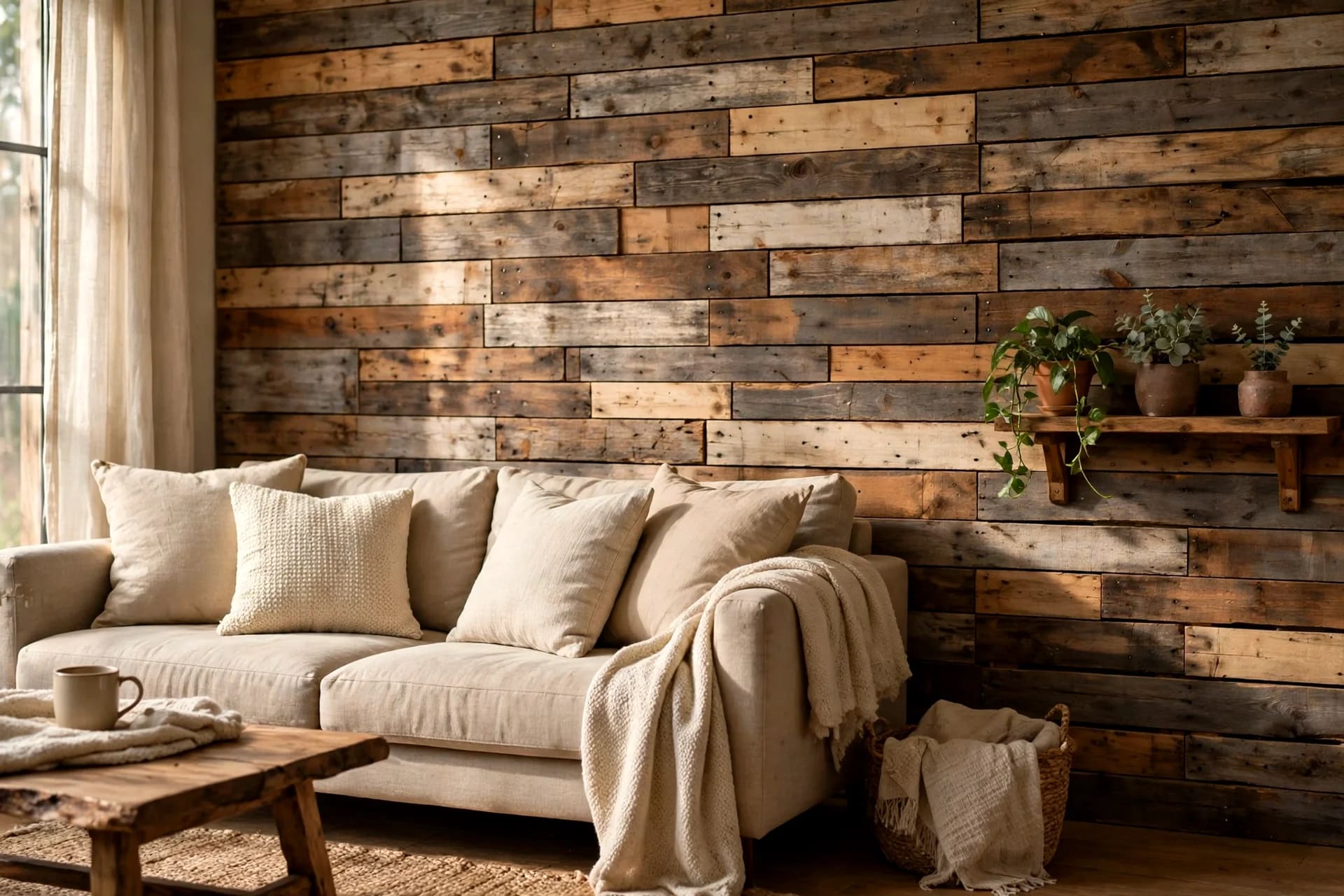
Pallet wood has a warmth flat-pack panels struggle to copy. The grain is uneven, tones vary from board to board, and a wall of reclaimed planks looks collected over time rather than bought in one box. That character is why pallet projects photograph so well, but also why many fail: boards are fixed without checking what they are made from, hung on fixings that cannot carry the weight, or left unsealed where steam and grease soon ruin the finish.
This guide takes a more practical route. It starts with the safety check that matters more than any design choice, works out how many boards and how much money a real wall needs, then moves through fifteen ideas grouped by what they do in a room. You will also find a tutorial for a pallet-shelf accent panel, finishing advice for kitchens and bathrooms, and options for a rented home without drilling. If you are starting from scratch, our DIY wall decor guide will help you place a pallet wall within a wider scheme first.
Key Takeaways
- Use only heat-treated (HT) pallets; never use MB-stamped or unmarked chemically treated pallets indoors.
- A 3-metre accent wall typically needs 28–34 deck boards and costs $60–$140 in materials.
- Fix heavy pallet panels into studs or masonry, never into plasterboard alone.
- Sand, stain or whitewash, then seal — especially in kitchens, bathrooms and hallways.
- Renters can get the same look with leaning panels and freestanding frames, no drilling required.
Table of Contents
- How to Choose Safe Pallets: The HT-Stamp Rule
- How Many Boards and What Will It Cost
- 15 DIY Pallet Wall Decor Ideas
- Step-by-Step Build a Pallet-Shelf Accent Panel
- Finishing and Sealing for a Lasting Result
- Renter-Friendly Pallet Wall Decor No Drilling Required
- Common Mistakes and How to Fix Them
- FAQ
How to Choose Safe Pallets: The HT-Stamp Rule
Every pallet that travels internationally should carry a stamp burned or printed on one of its side blocks. Look for the letters HT, which mean the wood was heat-treated to kill pests. Heat treatment uses high temperature only, so HT pallets are generally suitable indoors once cleaned, sanded and sealed.
Never bring an MB-stamped pallet into your home. MB stands for methyl bromide, a chemical fumigant, and MB pallets should not be cut, sanded or used indoors. The same caution applies to pallets with no stamp at all, pallets stained with oil or chemicals, and pallets that smell strongly of chemicals or spilled contents. If you cannot read the stamp clearly, leave the pallet behind; safe pallets are common enough that guessing is never worth it.
Good sources include garden centres, tile and flooring shops, builders' merchants and small warehouses, which often give pallets away rather than pay for disposal. Ask what the pallet carried: dry goods, tiles and garden supplies are far better bets than paint, chemicals or food that may have leaked. Check for rot, large splits, protruding nails and damp. Soft, crumbling boards will not hold a screw or keep a straight edge, so choose dry, firm boards with a readable HT stamp and dismantle them slowly with a pry bar to limit splitting.
How Many Boards and What Will It Cost
Most idea lists skip the numbers, which is how projects stall halfway across a wall. Pallet deck boards are usually around 100–145 mm wide, so allow for gaps, cuts and a few rejects when you estimate. The table below assumes horizontal boards on a standard 2.4-metre-high wall, with 3–5 mm shadow gaps, and includes a 10% allowance for waste. Prices are for reclaimed boards plus screws, battens, sandpaper and finish; free pallets keep you at the low end, while bought reclaimed boards push you higher.
| Wall width | Deck boards needed | Battens and fixings | Finish and sandpaper | Estimated total | | --- | --- | --- | --- | --- | | Small, 2 metres | 19–23 | $15–$25 | $15–$25 | $40–$90 | | Medium, 3 metres | 28–34 | $20–$30 | $15–$25 | $60–$140 | | Large, 4 metres | 37–45 | $25–$40 | $20–$30 | $85–$180 |
Measure your wall before collecting pallets, and count in square metres rather than guessing by pallet. One standard pallet typically yields five to seven usable deck boards, so a medium wall may need five or six pallets. Weight matters too: a full board-clad wall is often 15–25 kg per square metre once battens and boards are combined. That is why fixing method matters as much as appearance, and why a floating shelf weight capacity check is worth reading before loading a pallet shelf.
15 DIY Pallet Wall Decor Ideas
The ideas below are grouped by function.
Accent walls
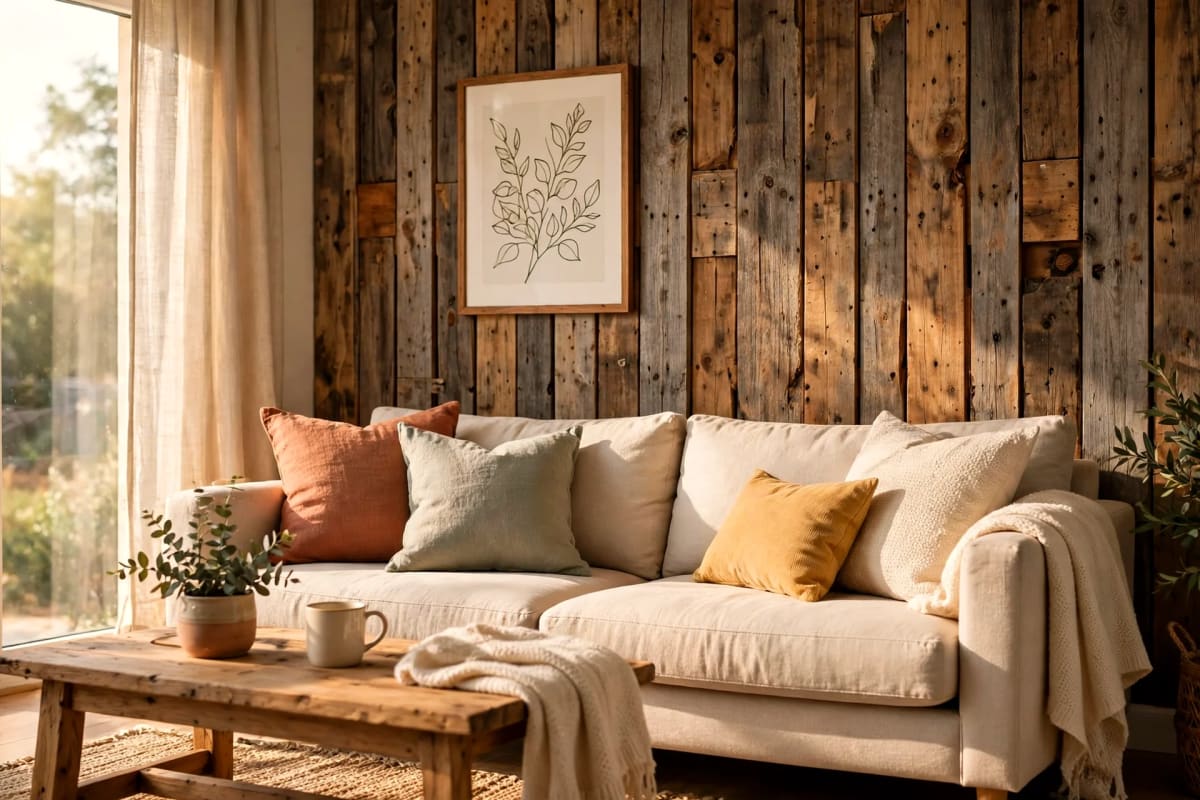
1. Horizontal plank accent wall. The classic pallet wall: boards run horizontally with small, even gaps, in mixed tones. Keep the darkest boards near the floor so the wall feels grounded.
2. Herringbone feature panel. Cut short boards at 45 degrees and lay them in a herringbone pattern inside a framed section, rather than across a whole wall. It uses offcuts well.
3. Vertical slat panel. Vertical boards make a low ceiling feel taller and suit narrow hallway walls. For a cleaner version, compare our wood slat accent wall guide.
Shelves and storage panels
4. Pallet-shelf accent panel. A framed panel of horizontal boards with two or three small shelves. The tutorial below builds this version.
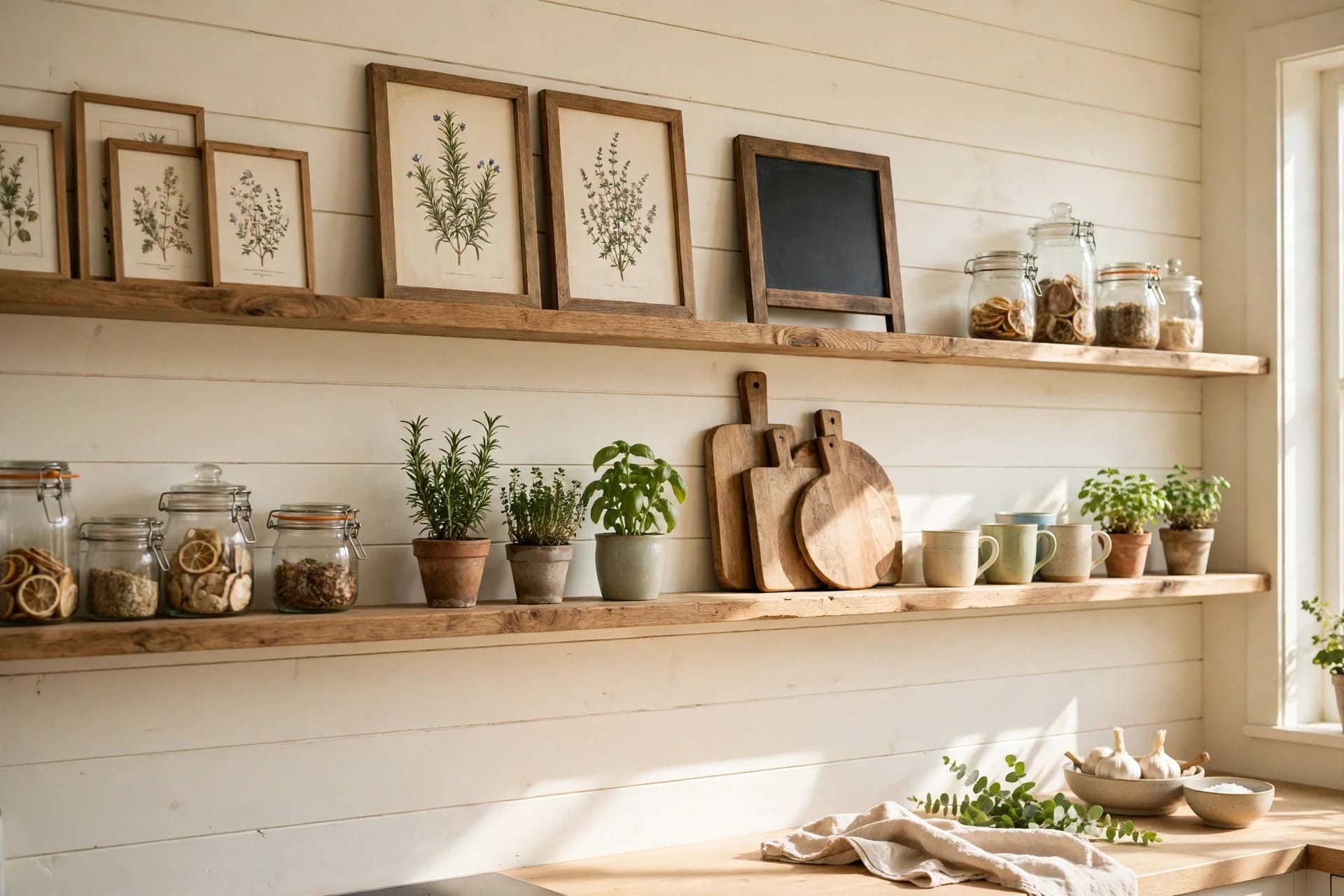
5. Kitchen utensil rail panel. A short panel with hooks and a narrow shelf holds utensils, mugs and small jars, freeing counter space. Seal it well.
6. Entryway key and coat panel. A single-width panel with hooks and a small shelf for keys keeps a hallway tidy without a bulky unit.
Planters and greenery
7. Vertical herb planter. Line the back of a shallow pallet frame, fill pockets with pots rather than loose soil, and hang it where herbs get light.
8. Trailing plant panel. Fix small pots to a board panel and let trailing plants soften the wood. Choose lightweight pots.
9. Succulent wall frame. Shallow boxes fixed to a backing board hold succulents in a grid. Keep it small and near a window.
Signs, photos and display
10. Painted quote sign. Two or three joined boards, sanded smooth, make a sturdy sign blank. Paint lettering with a stencil, then seal it.
11. Photo ledge wall. Narrow pallet ledges at two heights display framed prints and small objects, and let you swap pictures without new holes.
12. Clothes-peg photo display. Fix wire or twine across a framed board panel and peg prints along it. The display can change in minutes.
Headboards and holders
13. Rustic headboard panel. A panel slightly wider than the bed, sanded extra smooth and sealed, gives a bedroom instant texture. Sand edges thoroughly; a headboard is touched daily.
14. Mug holder panel. Short boards with sturdy hooks hold mugs by their handles in a kitchen or coffee corner. Space hooks so mugs do not chip.
15. Tool and craft holder. In a workshop or craft room, a board panel with hooks, small shelves and a magnetic strip keeps tools visible and reachable.
Step-by-Step Build a Pallet-Shelf Accent Panel
This project makes a framed panel about 120 cm wide and 90 cm high, with two shelves, sized to hang as one unit.
Tools and materials: HT pallet boards, two pine battens (45 × 20 mm), wood screws (40 mm and 60 mm), a saw, drill, spirit level, tape measure, stud finder, 80-grit and 120-grit sandpaper, wood glue, stain or whitewash, and clear sealant. For masonry walls, add wall plugs rated for the panel weight.
Step 1: Prepare the boards. Dismantle HT pallets, remove nails, and discard split or soft boards. Cut boards to 120 cm and sand every face and edge, starting with 80-grit and finishing with 120-grit.
Step 2: Build the frame. Lay boards face down with 4 mm gaps. Glue and screw two vertical battens across the back, 15 cm in from each end, using 40 mm screws. Check it is square by measuring both diagonals.
Step 3: Add the shelves. Cut two shelf boards to 110 cm. Fix support blocks to the front at 30 cm and 65 cm from the base, then screw the shelf boards down from above. Keep shelf depth to 15–18 cm.
Step 4: Finish before hanging. Stain or whitewash the panel, let it dry fully, then apply two coats of sealant. Finishing flat avoids drips and missed edges.
Step 5: Fix into studs or masonry. Find studs with a stud finder and mark them. On stud walls, drive 60 mm screws through the battens into at least two studs. On masonry, drill, plug and screw at the same batten points. Never rely on plasterboard fixings alone.
Step 6: Load within limits. Check the panel with a level, then load gradually. As a working guide, keep each shelf under 5 kg unless your fixings are rated higher, and keep heavier items low and close to the battens. For broader shelf projects, our DIY floating shelves guide covers brackets and spans.
Finishing and Sealing for a Lasting Result
Sanding decides how the finish looks. Start with 80-grit to remove rough fibres, then 120-grit for a smooth touch, and 180-grit on surfaces hands will touch, such as headboards and shelf edges. Sand along the grain, wear a dust mask, and wipe boards with a slightly damp cloth before finishing.
Stain deepens the wood and keeps grain visible, while whitewash lightens boards and suits bright, coastal rooms. Test both on an offcut first: pallet boards vary, and the same stain can look two shades different on neighbouring planks. Apply thin coats, let each dry fully, and sand lightly between coats with 220-grit paper.
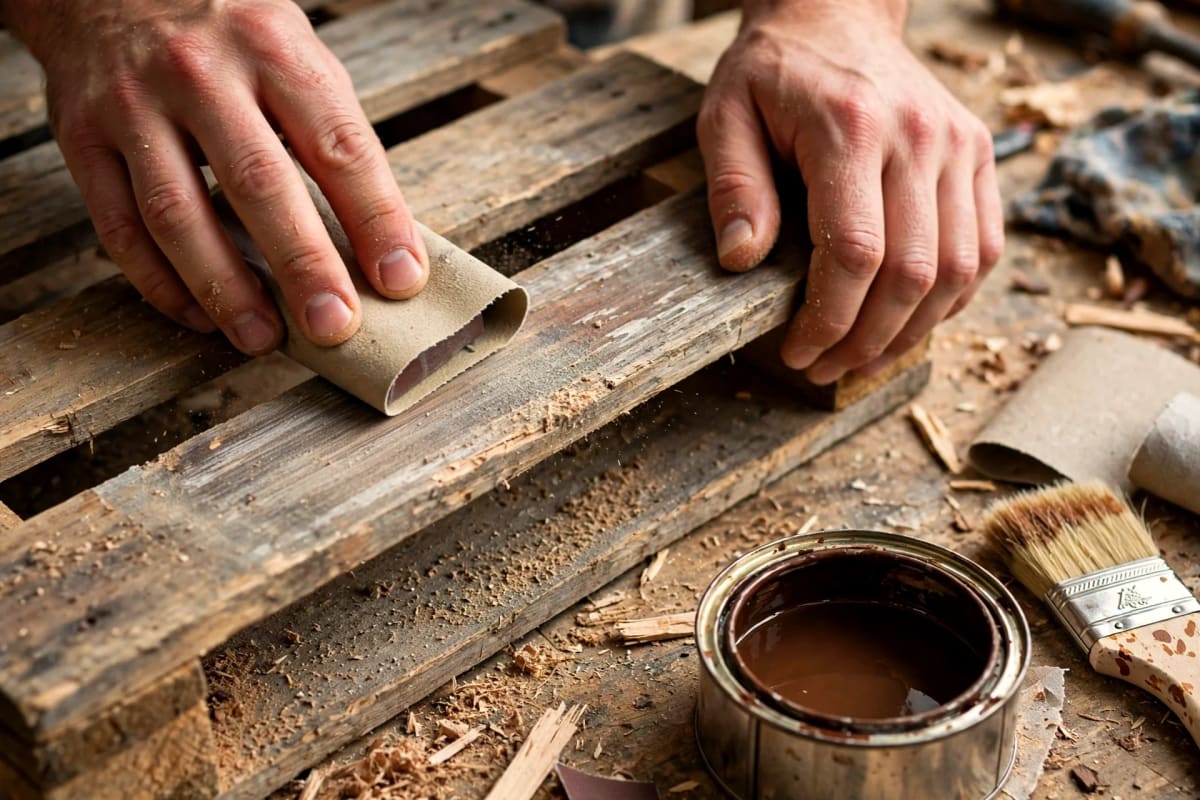
Sealing is not optional in kitchens, bathrooms and busy hallways. Use clear water-based polyurethane or hardwax oil for most walls, and a moisture-resistant sealant in damp rooms. Two thin coats beat one thick coat, which can pool in gaps. In bathrooms, keep pallet wood away from direct splashes and check the seal annually.
Renter-Friendly Pallet Wall Decor No Drilling Required
Renters do not need to give up the pallet look. A leaning panel is simplest: build a framed board panel, stand it against the wall at a slight angle, and secure the top with removable adhesive strips or a furniture strap. It works best beside a sofa, bed or console, where furniture stops it sliding.
Freestanding frames offer a more finished result. Fix pallet boards to a simple A-frame or easel-style back, so the piece stands on its own and can move between rooms. Keep the footprint wide enough to stay stable. For more no-drill ideas, see our renter-friendly wall decor guide.
Whatever route you choose, check the weight before leaning anything tall against a wall, keep panels away from radiators and damp corners, and test adhesive strips on an inconspicuous spot first.
Common Mistakes and How to Fix Them
Using unmarked or MB pallets. Fix: check the stamp before cutting. If it is missing or reads MB, do not use the pallet indoors.
Fixing into plasterboard alone. Fix: locate studs or use masonry plugs. If a panel already sags, take it down and refix it properly.
Skipping sanding. Fix: rough boards snag clothes and reject stain unevenly. Sand in stages, and re-sand rough patches before sealing.
Sealing too late or not at all. Fix: finish panels before hanging, and seal kitchen and bathroom pieces with two coats. A greasy, unsealed shelf can usually be cleaned, sanded back and sealed, but prevention is far easier.
Overloading shelves. Fix: move heavy items to lower shelves, spread weight across battens, and upgrade fixings if a shelf bows. A shelf that bends has already told you its limit.
Boards of wildly different thickness. Fix: sort boards by thickness before laying them out, and hide small steps behind shelves or frames.
FAQ
Are pallet walls safe indoors?
Yes, when pallets are heat-treated (HT), clean and dry, and the finished wall is sanded and sealed. Avoid MB-stamped, unmarked or chemically stained pallets.
How much does a pallet accent wall cost?
A small 2-metre wall typically costs $40–$90, a medium 3-metre wall $60–$140, and a large 4-metre wall $85–$180, including battens, fixings and finish. Free HT pallets keep costs low; bought boards save dismantling time.
Can I put a pallet wall in a bathroom?
You can, with conditions. Use HT boards, seal with a moisture-resistant finish, keep wood away from direct shower spray, and ventilate well. Check the seal each year.
How do I find free pallets?
Ask garden centres, tile shops, builders' merchants and small warehouses, and check the HT stamp before accepting any pallet. Avoid pallets that carried chemicals, paint or leaking goods, and reject soft or rotten boards.
Do pallet walls damage the wall behind them?
Boards fixed into studs or masonry leave only small screw holes, easy to fill when the panel comes down. Loose boards glued directly to plaster are harder to remove, so a batten-fixed panel is kinder to the wall.
What weight can a pallet shelf hold?
It depends on the fixings and the wall, not just the wood. As a safe working guide, keep each 15–18 cm deep shelf under 5 kg unless your fixings are rated higher.