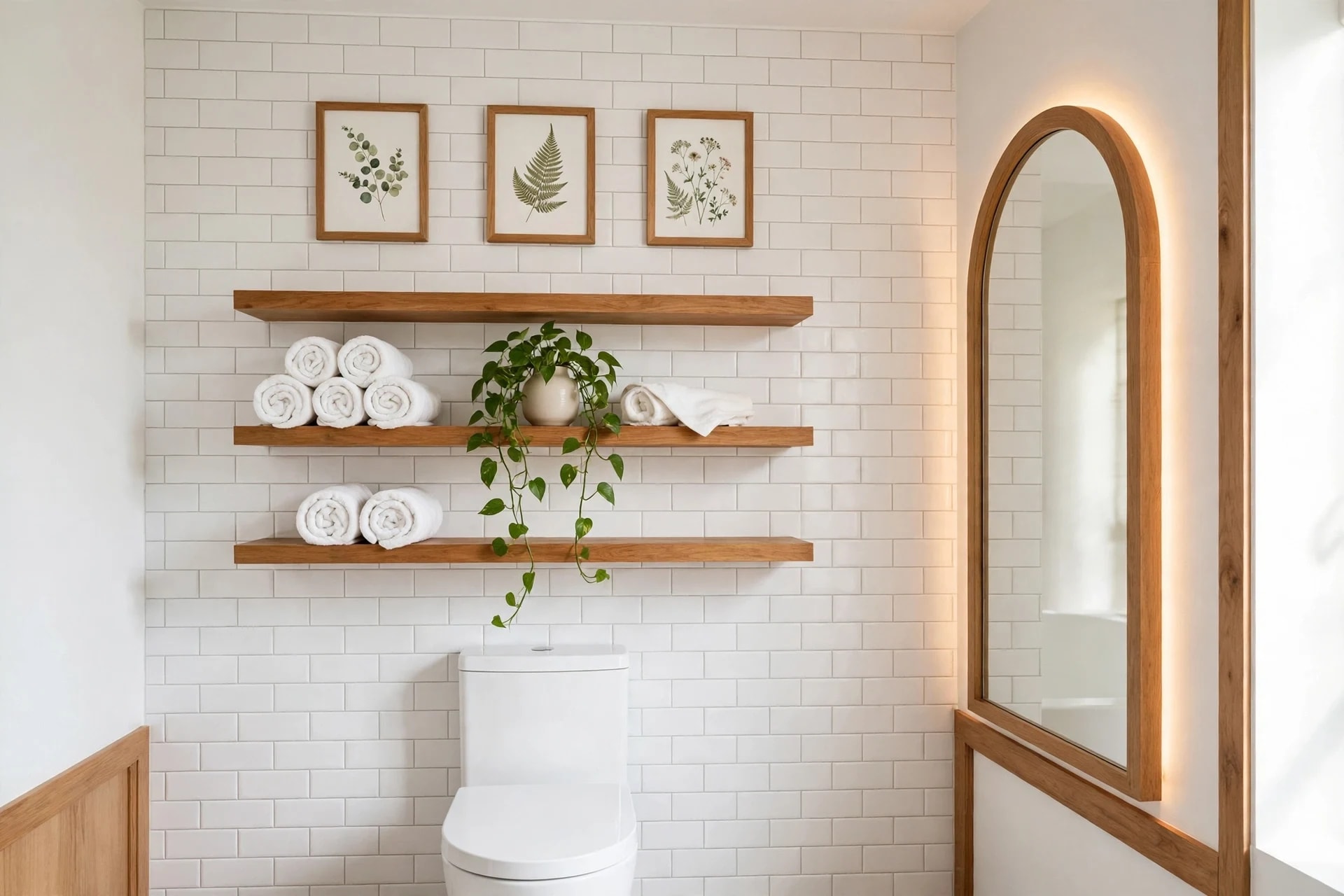
A bathroom wall is the hardest wall in the house to decorate well. It faces daily steam, splashes and cleaning sprays, it is usually small, and it has a toilet, a basin and a mirror competing for the same few square metres. Most bathroom decor lists ignore all three problems and suggest paper prints and raw wood as if the room were a bedroom. Within months, those pieces curl, spot and warp, and the bathroom looks worse than it did bare.
This guide starts from what actually survives a bathroom: sealed materials, glass-protected art, mirrors, tile and metal. You will get fifteen ideas with the measurements that matter — above-toilet heights, mirror sizes, shelf depths — plus the humidity rules that decide whether a piece lasts a year or a month. The goal is a bathroom that feels like a small spa, not a showroom, and stays that way through daily showers.
Key Takeaways
- Bathroom humidity regularly reaches 60 to 80 percent after a shower: only sealed wood, metal, tile, glass and synthetic prints belong on the wall.
- An above-toilet vignette works at 15 to 20 centimetres above the tank, with one shelf and a small gallery, not a crowded stack.
- A bathroom mirror should span two thirds to three quarters of the basin width, hung with its centre at eye level.
- Paper prints need glass and a sealed frame; unframed paper curls within weeks in a steamy bathroom.
- Ventilation matters more than any product: run the extractor for 20 minutes after a shower to protect every wall piece.
Table of Contents
- Plan a bathroom wall around water
- 15 bathroom wall decor ideas
- Step by step: an above-toilet shelf vignette
- What survives humidity, and what does not
- Small bathrooms and rented bathrooms
- A weekly bathroom wall routine
- Common mistakes and fixes
- FAQ
Plan a bathroom wall around water
Start by mapping the wet zones. The wall directly above a bath or inside a shower enclosure is a tile-or-nothing wall: no art, no wood, no paper belongs there. The wall above the basin gets splashes but dries quickly, so sealed and glass-protected pieces work. The wall above the toilet and the wall opposite the mirror are the driest walls in the room, and they are where most decor belongs.
Next, check ventilation honestly. A bathroom with a working extractor that runs after every shower can carry framed prints and sealed wood for years. A bathroom with no extractor and a window that stays shut will defeat almost any wall decor, however well sealed.
Finally, measure the three numbers that decide most bathroom decor: the toilet tank height, the basin width, and the wall width beside the mirror. Those numbers set shelf height, mirror size and gallery width, and they stop the most common bathroom error, which is buying a beautiful piece in entirely the wrong size for the wall it was meant for.
15 bathroom wall decor ideas
1. An above-toilet shelf vignette
One floating shelf above the toilet, styled with a small plant, a candle and a rolled towel, with two small framed prints above it. Cost around £30 to £60.
2. An oversized arched mirror
A large arched mirror above the basin, spanning two thirds to three quarters of the basin width, with a warm backlight halo if the budget allows. Cost around £40 to £90.
3. Floating shelves that store and style
Two floating shelves beside the mirror, styled by the rule of three: rolled towels, a ceramic jar and a trailing plant per shelf. Cost around £30 to £65.
4. A fluted wood slat accent wall
Vertical wood slats, sealed against moisture, on the wall behind the basin for a boutique-hotel look. Cost around £50 to £120 for a basin-width panel.
5. Peel-and-stick wallpaper on one wall
Moisture-resistant peel-and-stick wallpaper on the driest wall, usually the toilet wall or the wall opposite the mirror. Cost around £25 to £50.
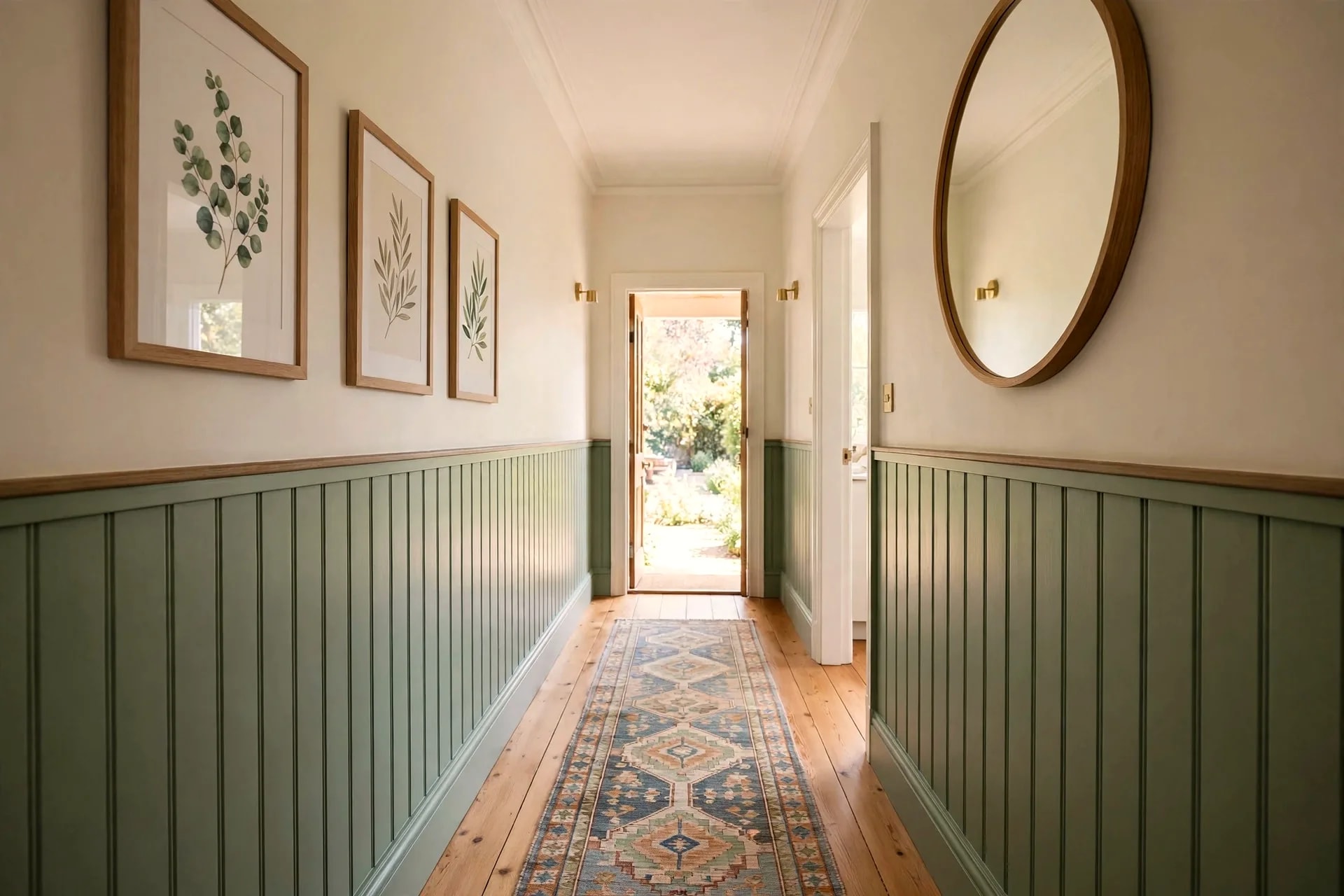
6. Glass-framed botanical prints
Botanical or coastal prints behind glass in sealed frames, hung on a dry wall as a row or a pair. Cost around £30 to £70.
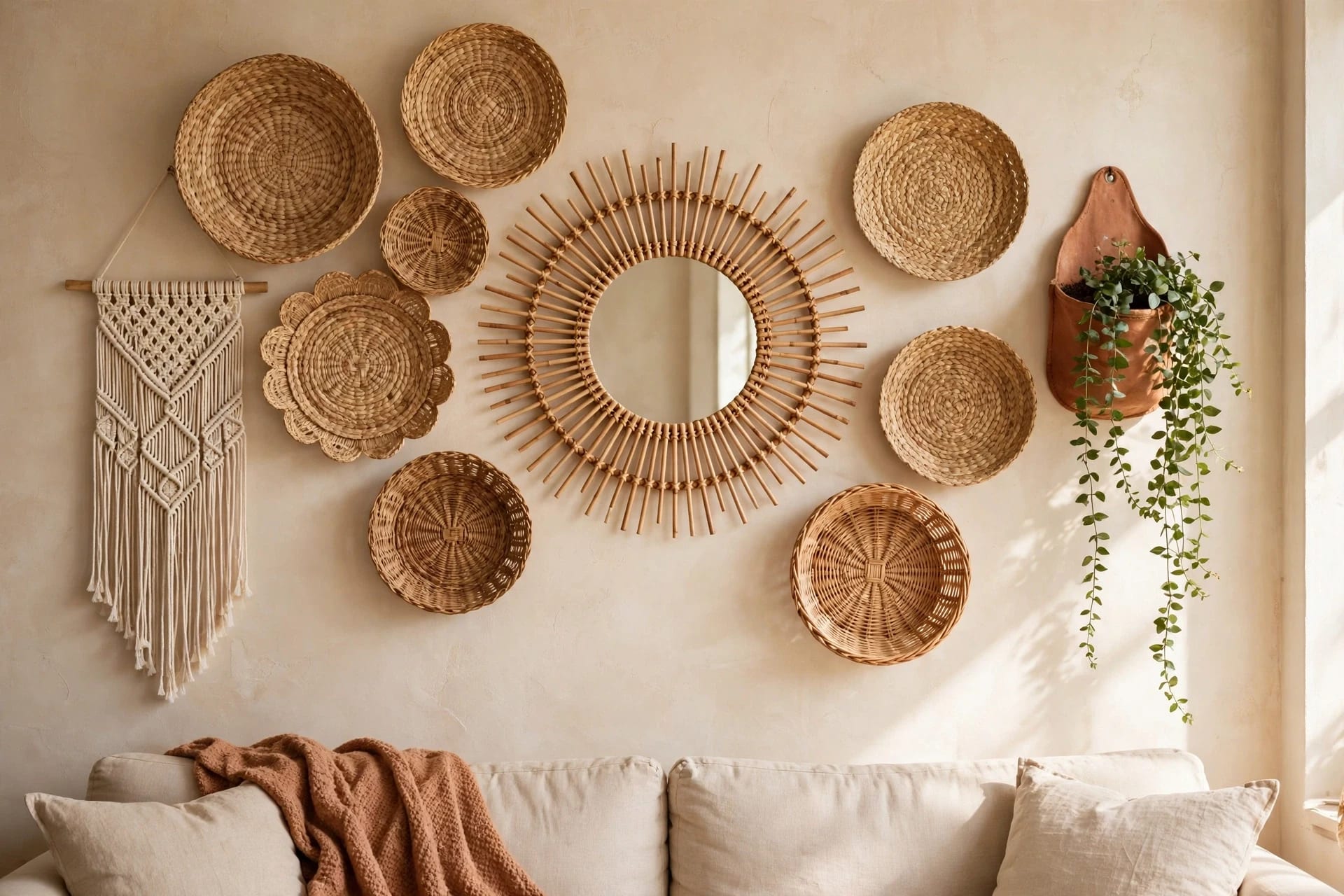
7. A woven basket wall, bathroom edition
Three to five flat woven baskets on the driest wall, for texture without weight or moisture risk. Cost around £20 to £45.
8. A brass rail with hanging towels
A brass or matte black rail holding hand towels on rings or hooks, turning daily towels into wall decor. Cost around £20 to £45.
9. A spa-style shelf with eucalyptus
A single shelf or wall vase holding eucalyptus sprigs, a candle and a small stone or ceramic dish, for a spa look that costs almost nothing to refresh. Cost around £15 to £30.
10. A tiled feature strip
A horizontal strip of patterned or coloured tiles across the mirror wall, at eye level, to give a plain bathroom a finished edge. Cost around £30 to £80.
11. A moody navy or green wall with brass
One wall painted deep navy or green, with brass sconces and black-framed prints, for a moody, hotel-like bathroom. Cost is paint plus fixtures, around £50 to £100.
12. A ladder shelf for towels and plants
A leaning ladder shelf against a dry wall, holding folded towels, a plant and a basket, with no drilling required. Cost around £35 to £70.
13. A gallery above the bath, done safely
A small gallery on the wall beside, never directly above, the bath, using glass-framed prints hung well clear of splash height. Cost around £30 to £60.
14. A backlit mirror halo
An LED-backlit round or arched mirror above the basin, giving soft evening light and a spa glow without new wiring in many models. Cost around £45 to £95. Battery or plug-in backlit mirrors suit renters; wired models need an electrician and are a landlord decision, not a weekend job.
15. A seasonal swap ledge
One small ledge or shelf reserved for seasonal change: a shell or coastal piece in summer, a pine sprig in winter, a fresh towel colour in spring. Cost is under £15 per change. A single swap point keeps the bathroom feeling fresh without redecorating, and it stops seasonal pieces cluttering the basin edge.


Step by step: an above-toilet shelf vignette
You need one floating shelf, 60 to 75 centimetres wide, two small framed prints, a small plant, a candle and a rolled towel, plus fixings rated for at least 10 kilograms. Measure the toilet tank height first, then mark the shelf line 15 to 20 centimetres above the tank lid: lower, and the shelf blocks the lid; higher, and the shelf floats disconnected from the toilet below.
Fix the shelf into studs or solid wall, never plasterboard alone, and test it with your heaviest items before styling. Style it by the rule of three — plant, candle, rolled towel — then hang the two prints above the shelf, centred on it, with 8 to 10 centimetres between shelf and frames. Step back and check from the doorway: the vignette should read as one group, shelf plus prints together, not as three separate decisions. Total time is under an hour, and the shelf itself is usually the only purchase.
For shelf fixing and weight limits in general, see floating shelf weight capacity and the DIY floating shelves build. For mirror sizing and placement, see mirror wall decor ideas.
What survives humidity, and what does not
Sealed wood, metal, ceramic, tile, glass and synthetic prints survive bathroom humidity well, provided the room is ventilated. Unsealed wood absorbs steam, darkens and eventually warps; raw MDF swells at cut edges within weeks. Paper prints curl and spot without glass; canvas prints fare slightly better but still absorb moisture at the edges. Fabric hangings, including unsealed macrame, hold damp and can smell musty in a poorly ventilated bathroom, so keep them for dry walls in well-ventilated rooms only.
Sealing is the difference, not the material alone. A wooden shelf sealed on all sides, including the back and cut ends, with a bathroom-grade sealant lasts for years; the same shelf sealed only on the visible face fails from behind. Re-seal wood once a year, wipe metal and tile weekly, and clean glass monthly. If a piece cannot be wiped or re-sealed, it does not belong in a bathroom, however well it photographs.
Small bathrooms and rented bathrooms
A small bathroom needs one decorated wall, not four. Choose the above-toilet wall or the mirror wall, decorate that one well, and leave the rest to tile and paint. A large mirror is worth more in a small bathroom than any gallery, because it doubles light and depth, and a single shelf beats a crowded gallery for both storage and looks. Keep colours pale on three walls and let one wall — the decorated one — carry any strong colour or pattern.
Renters can decorate a bathroom almost fully without drilling: adhesive hooks for baskets and light frames, a leaning ladder shelf for storage, a freestanding mirror, and a tension-rod shelf above the toilet in some layouts. Never use adhesive strips on tile, where they fail without warning, and never drill into tile without landlord permission, since a cracked tile is an expensive repair. See renter-friendly wall decor and damage-free wall decor for methods that leave no trace.
A weekly bathroom wall routine
A bathroom wall stays good with about ten minutes a week, and most of that time is drying, not decorating. Once a week, wipe the mirror and any glass-framed prints with glass cleaner, wipe metal rails and shelf edges with a damp cloth, and check the wall behind the toilet shelf and the towel rail for damp spots or early mould. Catching a damp spot early means wiping it away; catching it late means repainting or re-sealing, so the weekly check is worth more than any product.
Once a month, do the deeper jobs: dust baskets and woven pieces outside, re-check shelf fixings for looseness in steamy conditions, and wipe the top of frames and mirrors, where dust and steam residue collect unseen. Every six months, check sealed wood for dull or rough patches and re-seal if water no longer beads on the surface, and check the extractor filter, since a clogged extractor silently raises humidity for every piece on the wall. Put the routine on the same day as the bathroom clean, and it becomes habit rather than a project: the wall that gets ten minutes a week looks cared for for years, while the wall that gets an annual deep clean always looks tired in between.
If the bathroom also has a window that gets dressed seasonally, the same weekly wipe covers it, and the Christmas window decor ideas guide covers lit, renter-safe window treatments for the festive season.
Common mistakes and fixes
Hanging paper art in a steamy bathroom without glass is the most common mistake, and the fix is a sealed frame or a different wall: glass and a sealed back cost little and save the print. Hanging a shelf too high above the toilet is the second: if you cannot reach the shelf without standing on the toilet, lower it to 15 to 20 centimetres above the tank. Overcrowding a small bathroom wall is the third: remove a third of the pieces and the remaining ones suddenly look intentional.
The fourth mistake is ignoring ventilation and blaming the decor: no frame or sealant survives a bathroom where steam never clears. Run the extractor for 20 minutes after every shower, open a window when you can, and wipe the mirror wall weekly. Ventilation is boring, but it is what keeps every other bathroom decor decision alive.
FAQ
What wall decor survives bathroom humidity?
Sealed wood, metal, ceramic, tile, glass and synthetic prints, in a ventilated bathroom. Paper needs glass and a sealed frame; unsealed wood, raw MDF and fabric hangings do not survive steam well.
How high should a shelf be above the toilet?
15 to 20 centimetres above the tank lid. Lower blocks the lid, higher disconnects the shelf from the toilet below and makes it hard to reach.
Can I hang pictures in a bathroom?
Yes, on a dry wall, behind glass in a sealed frame, and clear of splash height. Never hang unframed paper in a bathroom, and never hang art directly above a bath where splashes reach it.
What size mirror suits a bathroom basin?
A mirror spanning two thirds to three quarters of the basin width, with its centre at eye level, roughly 150 to 160 centimetres from the floor. Larger mirrors suit small bathrooms because they double light and depth.
How do I decorate a rented bathroom without drilling?
Use adhesive hooks on painted walls for baskets and light frames, a leaning ladder shelf for storage, and a freestanding mirror. Never rely on adhesive strips on tile, and never drill tile without landlord permission.
Does a bathroom extractor really protect wall decor?
Yes, more than any sealant. Running the extractor for 20 minutes after a shower clears the steam that warps wood, curls paper and spots metal, and it protects every wall piece at once.