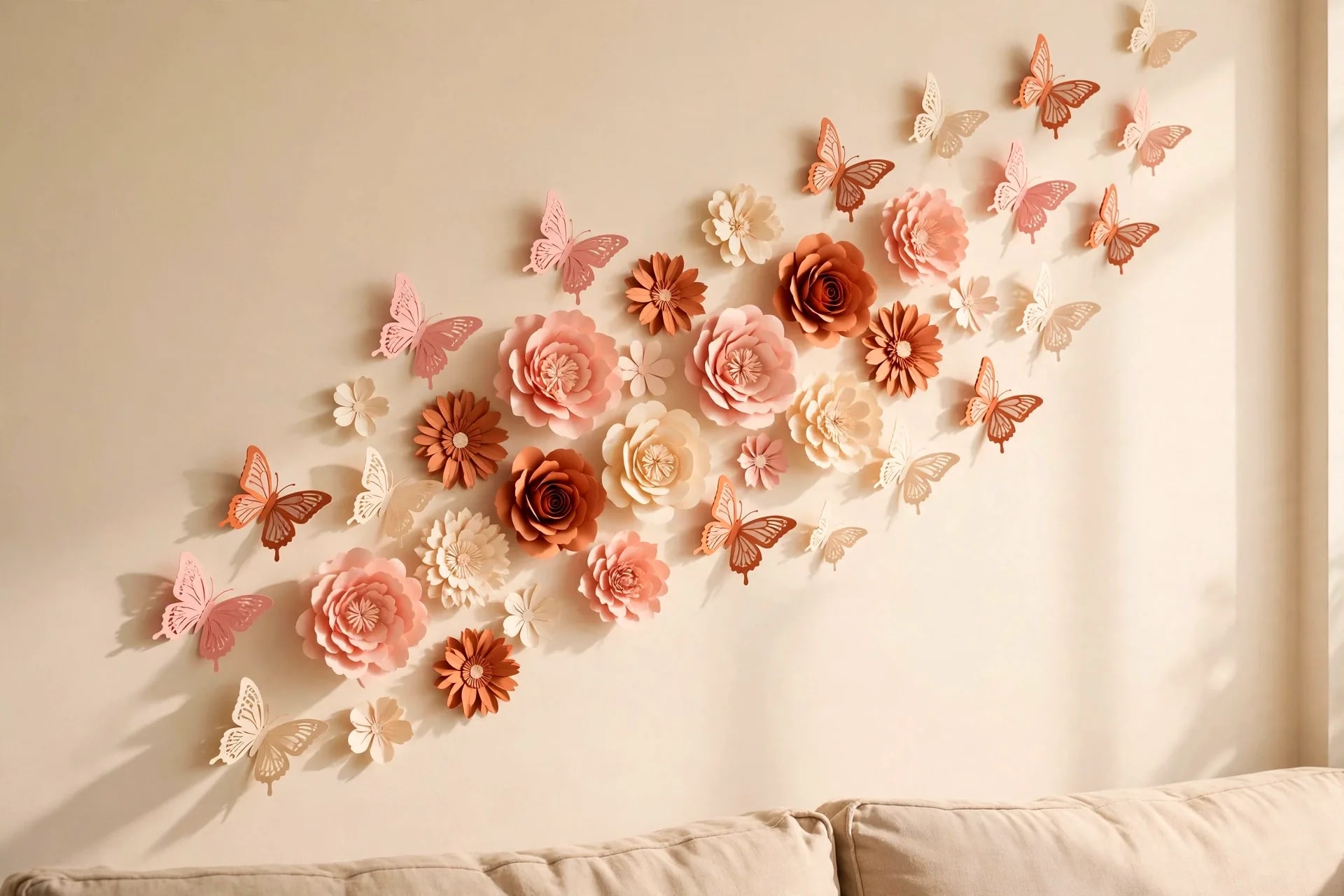
Paper is the most underestimated wall decor material in the house. It costs almost nothing, comes in every colour, and forgives mistakes — a miscut sheet goes in the recycling, not the bin of expensive regrets. Done well, it looks genuinely beautiful, not craft-fair amateur: the secret is large shapes, a limited palette and a planned layout.
That is the difference between paper decor that looks cheap and paper decor that looks designed. Make pieces big — flowers 15 to 25 centimetres across, butterflies with a 12 to 18 centimetre wingspan — limit the palette to two or three colours plus cream, and plan the layout on the wall with templates before anything gets stuck up, the same way you would plan a gallery wall.
This guide teaches twelve projects properly, with materials, costs, times, difficulty and finished sizes, plus a full 3D paper flower tutorial and the renter-safe hanging and durability advice the top-ranking articles skip entirely.
Key Takeaways
- Paper decor looks designed when pieces are large, the palette is limited to two or three colours, and the layout is planned first.
- Card stock between 160 and 250 gsm holds a 3D shape; ordinary printer paper flops within days.
- Removable adhesive dots hold paper on smooth painted walls without damage, but test one piece first.
- Paper lasts years indoors away from direct sun and humidity; sunlight fades colour within months.
- One statement wall of paper flowers or butterflies costs under £15 and takes an afternoon.
In this guide:
- Paper types and tools that matter
- Plan the layout before you cut
- 12 DIY paper wall decor projects
- Step by step 3D paper flower wall
- Sizing paper decor for small and large walls
- Renter safe hanging and removal
- How long paper decor lasts
- Common mistakes and fixes
- FAQ
Paper types and tools that matter
Paper weight decides whether your project holds its shape. Ordinary printer paper at 80 gsm suits flat snowflakes and garlands, but 3D flowers, butterflies and pinwheels need card stock between 160 and 250 gsm: heavy enough to hold a curl, light enough to cut cleanly. Construction paper suits children's projects, but its colours fade faster. For a wall you want to keep for a year or more, choose coloured card stock or scrapbook paper, and keep a spare sheet of each colour for repairs.
Tools are simple: sharp scissors or a craft knife with a mat, a ruler, a pencil, a hot glue gun for 3D shapes, double-sided tape for flat pieces, and removable adhesive dots for hanging. A spoon handle curls petals without tearing them. A cutting machine is a luxury: every project here has a scissors-only version.
Buy paper by the pack: one large flower takes three to five sheets, and fifteen flowers take 45 to 75. Packs of 50 sheets cost around £4 to £7 per colour, so a three-colour wall costs roughly £12 to £20 plus glue. Keep offcuts for leaves and small pieces.
Plan the layout before you cut
Paper decor goes wrong at the layout stage more than the cutting stage. Before cutting anything, decide the shape of the whole arrangement: a diagonal cluster rising from a sofa corner, a symmetrical arch above a bed, a horizontal garland line, or a grid of identical pieces. Diagonal clusters suit flowers and butterflies best, because they mimic how flowers and insects scatter; symmetrical grids suit pinwheels, fans and hearts, where repetition is the point.
Mark the arrangement on the wall with tape outlines or templates, then check it from the doorway: it should read as one arrangement from across the room. Above a sofa, span two thirds of the sofa width with the lowest piece at least 20 centimetres above the back; above a bed, centre on the bed and keep pieces clear of pillows.
Choose your palette before you cut: two colours plus cream — blush pink, terracotta and cream, or sage, mustard and cream — with an ombre fade for depth. Cut in one session, because dye lots vary and a second pack of "the same" pink may not match.

12 DIY paper wall decor projects
Costs assume paper packs and basic tools are bought once and shared across projects. Times are for one finished wall arrangement, not a single piece.
1. 3D layered paper flowers
Layered petals in three sizes, curled outward and glued at the centre. Cost around £12 to £20 for twelve to fifteen flowers. Time three to four hours. Difficulty easy. Full tutorial below.
2. Paper butterfly cluster
Butterflies folded so wings lift off the wall, arranged diagonally as if flying upward. Cost around £8 to £15. Time two to three hours for twenty to thirty butterflies. Vary wingspans from 10 to 18 centimetres.
3. Ombre paper heart wall
Hearts in one colour fading dark to light, in rows or one large heart shape. Cost around £8 to £12. Time two hours for forty to sixty hearts. Cut hearts 10 to 15 centimetres tall.
4. Paper pinwheel wall
Pinwheels in two sizes, pinned at their centres so they spin gently in a draught. Cost around £10 to £16. Time two to three hours for twelve pinwheels. Use a brad at the centre, never glue alone.
5. Folded paper fans
Accordion-folded fans in graduated sizes, overlapped like scales. Cost around £8 to £14. Time two hours for ten to twelve fans.
6. Giant geometric paper heart
One oversized faceted heart, 60 to 90 centimetres tall, from folded triangles on card backing. Cost around £6 to £10. Time two hours. Difficulty medium.
7. Paper quilled monogram
A letter shape filled with rolled paper coils in one or two colours, mounted on card. Cost around £8 to £12. Time three to four hours. Difficulty medium. Cut quilling strips from card stock if you have no kit.
8. Upcycled newspaper and book-page wall art
Old book pages, maps or newspapers cut into flowers, leaves or a collage. Cost around £2 to £5. Time two to three hours. Seal with matte varnish to slow yellowing, and keep out of direct sun.
9. Paper cut silhouette art
One sheet cut with a craft knife into a tree, skyline or botanical silhouette, mounted on contrasting card in a frame. Cost around £5 to £8. Time one to two hours. Difficulty medium. Leave 1 centimetre of border uncut so the sheet holds together.
10. Paper garland swag
Strung circles, leaves, stars or tassels on thread across a wall or window. Cost around £5 to £10. Time one to two hours. Space shapes 8 to 12 centimetres apart so the garland drapes.
11. 3D folded diamond wall art
Folded diamond shapes in graduated tones, in a grid or scattered cluster. Cost around £10 to £15. Time three hours for twenty diamonds. Difficulty medium. Score folds with a ruler before folding for crisp edges.
12. Paper flower medallion
One large circular medallion of layered petals, 50 to 70 centimetres across, as a single statement piece. Cost around £6 to £10. Time two hours. Mount on a card circle so it hangs and comes down as one piece.
Step by step 3D paper flower wall
Choose three colours plus cream in 160 to 250 gsm card. For each large flower, cut five petals in three sizes: large about 14 centimetres, medium 11, small 8. Round tips for roses, point them for dahlias. Curl each petal around a pencil — large petals least, small most — so the flower opens toward the centre.
Glue large petals in a ring on an 8-centimetre card circle, overlapping each by a third. Add the medium ring, then the small ring, then a rolled centre, and let each flower dry flat for 10 minutes. Make three sizes — large 22 to 25 centimetres, medium 16 to 18, small 10 to 12 — with twice as many medium flowers as large ones to fill gaps.
Lay the flowers on the floor in the cluster shape, largest at the centre or lower edge, smallest at the fading outer edges. Photograph the layout, transfer it to the wall starting with the largest flowers, and attach each with two adhesive dots pressed for 30 seconds. A fifteen-flower wall takes three to four hours and costs under £20.
Sizing paper decor for small and large walls
Paper decor scales by wall, not by project. On a small hallway wall, one medallion or five to seven flowers spanning 60 to 80 centimetres is enough. Above a sofa, span two thirds of the sofa width — typically 120 to 150 centimetres, fifteen to twenty pieces. On a very large wall, repeat the cluster twice with a gap between.
With ceilings under 240 centimetres, keep decor in the upper half of the wall with a 20-centimetre gap below the ceiling line. Mark the outline with tape and count pieces against it before cutting — running out halfway is the most common reason paper walls get abandoned.

Renter safe hanging and removal
Paper is the renter's ideal wall decor because it weighs almost nothing, so adhesives that fail for framed art work perfectly here. Removable adhesive dots hold a paper flower on smooth painted walls, and removable strips hold a framed silhouette. Clean the wall with a dry cloth first — dust is what makes adhesive fail — press for 30 seconds, and wait an hour before adjusting. For heavier medallions on card backing, use two strips rated for 1 kilogram each, even though the piece weighs far less, because the margin covers humidity and temperature changes.
For removal, peel dots slowly at a low angle along the wall, warming stubborn dots with a hairdryer on low. Never use adhesive on fresh paint under 30 days old, textured walls or wallpaper. Test one dot behind a door for 48 hours first. See the renter-friendly wall decor guide for more deposit-safe methods.
How long paper decor lasts
Indoors, away from direct sun and damp, paper decor lasts two to five years, and framed paper art far longer behind glass. The enemies are sunlight, humidity and dust. Direct sunlight fades coloured card within months on a south-facing wall, so keep paper walls on north or east walls, or frame pieces behind UV-filtering glass where sun is unavoidable. Humidity softens card and encourages curling, so avoid unventilated bathroom walls and kitchen walls directly above a hob.
Dust is the easiest enemy: a soft duster or cool hairdryer every month or two keeps pieces fresh, and matte varnish slows yellowing on newspaper art. Replace single faded flowers from spare sheets.
Common mistakes and fixes
The most common mistake is pieces too small: paper shapes under 10 centimetres across disappear from across a room, so scale up — flowers 15 to 25 centimetres, butterflies 12 to 18 centimetres wingspan, hearts 10 to 15 centimetres tall. Second, too many colours: limit the palette to two or three plus cream, and the wall instantly looks designed. Third, random spacing, which reads as clutter: plan an outline with even gaps, denser at the centre and sparser at the edges.
Fourth, weak paper: printer paper flops, so use card stock for 3D shapes. Fifth, adhesive failure: clean the wall, use two dots per flower, wait the full hour. Sixth, sun fading: move it, frame it behind glass, or replace it yearly — still far cheaper than framed art.
FAQ
What paper is best for 3D wall flowers? Coloured card stock between 160 and 250 gsm. It holds a curl without cracking, cuts cleanly, and keeps its shape for years indoors. Ordinary 80 gsm printer paper flops and curls within days.
How do I hang paper wall decor without damaging paint? Use removable adhesive dots or strips on smooth, clean painted walls, press for 30 seconds, and wait an hour before adjusting. Peel slowly at a low angle for removal, and test one dot for 48 hours behind a door first. Avoid fresh paint under 30 days old and textured walls.
How many paper flowers do I need above a sofa? Fifteen to twenty flowers in mixed sizes, spanning roughly two thirds of the sofa width — typically 120 to 150 centimetres. Make twice as many medium flowers as large ones, and keep the lowest flower at least 20 centimetres above the sofa back.
Does paper wall decor fade? Yes, in direct sunlight, within months on a south-facing wall. Keep paper art on north or east walls, frame pieces behind glass where sun is unavoidable, or treat the wall as seasonal and replace faded pieces from spare sheets.
Can I make paper wall decor without a cutting machine? Yes. Every project here works with scissors, a ruler and printed or hand-drawn templates at the sizes given. A cutting machine speeds up repeated shapes but is not required.
Is paper wall decor safe around children and pets? Yes, with two cautions: keep small pieces out of reach of toddlers, and hang the arrangement high enough that pets cannot pull it down. Hot glue should be fully cooled and hidden behind pieces before hanging.
Paper wall decor rewards the same discipline as any good design: big shapes, few colours, a planned layout. Start with one flower wall in one room, keep spare sheets for repairs, and you will have a feature wall for under £20 that guests assume cost ten times as much.