Small living rooms don't have a storage problem — they have a visible stuff problem. The fix isn't more square meters; it's making every piece of furniture work twice and using the vertical space you're ignoring. These 10 ideas come with real dimensions and costs, and they build on our small living room guide — read that first for the layout fundamentals. Every idea below was chosen for small rooms specifically: no McMansion solutions, no "just add a closet."
Key Takeaways
- The rule: every new item needs a home before it enters the room — storage fails without the declutter habit
- Biggest wins: storage ottoman, behind-sofa console, floor-to-ceiling shelving on one wall
- Budget range: $0 (rearrange what you own) to $150 per solution
- The measurement that matters: 25 cm under-sofa clearance fits standard storage bins; less doesn't
- Vertical > horizontal: walls are free square footage you're not using
In this guide:
- The declutter rule (read this first)
- The 20-minute storage audit
- 10 storage ideas with real dimensions
- The 60% shelf rule
- 5 storage mistakes
- The takeaway
- Frequently asked questions
The declutter rule (read this first)
No storage solution survives clutter creep. Before buying anything: remove everything from the room that doesn't belong there, then assign every remaining item a home. The rule going forward — one in, one out. A new throw blanket means an old one leaves. Bins and shelves can organize what you own; they can't absorb an endless inflow. Cap the collection, and the storage works.
The 20-minute storage audit
Before buying anything, diagnose. Walk your living room with a notepad and answer three questions:
- What's homeless? List every item sitting on a surface or floor that has no designated spot. These are your storage gaps — each one needs a home, not a bigger room.
- What's visible but ugly? Cables, remotes, paperwork, chargers. These need closed storage (doors, lids, baskets) — open shelves won't fix them.
- What's vertical space doing? Look at every wall above 1.2 m. If it's empty, that's your cheapest new storage — shelving costs less than furniture and uses zero floor.
Most audits reveal the same pattern: 5–10 homeless items, a cable situation, and two empty walls. That maps to exactly three purchases: one closed piece (ottoman/bench), one vertical piece (shelf), and cable management. Total: $100–$200 for a complete system.
10 storage ideas with real dimensions
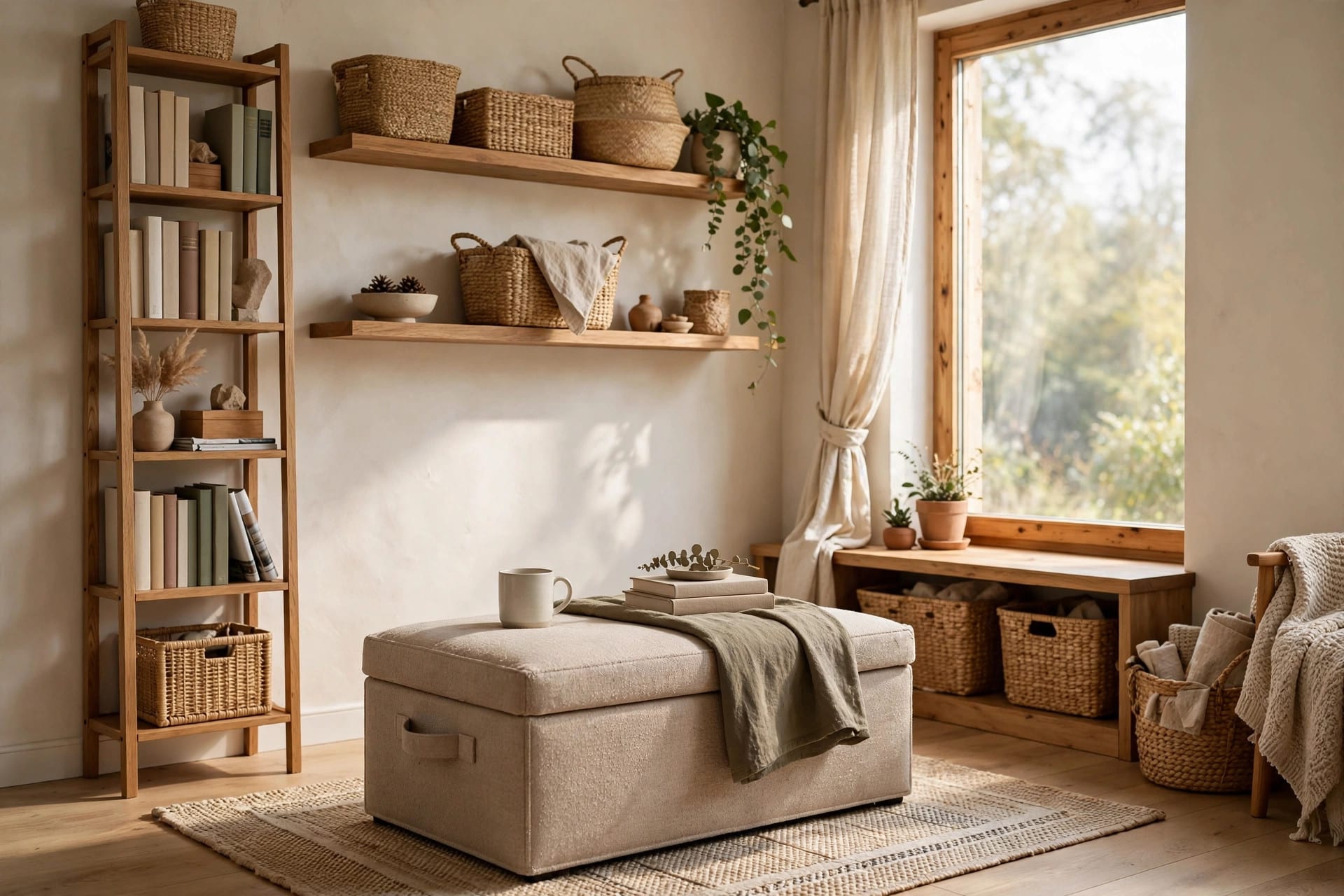
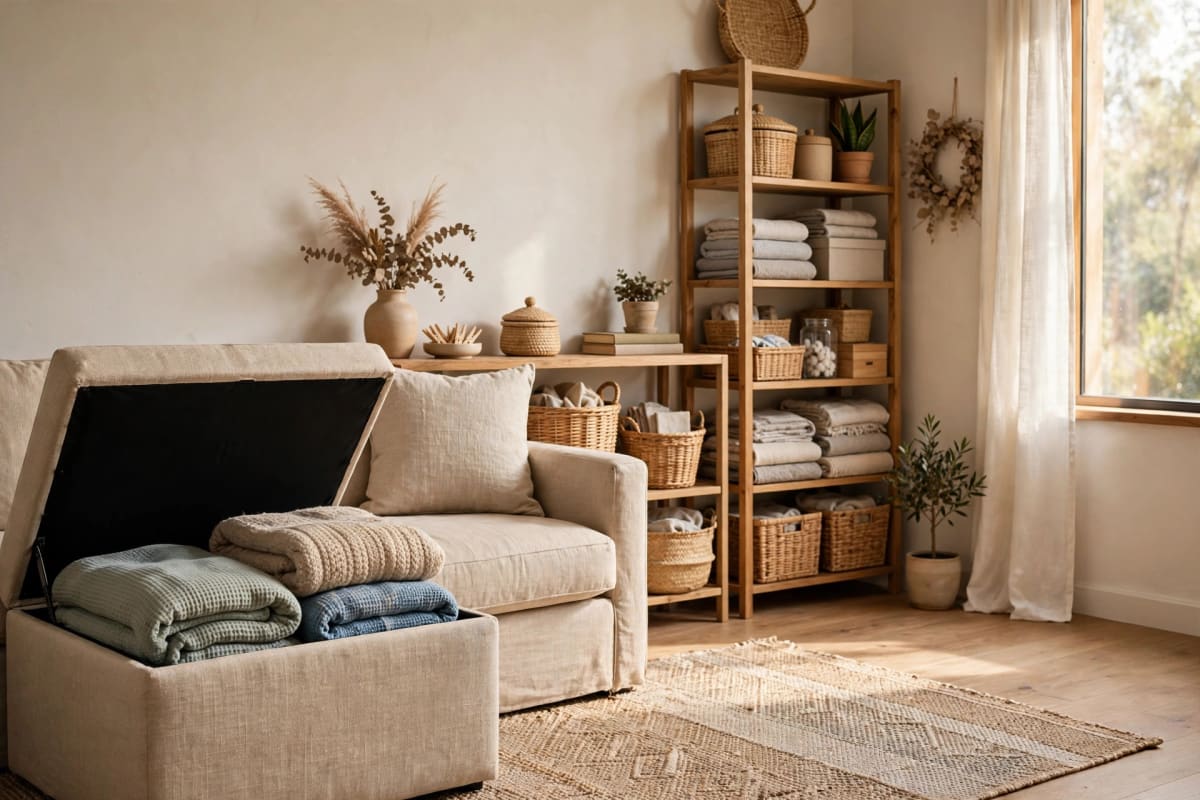
1. Storage ottoman as coffee table. A 90×60 cm storage ottoman replaces the coffee table and swallows blankets, remotes, chargers, and board games. Cost: $60–$120. This is the single highest-ROI storage purchase for a small living room — it stores as much as a small dresser while serving as seating and table. Best for: blanket/remotes/charger chaos — the everyday visible clutter.
2. Behind-sofa console. The 15–25 cm gap behind a floated sofa is dead space — fill it with a slim console (25–30 cm deep, sofa-width). Holds books, baskets, a lamp, and charging station. Cost: $40–$90. (Pairs with the float-your-furniture layout in our TV layout guide.) Best for: books, baskets, and giving the sofa a "finished" back view.
3. Floor-to-ceiling shelving, one wall. A single 80 cm-wide tower shelf from floor to ceiling adds roughly 2 square meters of storage while occupying 0.3 square meters of floor. Cost: $50–$150. One tall unit beats three short ones — it draws the eye up and makes ceilings feel higher. Best for: book collections, display + storage combos.
4. Under-sofa bins. If your sofa has 25+ cm clearance, flat storage bins (60×40×18 cm) slide underneath for seasonal items, wrapping paper, or rarely-used electronics. Measure first — many modern sofas sit at 10–15 cm, which fits nothing. Cost: $8–$15 per bin. Best for: seasonal items and things you need twice a year.
5. Lift-top coffee table. The tabletop lifts and slides toward you for laptop work or dining, revealing a deep storage well underneath. Cost: $80–$150. Ideal if the living room doubles as a home office — the work setup vanishes at 6 PM. Best for: work-from-home in the living room.
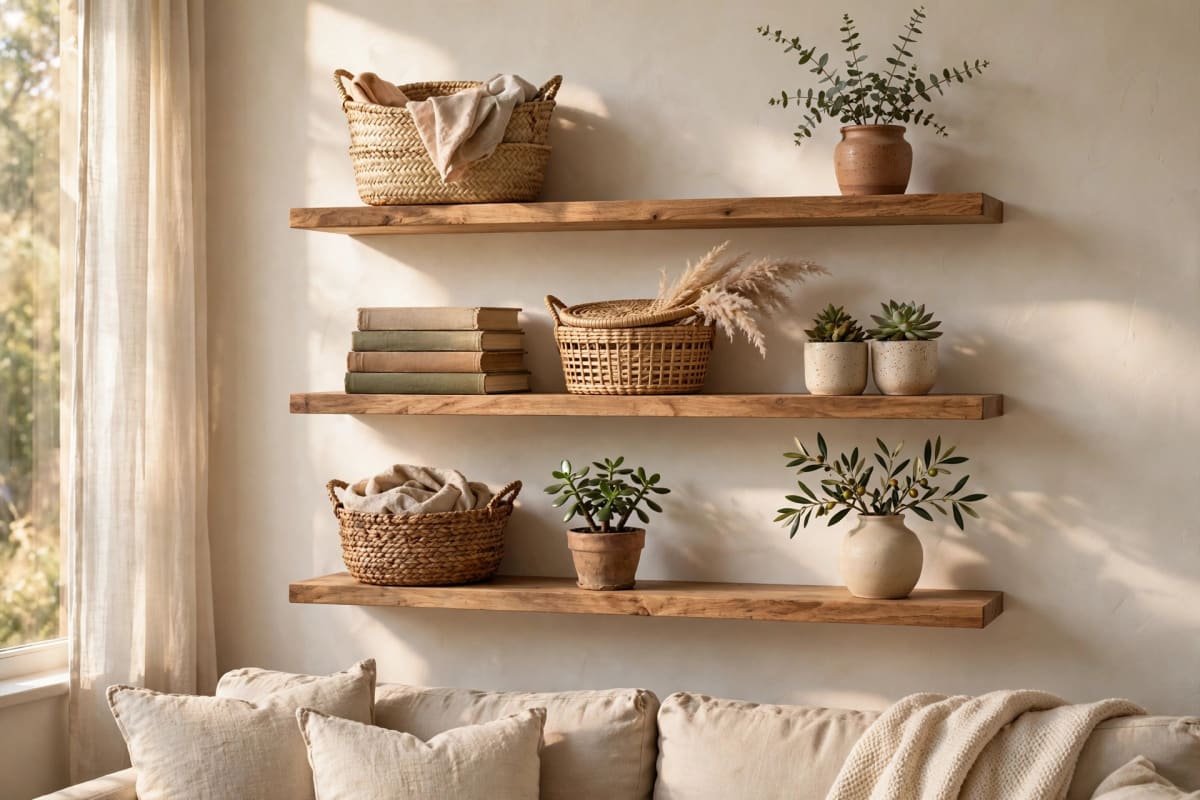
6. Floating shelves above the sofa. Two 120 cm floating shelves at 30 cm and 60 cm above the sofa back hold books, plants, and decor without touching the floor. Keep to the 60% rule below. Cost: $20–$40 for both. Best for: books and decor that deserve display.
7. Corner cabinet. Corners waste ~0.5 square meters in most layouts. A corner cabinet or triangular shelf unit reclaims it for media, games, or bar supplies. Cost: $50–$100. Best for: media equipment and the awkward corner nothing fits in.
8. Storage bench under the window. A 120 cm bench under the window = seating + hidden storage + a styled surface. The window wall is often the least-used wall in the room. Cost: $70–$130. Best for: extra seating that doesn't look like storage.
9. Over-door and wall hooks. The back of the living room door and short wall runs take hooks for bags, headphones, throws. Five adhesive or screw-in hooks = five items off surfaces. Cost: $10–$20. Best for: bags, headphones, and daily-grab items.
10. Nesting side tables. Two tables that tuck into one footprint — pull out the second when guests come, tuck it away daily. The nested table can hold a basket underneath for its own storage. Cost: $40–$80. Best for: flexible surfaces in tight layouts.
The 60% shelf rule
Open shelving fails when it's full. Keep shelves at 60% capacity maximum — the empty 40% is what makes it look styled instead of stuffed. Achieve it with:
- Baskets and lidded boxes for the ugly-but-necessary (chargers, remotes, paperwork)
- Books shelved both vertically and in horizontal stacks (visual rhythm)
- One empty stretch per shelf — negative space is a design element
Closed storage (cabinets, ottomans, bins) can go to 100% — nobody sees inside. The 60% rule is only for what's visible.
5 storage mistakes
- Buying storage before decluttering. New bins just organize clutter instead of eliminating it. Purge first, measure second, buy third.
- Too many small organizers. Ten tiny baskets cost more and hold less than one right-sized piece. Consolidate.
- Ignoring the vertical 60%. Most living rooms use only the bottom 1.2 m of wall height. The space above is free — shelve it.
- Storage that blocks flow. A cabinet in the walkway (under 75 cm clearance) makes the room feel smaller than the clutter did. Measure walkways before placing anything.
- Open storage for ugly things. Cables, remotes, and paperwork need doors. If it can't be styled, it needs to be hidden.
The takeaway
Small living room storage is a system, not a product: declutter first, then add 2–3 of these ideas (ottoman + one vertical solution + one hidden solution covers 80% of needs). Measure your clearances, respect the 60% shelf rule, and keep the one-in-one-out habit. The room will feel twice as big — not because it gained space, but because it stopped showing you everything it owns.
Frequently asked questions
What is the best storage for a small living room? A storage ottoman used as the coffee table — it replaces existing furniture (no new footprint) while adding dresser-scale hidden storage. Pair it with one vertical solution (tall shelf) for the complete system.
How do you store blankets in a small living room? Storage ottoman, lidded basket, or a blanket ladder on the wall. Fold thick throws in thirds for neat stacking. Avoid draping more than one throw over furniture — it reads as clutter fast.
Where do you put things when there's no storage space? Go vertical (walls are unused square footage), go hidden (ottomans, benches, under-sofa bins), and go behind (the gap behind a floated sofa fits a slim console). If all three are full, the answer is decluttering, not more storage.
Should I get built-in or freestanding storage? Freestanding for renters and the budget-conscious (it moves with you, costs less). Built-ins for owners maximizing awkward spaces. Most small living rooms do best with a mix: freestanding furniture + wall-mounted shelves.
How do I hide TV cables in a small living room? A media console with cable openings and ventilation, plus adhesive cable channels painted to match the wall. Surrounding the TV with shelves or cabinets hides both the cables and the visual bulk of the screen.
What if I can't afford new storage furniture? Rearrange first: the audit often reveals you're storing things in the wrong place. Then go free/cheap: declutter (removes the need), repurpose (dresser as media console), and thrift (storage ottomans are common secondhand). Under-sofa bins at $8 each are the cheapest real storage you can buy.
How much storage does a small living room actually need? Less than you think. The audit's "homeless items" list is the true requirement — usually 5–10 items needing homes. One ottoman + one shelf + cable management covers it for most rooms. If you're buying a fourth storage piece, you're probably avoiding a declutter decision.