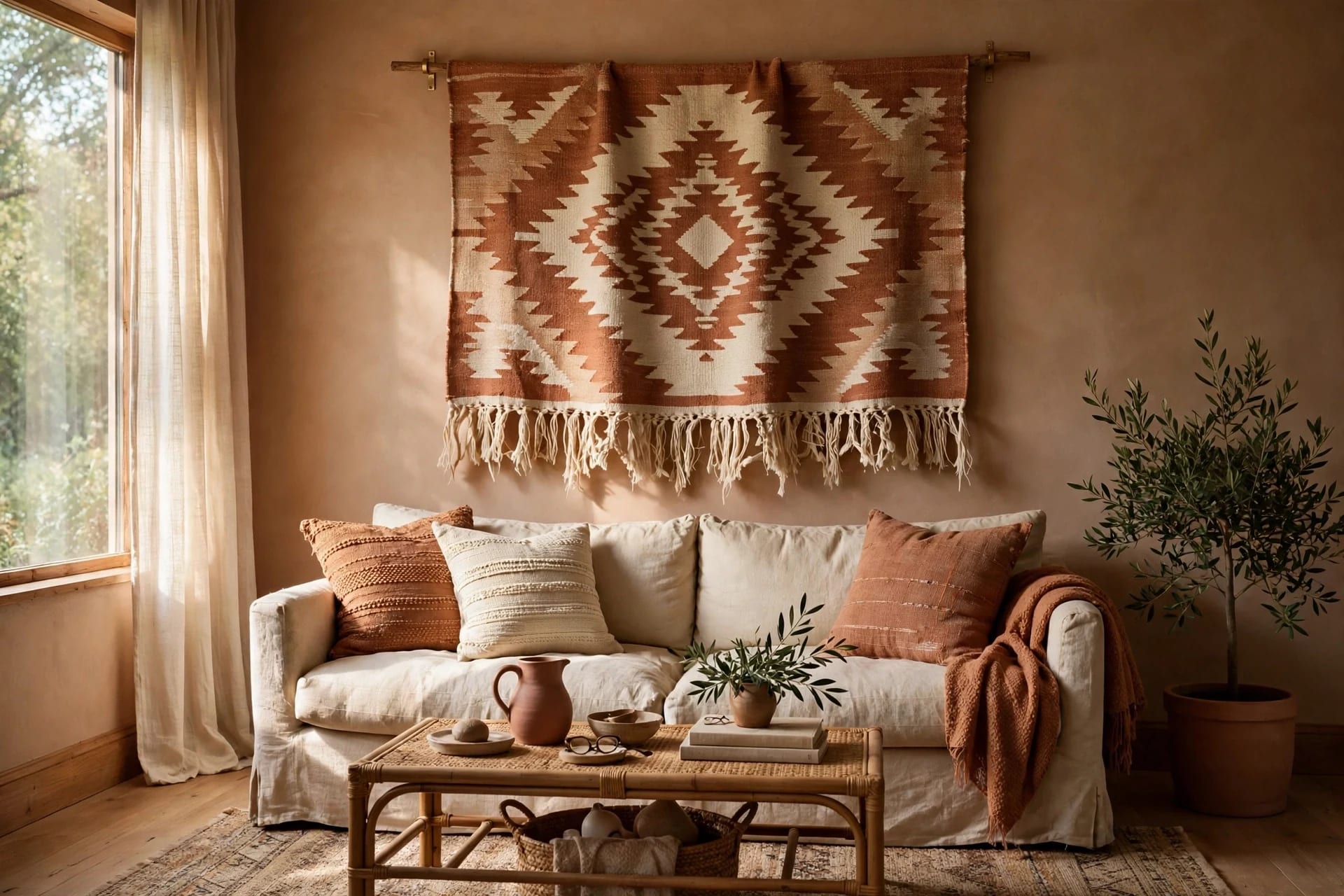
A tapestry does three jobs no frame can: it covers a serious amount of wall for very little money, it softens a room's sound and feel in a way hard decor never does, and it hangs with zero commitment — fold it up and the wall is bare again. What it doesn't forgive is being hung carelessly. Fabric hung from two points sags, curls and cheapens itself within months; fabric hung properly looks like the oldest, most intentional decor in the house — which, historically, it is.
Key Takeaways
- Size: above a sofa, a tapestry should span about ⅔ to ¾ of the sofa's width; when in doubt, go bigger
- Under 5 lbs: clips, adhesive hooks or hook-and-loop work. 5–15 lbs: rod + sleeve. Over 15 lbs: a wall batten
- A rod sleeve spreads the load across the whole top edge — point-hanging is what tears and sags fabric
- Block before hanging: mist, lay flat, square it up, let it dry — this is the anti-sag step
Table of Contents
- Choosing: size, fabric and style
- Hanging methods by weight
- The rod sleeve, including the no-sew version
- Blocking: fixing the sag and the curl
- Damage-free and renter options
- Care: dust, light and washing
- FAQ
Choosing: size, fabric and style
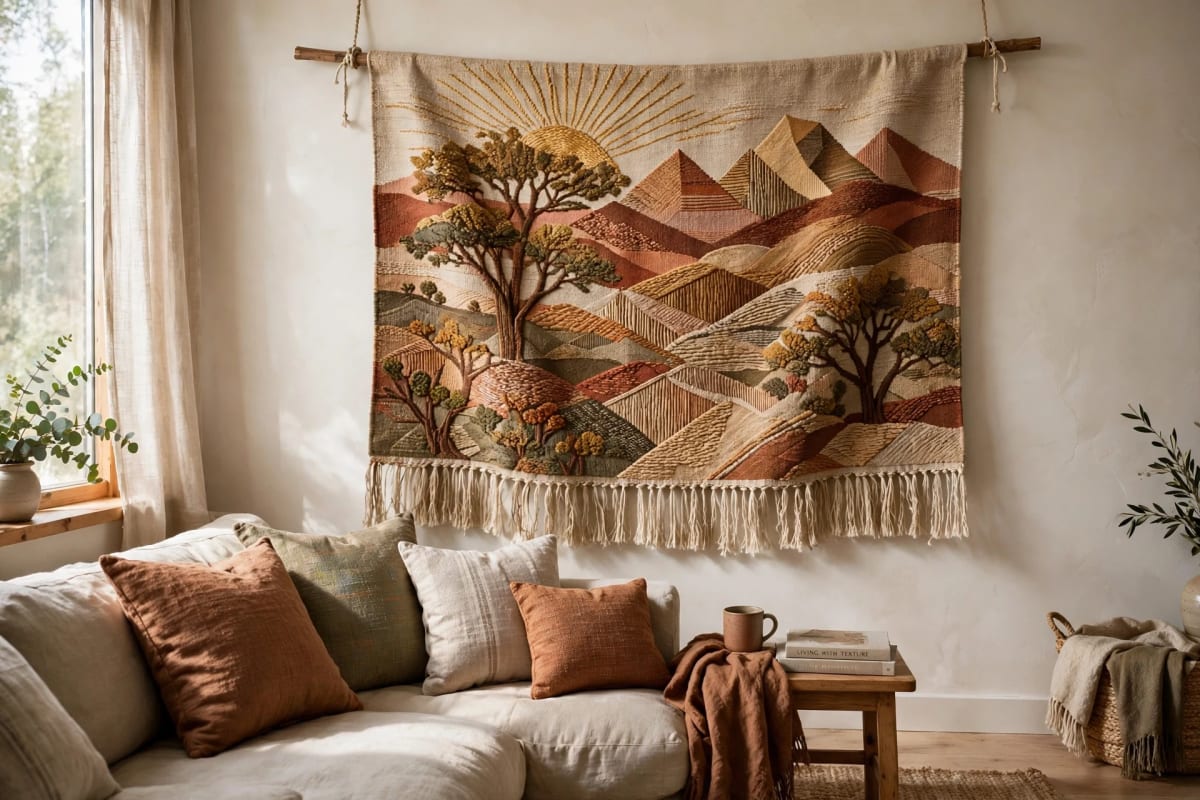
Undersizing is the tapestry's endemic disease — a small textile floating on a big wall reads as a tea towel that got lost. Use the artwork rule: over a sofa or bed, the piece should cover roughly two-thirds to three-quarters of the furniture's width. A 84-inch sofa wants a 56–63-inch tapestry; common ready-made sizes (around 51×59 and 59×82 inches) exist precisely because they fit that math. For a standalone wall, treat the tapestry like the statement it is and fill most of the visual field between furniture pieces.
Fabrics sort by weight and temperament:
- Cotton and cotton-blend prints — the budget staple ($20–$60). Light, easy to hang, colors stay bright; also the most prone to curl and fade.
- Woven jacquard — the pattern is woven in, not printed on. Heavier, drapes like it means it, costs more ($80–$300+), reads as a real textile artwork.
- Wool and wool-blend — the warmest visually and acoustically, the heaviest to hang, and moths consider it a restaurant. Cedar and airtight storage in off-seasons.
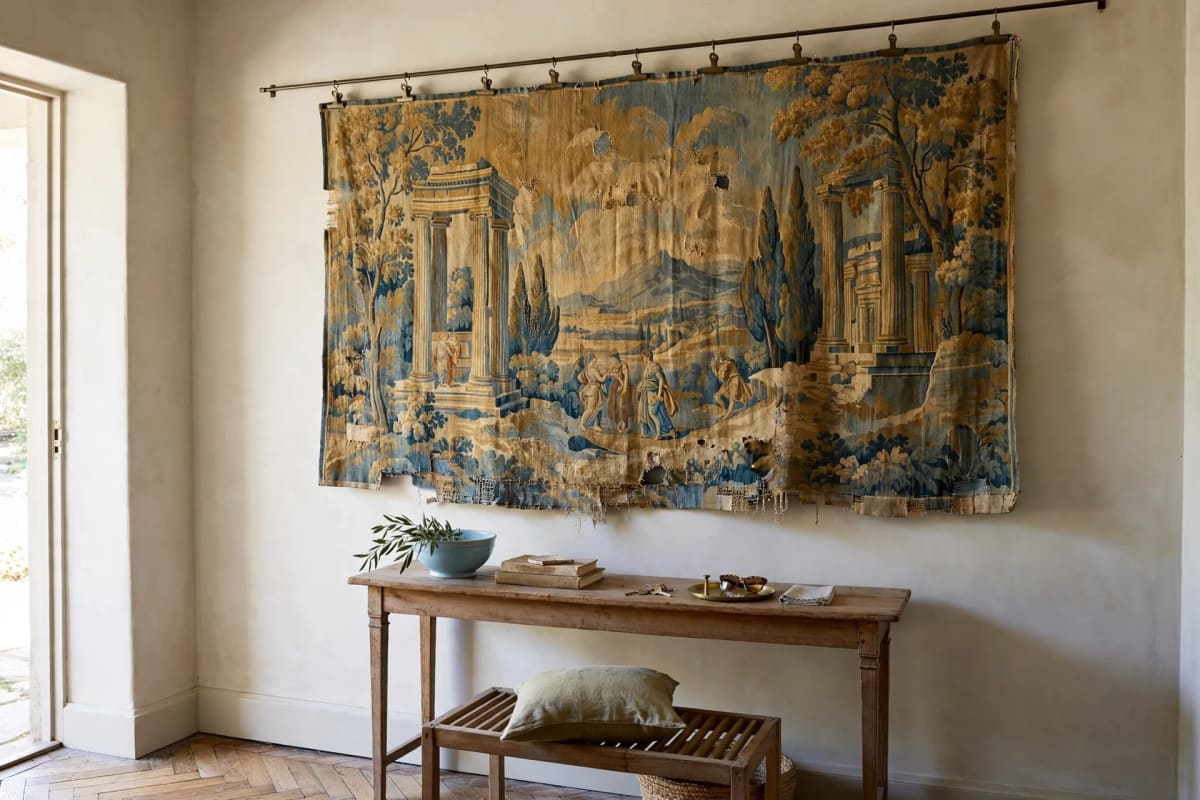
- Vintage and antique pieces — kantha quilts, suzanis, kilims pressed into wall duty: unmatched character, fragile edges, hang them by the most supportive method you have (below) and keep them out of direct sun.
Style-wise, the current wave runs to earthy abstracts, botanical prints, celestial and landscape scenes, and genuine vintage textiles — all of which sit happily beside the woven textures in our basket wall decor guide.
Hanging methods by weight
The method follows the scale, honestly:
- Under ~5 lbs (most printed cotton): decorative clips or clamp hangers along the top edge, binder clips on hooks (the clip grips the fabric; the wall hook carries the clip's wire loop — an industrial look that suits boho prints), hook-and-loop strips with the soft side on the fabric, or adhesive hooks rated well above the weight. Press adhesive strips for a full 30 seconds and give them their cure time before loading — the same discipline as in our damage free wall decor guide.
- 5–15 lbs (jacquard, lined pieces): a rod through a sleeve, with the rod on brackets screwed into studs or proper anchors. This is the default correct method for anything you care about.
- Over 15 lbs (wool, large vintage): a wooden batten screwed to the wall across studs; the tapestry attaches to the batten with hook-and-loop (soft side sewn to the textile, hook side stapled to the batten) or is carefully tacked along its top edge. Weight spread across the batten's whole length — no point loads anywhere.
The rod sleeve, including the no-sew version
A sleeve (rod pocket) is a fabric tunnel sewn along the back of the top edge; the rod slides through it and carries the full width evenly. Many tapestries arrive with one. If yours didn't:
- Sewn: fold a 3–4-inch strip of sturdy cotton along the back top edge and stitch both long edges (leave the ends open). Twenty minutes by machine, under an hour by hand.
- No-sew: iron-on hem tape or fabric glue bonds the same strip for lighter pieces. Respect its limits — this is a sub-5-lb solution wearing a bigger solution's clothes.
- The rod: wooden dowel or a slim curtain rod, cut 2–4 inches wider than the fabric per side. For spans over ~80 inches, step up the dowel's diameter — a thin dowel bows in the middle and the whole piece sags with it. Poplar dowels are the hardware-store bargain: cheap, straight, light.
Blocking: fixing the sag and the curl
Woven fibers relax and take a set — that's why a tapestry that hung flat in month one can ripple by month six. Blocking resets the weave: lay the piece face-down on a clean flat surface, mist the back lightly with water, gently pull it back into a true rectangle (measure the diagonals — equal diagonals mean it's square), pin or weight the edges, and let it dry completely flat before hanging. For creases from shipping, a steamer passed over the hung piece relaxes them in place; go gently, and keep steam brief on synthetic blends, which can shrink or glaze under heat. Curled side edges on printed cotton usually surrender to blocking plus the even tension of a proper rod sleeve.
Damage-free and renter options
Tapestries are the renter's friend precisely because the light ones need almost nothing: two or three adhesive hooks carrying a dowel, clips on adhesive strips, or a tension rod sprung between two facing walls or inside an alcove — zero wall contact at all. Our renter friendly wall decor guide covers the hook weight math; the tapestry-specific caution is to hang the rod from the hooks rather than sticking adhesive directly to fabric, which bonds poorly to fibers and fails at 3 a.m. with maximum drama.
Care: dust, light and washing
- Dust: shake the piece outdoors monthly; vacuum occasionally with a brush attachment through a mesh screen for delicate weaves. Dust left in wool feeds moths — the shaking is pest control as much as cleaning.
- Light: direct sun bleaches dyes unevenly, worst on cotton prints and antique pieces. Hang out of direct sun paths, or rotate the piece's position seasonally. There's no fix for a bleached stripe; there's only prevention.
- Washing: most printed cotton tapestries take a gentle cold machine wash; jacquard and wool pieces go to dry cleaning or careful hand washing, and vintage textiles go to a professional — period. Whatever the method, hang-dry flat-ish and re-block while damp.
- Storage: never fold a good tapestry into a box crease-first and forget it. Roll it (face out, around a tube if you have one), wrap it in a clean cotton sheet rather than plastic, and store it somewhere dry. Off-season storage in an airtight container with cedar is the wool owner's moth insurance; a piece stored folded for a year will spend its first month back on the wall slowly forgetting the creases, and some weaves never entirely do.
FAQ
How high should a tapestry hang? Treat it like artwork: center around 57–60 inches from the floor, or 6–10 inches above the back of the sofa it hangs over. Long pieces can run closer to the floor for a dramatic, gallery drop.
Can I hang a rug as a tapestry? Yes — flatweaves and kilims hang beautifully and it's a classic use for a rug too good for traffic. They count as heavy: batten or a serious rod, into studs. Inspect the edges first; a rug with worn binding will keep unravelling under its own weight.
Why does my tapestry keep curling at the corners? Printed cotton curls toward its print side as humidity swings. Blocking helps; adding a light bottom dowel (a second rod in a bottom sleeve) or discreet corner weights pulls the piece into line permanently.
How do I hang a tapestry on a brick or concrete wall? Masonry anchors for brackets, or adhesive hooks rated for the load on smooth brick. The no-drill champion remains the tension rod in an alcove or between walls.
Are tapestries good for echoey rooms? Noticeably, yes — a large textile is a soft, porous surface, and paired with a rug and upholstered furniture it takes the hard edge off a room's echo. It's the same softening effect layered in our small living room ideas, at wall scale. Thicker weaves absorb more than thin prints — actual fiber depth is what eats the sound, so a jacquard will outperform a printed panel at the same size.