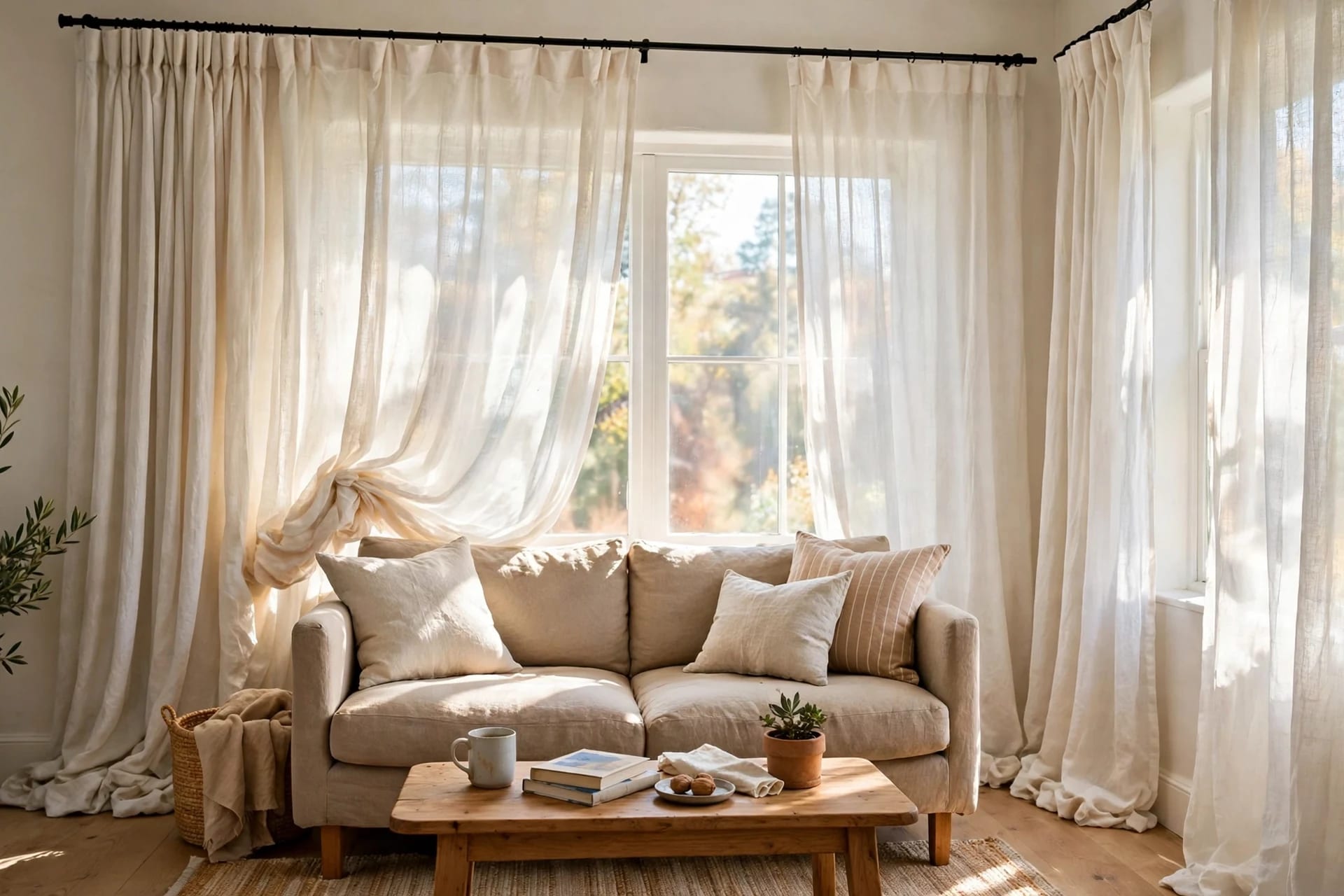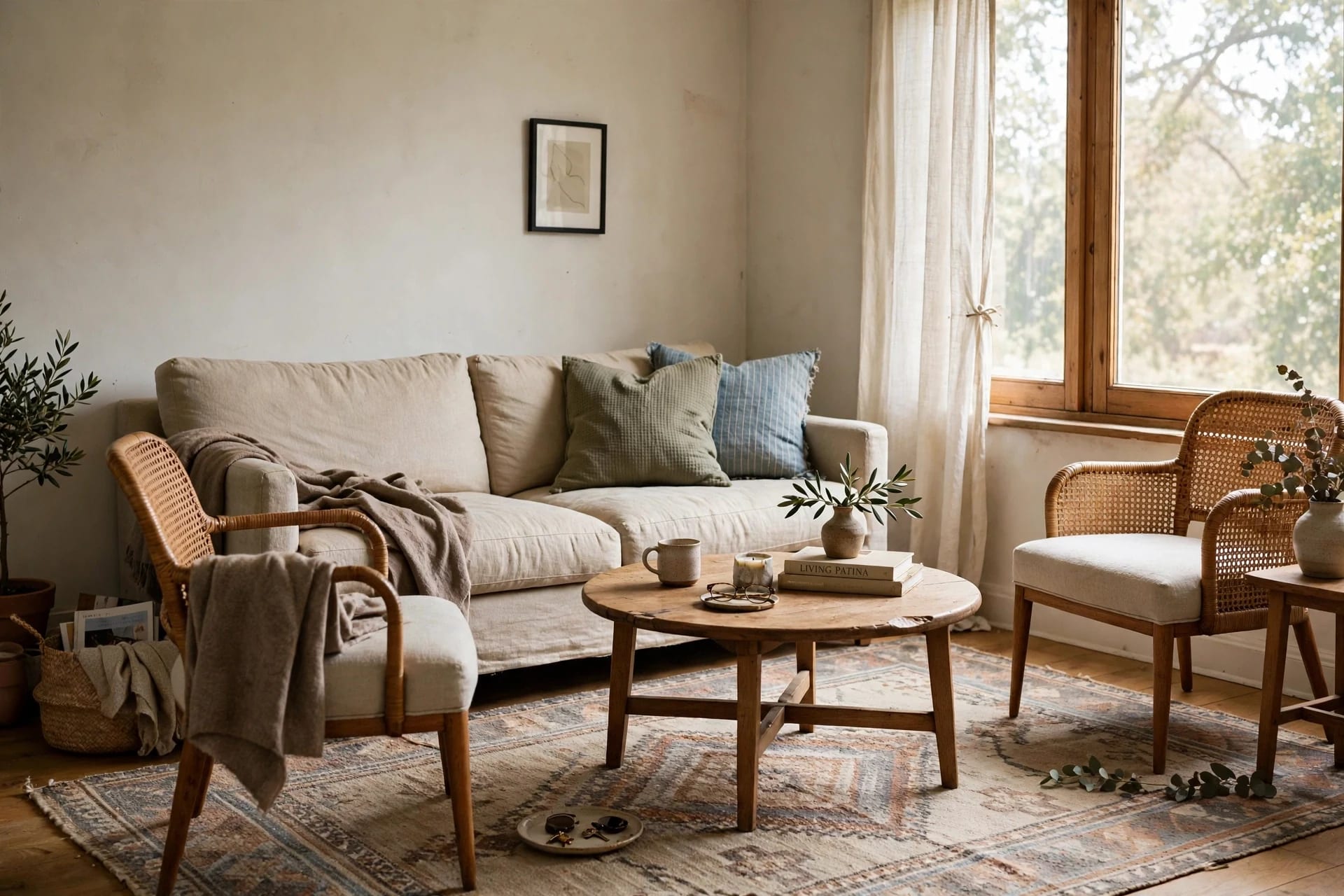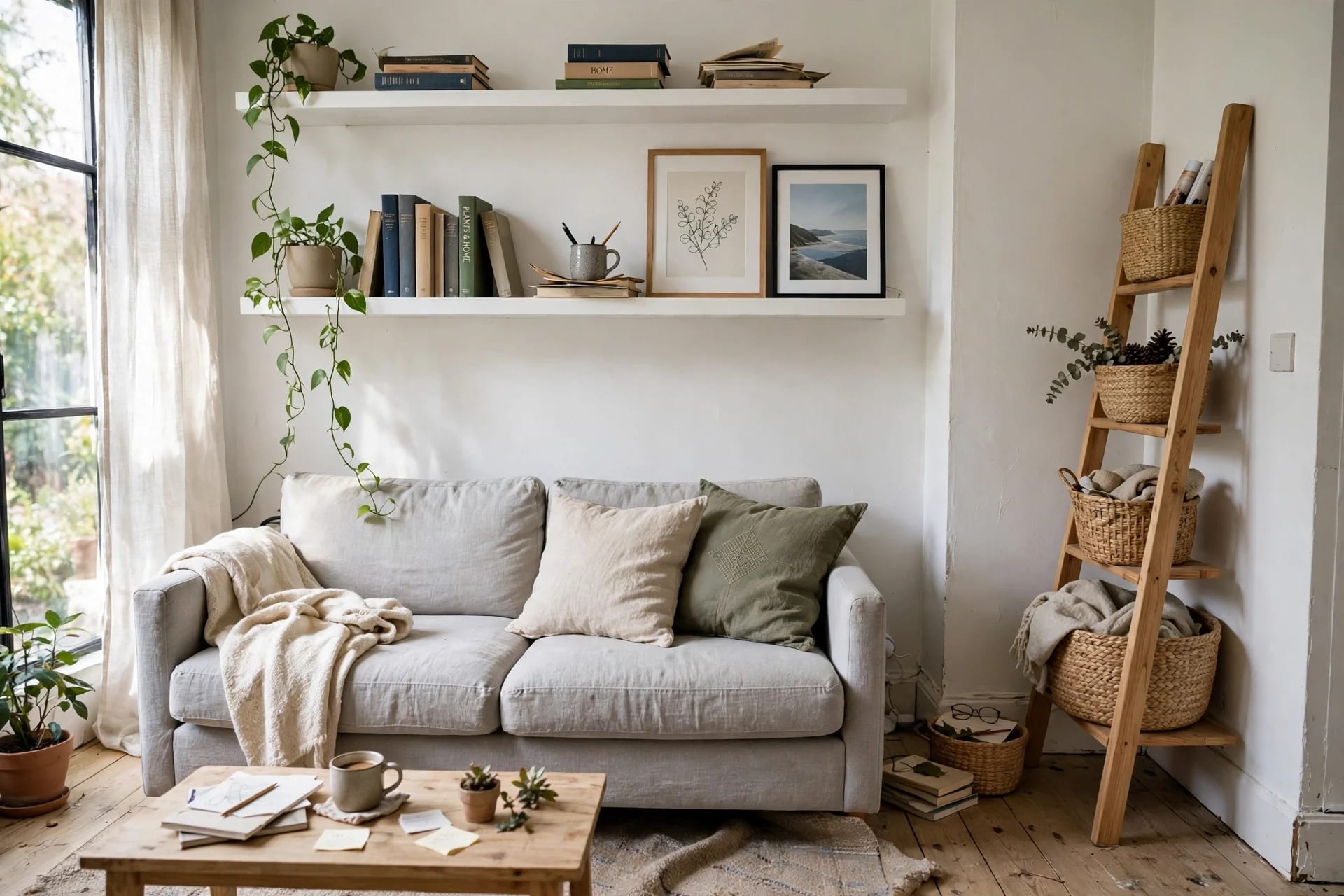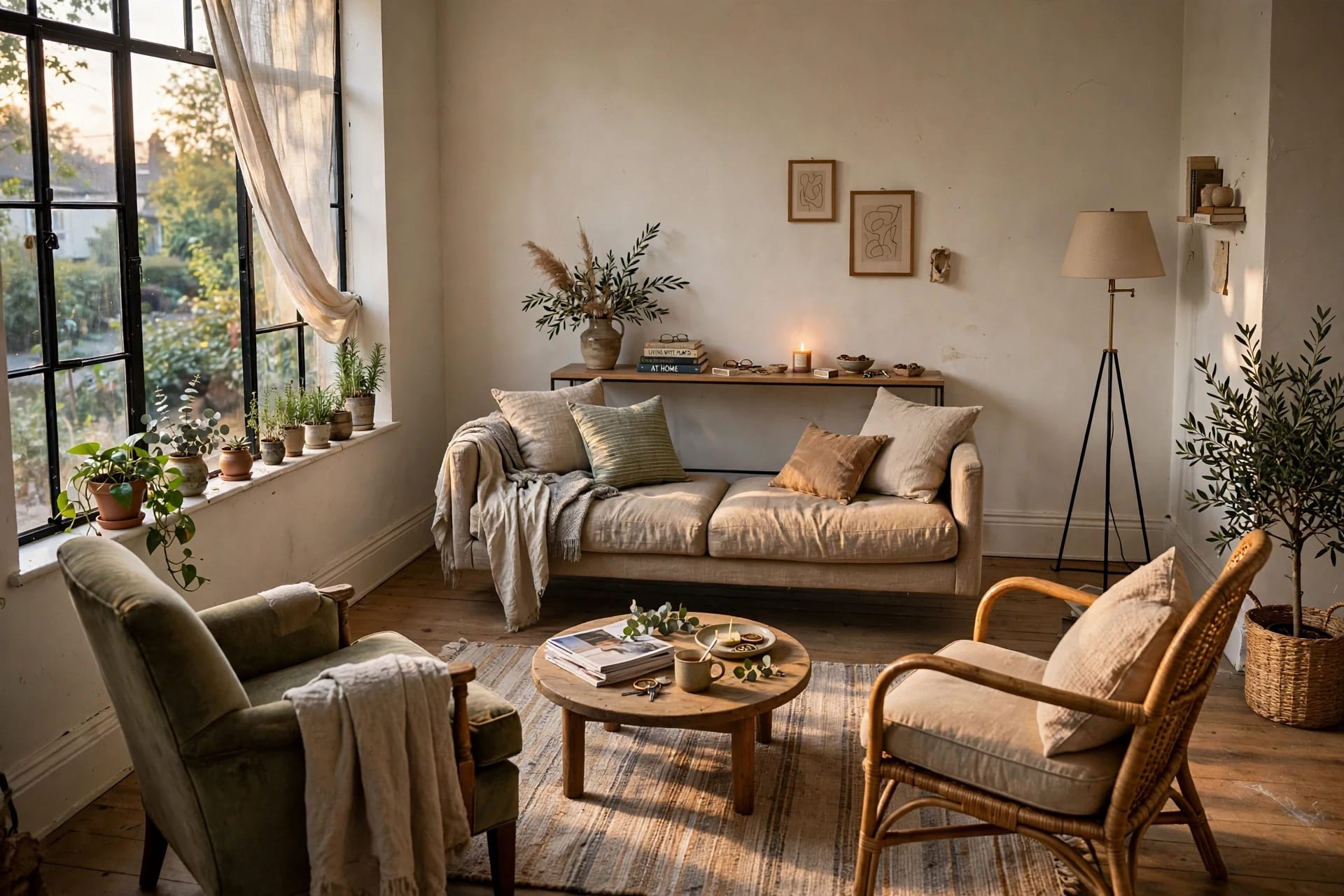
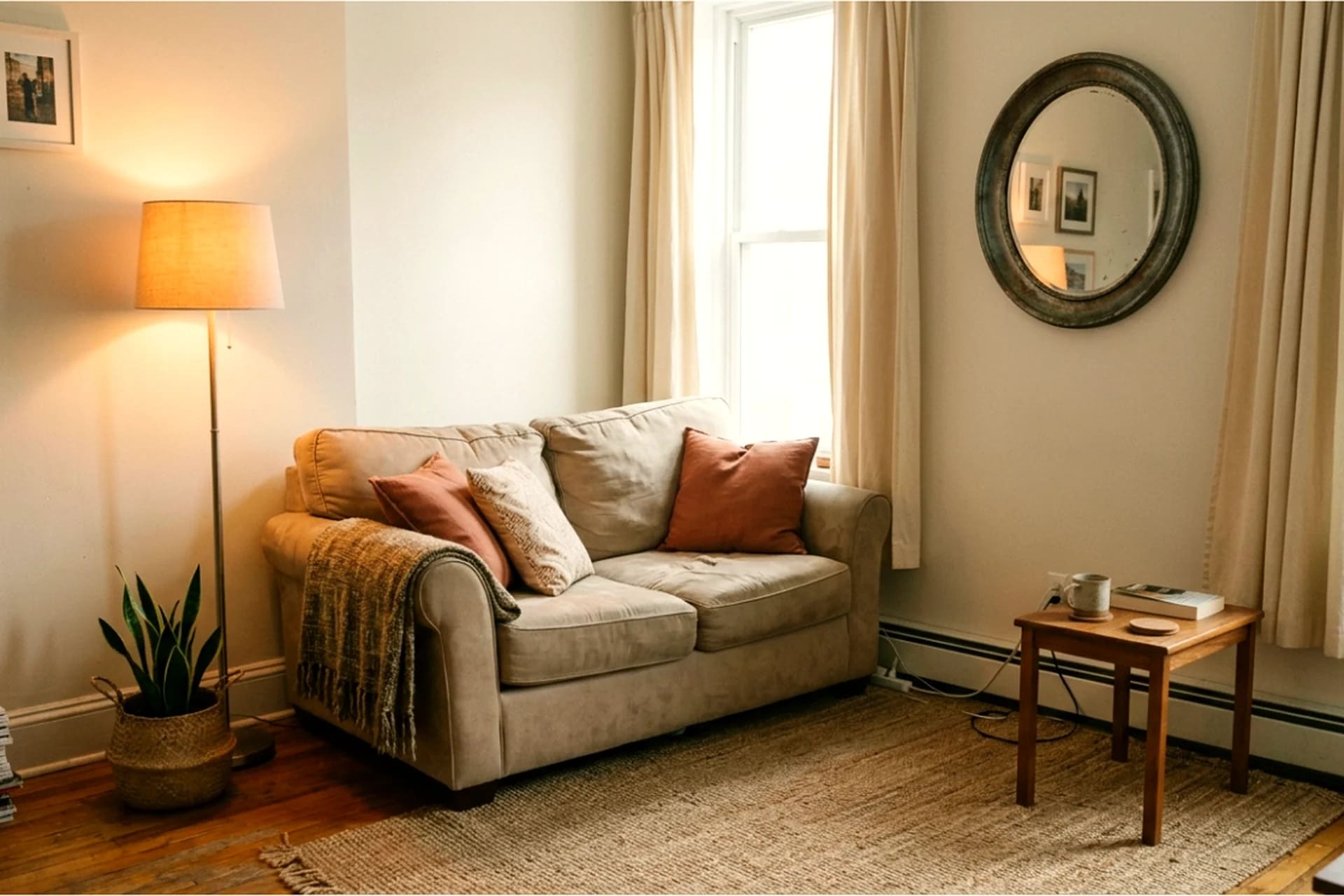
A small living room doesn't need a big budget to feel bigger, calmer, and more put-together. It needs decisions: what stays, what moves, and where the eye goes first. Most cramped-feeling living rooms aren't actually too small — they're just decorated in ways that fight the space. These 12 ideas cost under $100 combined, and half of them cost nothing at all.
If you haven't sorted the fundamentals yet, read our small living room ideas first — this guide is the budget execution manual for those principles.
Key Takeaways
- Total budget: under $100 for all 12 ideas (most cost $0–$25 each)
- Biggest free win: rearranging furniture and decluttering — costs nothing, changes everything
- Best $25 spent: one accent wall of paint or a thrifted mirror — both double the perceived space
- The rule: every item must earn its footprint; in a small room, each object is either helping or hurting
- Timeline: one weekend, roughly 6–8 hours including a thrift-store run
Table of Contents
- Idea 1: Rearrange before you buy anything
- Idea 2: Paint one wall (or fake it for $0)
- Idea 3: Add a mirror where it doubles a window
- Idea 4: Swap cushion covers, not cushions
- Idea 5: Declutter surfaces, then style what's left
- Idea 6: Make one piece of wall art yourself
- Idea 7: Layer warm lighting
- Idea 8: Fix the rug situation
- Idea 9: Add one real plant
- Idea 10: Hang curtains high and wide
- Idea 11: Style the coffee table with a tray
- Idea 12: Build a mini gallery wall from what you own
- The $100 budget breakdown
- The takeaway
- Frequently asked questions
Idea 1: Rearrange before you buy anything
Cost: $0. Time: 1–2 hours.
Before spending a cent, pull every piece of furniture 5–10 cm away from the walls and try the "conversation layout": sofa facing two chairs (or the TV), coffee table in the middle, clear walkways of at least 75 cm on the main path. Most small living rooms are arranged the way they were on move-in day and never touched again.
Try three arrangements and photograph each from the doorway — the camera reveals what your eyes normalize.
Mistake to avoid: pushing everything against the walls "to make space." Floating furniture even slightly creates shadow lines that read as depth — wall-hugging furniture makes a room feel like a storage unit.
Idea 2: Paint one wall (or fake it for $0)
Cost: $0–$25. Time: 3–4 hours.
A single accent wall in a slightly deeper tone than the other three adds architectural interest that distracts from square footage. One liter of paint ($20–$25) covers a typical 3×2.5 m wall with two coats. Choose a color 2–3 shades deeper than your main wall color — not a random bold color, which chops the room up.
Renters or paint-shy? Fake it with a large textile or removable wallpaper on one wall — same effect, zero commitment. Our paint color guide lists 7 shades that work in tight spaces.
Mistake to avoid: painting the accent wall behind the TV. The contrast makes the black screen pop harder and the wall feel closer. Accent the wall you see when you enter, not the one the TV hangs on.
Idea 3: Add a mirror where it doubles a window
Cost: $10–$20 thrifted. Time: 30 minutes.
A mirror opposite or adjacent to a window doubles natural light and visually doubles the room — it's the oldest small-space trick because it works. Thrift stores are full of large mirrors for $10–$20; check the back for solid mounting hardware.
Go big: 60×90 cm minimum; a leaning floor mirror (120×40 cm) needs no holes — ideal for renters. Round softens a boxy room; vertical rectangles add height.
Mistake to avoid: hanging a mirror where it reflects clutter — a messy shelf doubled is twice the mess. Aim it at the window, a plant, or clean wall.
Idea 4: Swap cushion covers, not cushions
Cost: $20–$30. Time: 20 minutes.
New cushion covers (not new cushions) are the highest-ROI textile swap in a living room. Two or three covers in a cohesive palette — say, warm white, terracotta, and one pattern — make a tired sofa look intentional. Standard 45×45 cm covers run $6–$10 each online.

Stick to 60-30-10: neutral base, secondary color, one accent. Washable covers only — small-room cushions get touched constantly.
Idea 5: Declutter surfaces, then style what's left
Cost: $0–$15. Time: 2 hours.
Remove everything from every surface. Clean. Then put back only what earns its place: one stack of books, one plant, one tray, one candle — per surface, max. Box the rest for a week; if you don't miss it, donate it.
For hidden storage, our small living room storage ideas cover 10 space-saving solutions. A $10–$15 lidded basket per shelf turns open storage into clean lines.
The test: photograph each surface. If your eye doesn't know where to land, there's still too much.
Idea 6: Make one piece of wall art yourself
Cost: $5–$15. Time: 1–2 hours.
Bare walls shrink a room; one confident piece of art expands it. You don't need to buy art — make it. A thrifted frame ($3–$5) with a free printable, a painted canvas in two tones, or pressed botanicals in glass. Our renter-friendly wall decor guide has 9 zero-hole ideas, and the thrifted frame makeover shows 3 finishes under $5 each.
Hang it at 145 cm to center — art hung too high is the most common small-room mistake.
Idea 7: Layer warm lighting
Cost: $15–$25. Time: 30 minutes.
Overhead-only lighting flattens a small room and makes it feel institutional. Add two more light sources at different heights: a floor lamp in a dark corner ($15–$25 thrifted or budget) and a string of warm-white fairy lights ($8–$12) along a shelf or window.
Use 2700K warm-white bulbs everywhere — cool bulbs feel clinical in small rooms. If you buy one thing here, make it a dimmable warm floor lamp.
Mistake to avoid: fairy lights everywhere. One strand, placed deliberately, is cozy. Five strands is a dorm room.
Idea 8: Fix the rug situation
Cost: $0. Time: 20 minutes.
A too-small rug chops a room into pieces; the right rug unifies it. The rule: front legs of the sofa and chairs ON the rug. If your current rug is too small, try removing it entirely for a week — bare floor with well-placed furniture often looks bigger than a postage-stamp rug.
No budget for a new rug? Layer a flat $15–$20 jute rug under your existing one to fake a larger footprint, or check thrift stores — large neutral rugs appear regularly for $15–$30. Our main small living room guide covers the exact rug sizing that makes rooms feel twice as big.
Idea 9: Add one real plant
Cost: $10–$20. Time: 10 minutes.
One healthy, decent-sized plant adds life, height, and a focal point that isn't furniture. A 60–90 cm snake plant, pothos on a shelf, or fiddle-leaf fig in a corner — pick one, not five. One confident plant reads as design; five small ones read as clutter.
Put it where the room needs height: an empty corner, beside the TV console, or on a plant stand ($10–$15) to lift it off the floor. Terracotta or woven basket pots ($5–$10) beat plastic nursery pots instantly.
Mistake to avoid: fake plants — in a small room everything is up close, and fakes look dusty. One real, easy plant beats three fake ones.
Idea 10: Hang curtains high and wide
Cost: $20–$30. Time: 1 hour.
Mount the curtain rod 10–15 cm below the ceiling and 15–20 cm wider than the window on each side. Hang curtains that just kiss the floor. This single trick makes windows look 30–40% larger and ceilings higher — it's the most disproportionate win in small-room decorating.
One pair of light-filtering linen-look panels ($20–$30) is enough. Keep them close to your wall color so they read as architecture.
Idea 11: Style the coffee table with a tray
Cost: $5–$10. Time: 15 minutes.
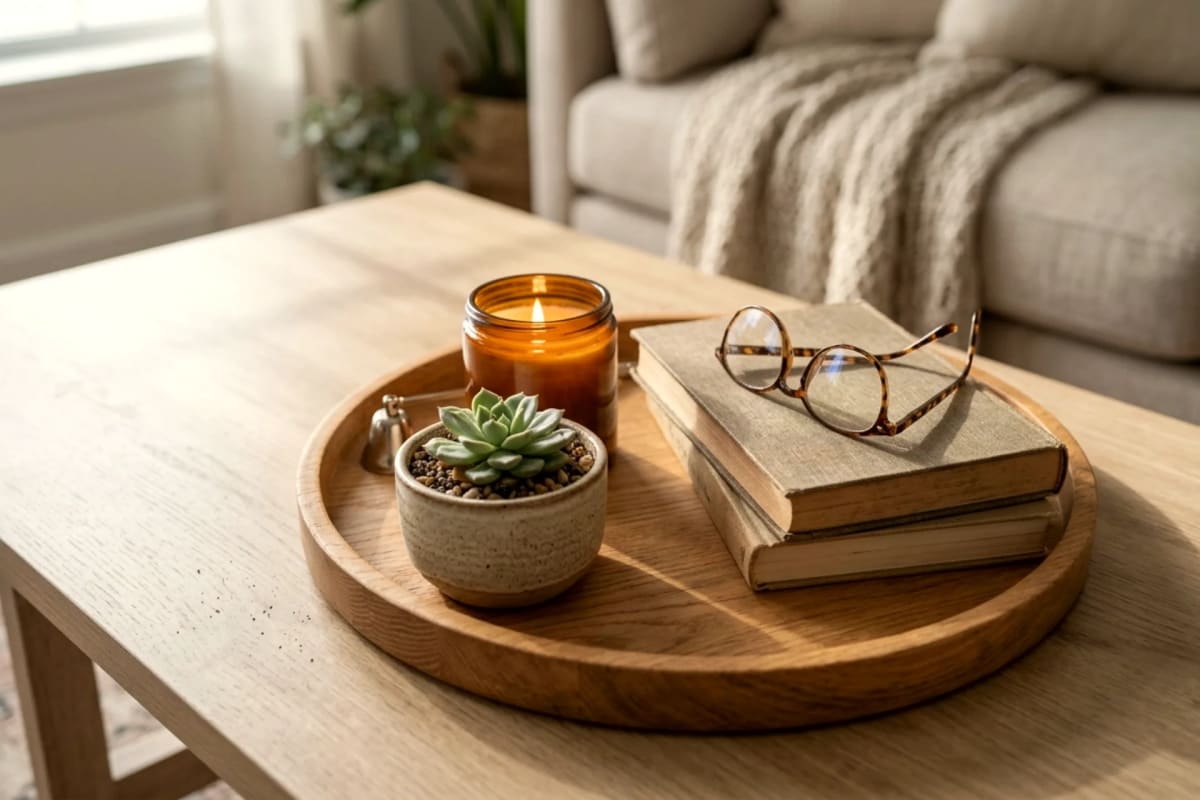
A tray ($5–$10 thrifted) corrals coffee-table chaos into one intentional vignette: tray + small plant or candle + one book or object. Everything else lives elsewhere. The tray creates a visual boundary that makes even a cluttered table look styled.
The 3-object rule: never more than three groupings on a coffee table — the tray vignette counts as one. Remotes live in a drawer, never loose.
Idea 12: Build a mini gallery wall from what you own
Cost: $0–$10. Time: 1–2 hours.
Gather every frame, print, and postcard you already own. Lay them on the floor in a tight arrangement — 5–8 cm gaps, one outer shape (rectangle or organic cluster). Trace each frame on kraft paper, tape the paper to the wall, then hang. Our renter-friendly wall decor shows how to do this with zero holes using adhesive strips.
Keep frames within one color family (all black, all wood) for cohesion.
The $100 budget breakdown
| Idea | Cost | |---|---| | Rearrange furniture | $0 | | Accent wall paint (1L) | $25 | | Thrifted mirror | $15 | | 3 cushion covers | $24 | | Declutter + 1 basket | $10 | | DIY wall art | $8 | | Floor lamp (thrifted) | $0–$20 | | Rug fix | $0 | | One real plant + pot | $15 | | Curtain panels | $0–$25 | | Coffee table tray | $8 | | Gallery wall | $0–$10 |
You won't need all twelve — pick the 6–8 that fit your room and you'll land well under $100.
The takeaway
Small living rooms reward editing more than spending. Rearrange first, add light in layers, give the walls one confident moment, and make every object earn its footprint. Do the free ideas this weekend; add the $25 ones as budget allows. The room will feel twice as big before you've spent $50.
Frequently asked questions
How can I decorate my small living room on a budget? Start free: rearrange furniture for clear 75 cm walkways, declutter every surface, and reposition your rug so front furniture legs sit on it. Then spend small on high-impact items: cushion covers ($20–$30), a thrifted mirror ($10–$20), and warm layered lighting ($15–$25). Under $100 total transforms most small living rooms.
What colors make a small living room look bigger? Light, warm neutrals with LRV 60+ — warm whites, pale greige, soft beige. One accent wall 2–3 shades deeper adds depth. Avoid stark cool whites and dark colors on more than one wall.
Where should I put a mirror in a small living room? Opposite or next to a window, so it doubles natural light — never where it reflects clutter. Go big: minimum 60×90 cm, or a leaning floor mirror for maximum effect with zero wall holes.
How do I arrange furniture in a tiny living room? Float furniture 5–10 cm off walls, keep a 75 cm main walkway clear, and arrange seating in a conversation grouping rather than lining everything against walls. Photograph each arrangement from the doorway — the camera shows which layout feels biggest.
Are gallery walls good for small living rooms? Yes — one confident gallery wall adds richness and personality that makes a small room feel curated rather than cramped. Keep 5–8 cm gaps, one frame color family, and hang the center at 145 cm. Use adhesive strips for a zero-hole renter-friendly version.
What's the cheapest way to make a small living room look expensive? Cohesion: a tight color palette (60-30-10 rule), matching curtains hung high and wide, warm 2700K lighting in three layers, and clutter-free surfaces. Under $60 combined, and it reads far more expensive than any single statement piece.