
A garland is the most forgiving Christmas decoration you can buy. A wreath has to be round and balanced, a tree has to be full on every side, but a garland only asks two simple things of any spot: a ledge to rest on and a way to stay put. Once you see your home that way — mantels, banisters, doorways, mirrors, consoles, window frames — you start seeing garland spots everywhere, and the difference between a garland that looks store-bought and one that looks designer comes down to three things: fullness, layering, and one repeated accent carried through the house.
Key takeaways
- The designer look comes from layering: a faux base for structure, fresh sprigs for scent and texture, then lights and one repeated ribbon.
- Fresh garland lasts 2–4 weeks indoors with misting and distance from heat; quality faux lasts for years but eventually looks tired.
- The three highest-impact spots are the mantel, the staircase, and the doorway — everything else is a bonus.
- Measure before you buy: a standard garland runs about 9 feet, and a staircase needs far more than a mantel.
- Secure with ribbon, floral wire, or removable hooks — never nails through a mantel or banister you care about.
Table of Contents
- Fresh, faux, or both: the honest math
- How much garland to buy
- The mantel formula
- The staircase formula
- The doorway formula
- Seven more places that take garland beautifully
- Styling: lights, ribbon, and accents
- Making it last and storing it
- FAQ
Fresh, faux, or both: the honest math
This is the first decision, and it is worth making honestly rather than on principle.
Fresh garland smells like Christmas in a way nothing else does, and it looks alive because it is. It also has a clock on it. Indoors, a fresh garland typically lasts 2–4 weeks, and the good-looking part of that is really the first two: needle retention starts to decline after about a week, subtle browning shows by day ten, and by two weeks most garlands are shedding even with care. Misting every couple of days, keeping it away from heat vents and fireplaces, and buying it no more than a few days before display all stretch that window. Outdoors in the cold, fresh garland can stretch to about four weeks.
Faux garland lasts for years — a mid-tier one kept indoors and stored well holds its shape and color for roughly 5–7 seasons, and premium ones longer — but it has its own expiry. Faux foliage stiffens, fades unevenly, and sheds its "fresh" look long before it physically falls apart. Many people replace a faux garland within a few years not because it broke, but because it started looking tired next to everything else. The honest comparison is not "real good, plastic bad." A locally cut fresh garland composted in January is hard to beat, and a premium faux garland reused for a decade is genuinely defensible. A cheap faux garland that sheds by year two and lives in a landfill is the worst of both.
The layered approach gets you both. Use an inexpensive faux garland as the base — it carries the weight, holds the shape, and fills the length — then tuck fresh sprigs of cedar, pine, or eucalyptus into it for scent and real texture. When the fresh pieces fade, pull them out and tuck in new ones without rebuilding anything. This is the trick behind most of the garlands that photograph like a designer's work: the structure is faux, the life is fresh, and nobody can tell where one ends and the other begins.
Cost-wise, expect roughly $30–$70 for 6–9 feet of fresh garland, and $60–$150 once for a quality faux garland you will reuse. A cheap faux garland costs less and looks it within a season or two — if you are going faux, spending once on something that will not shed by year two is the cheaper move over time.
One safety note that matters if you forage: never grab unknown evergreens. Yew looks festive and is toxic to pets and children. Stick to known cuttings — pine, fir, cedar, boxwood, eucalyptus — or buy from a seller who labels them.
How much garland to buy
Garland math is where people underbuy, and an underfed garland is the one that looks thin and sad. A standard single garland runs about 9 feet (around 270 cm). Work out each spot before you shop:
- Mantel: the mantel width plus enough to drape down each side — typically 1.5 times the mantel width, so a 5-foot mantel wants about 7–8 feet, and a generous swag with long tails wants a full 9 feet or two lengths joined.
- Staircase: measure along the banister, then add at least a third extra for the swag between attachment points. A straight 12-foot banister with a gentle drape needs roughly 15–18 feet — two garlands joined end to end.
- Doorway: the width plus both sides down to the height you want the tails to reach. A standard doorway frame takes one 9-foot garland comfortably.
- Table runner: the table length plus 12–18 inches of overhang at each end.
Joining two garlands is easy and invisible if you overlap them by 6–12 inches and wire the joint, then fluff the branches over it. Buying one long garland is tidier, but two joined ones let you mix: a faux base length plus a fresh length, or two different foliages for a fuller, more natural mix.
The mantel formula
The mantel is the heart of holiday decorating, and the formula is simple: a full base, a graceful drape, and height at the ends.
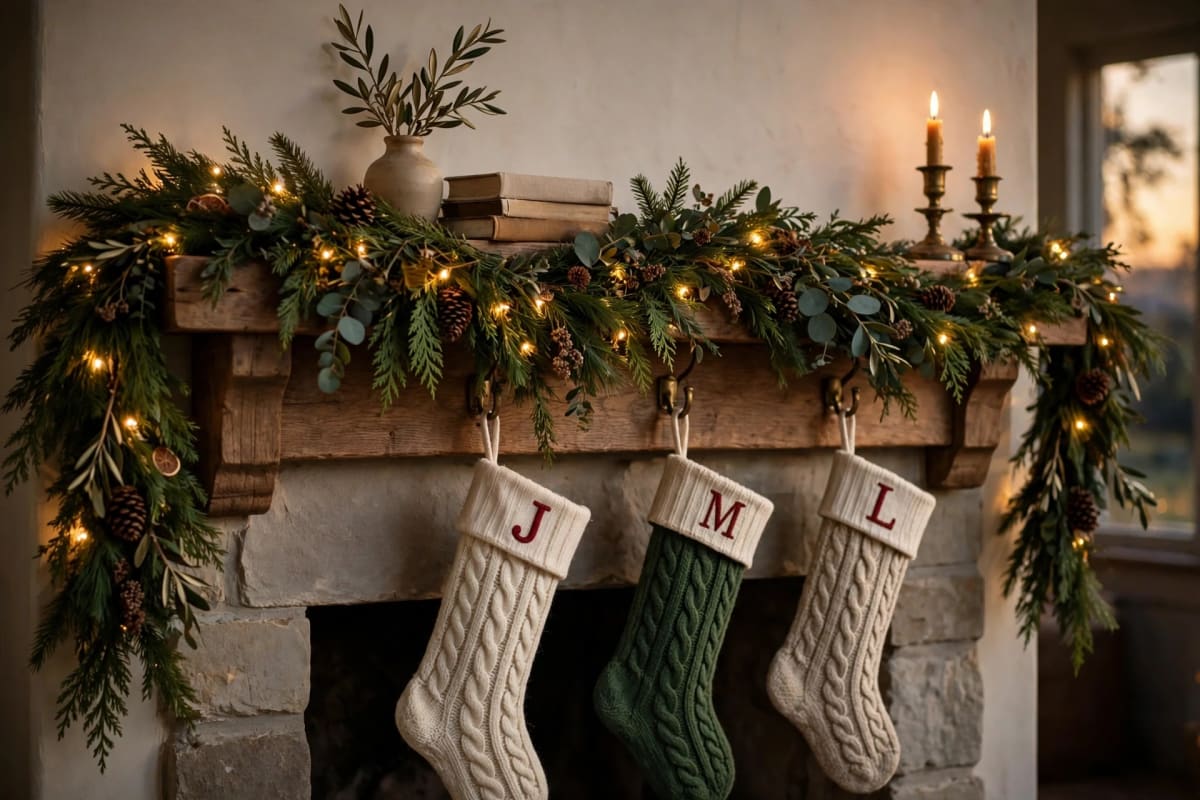
Start with the garland itself — full, not thin — and lay it along the mantel so it drapes rather than sitting rigidly. Let the ends fall naturally down each side; a garland that stops dead at the mantel's edge looks cut short, while one that cascades a foot down each side looks finished. If your mantel is deep, push the garland slightly forward so it reads from the room, not from above.
Then add height at the ends, not in the middle. Tall taper candles in brass holders, a pair of small vases with winter stems, or a stack of books under a lantern — height at the edges frames the garland instead of competing with it. Stockings hang from the garland's underside, spaced evenly, and they look best when they are not all the same length.
For the classic look, weave in warm-white fairy lights before you add anything else, so the wire disappears into the foliage. For a modern look, skip the ornaments entirely and let one material do the work: a single strand of preserved eucalyptus with ivory bows is simple, elegant, and endlessly photogenic.
The staircase formula
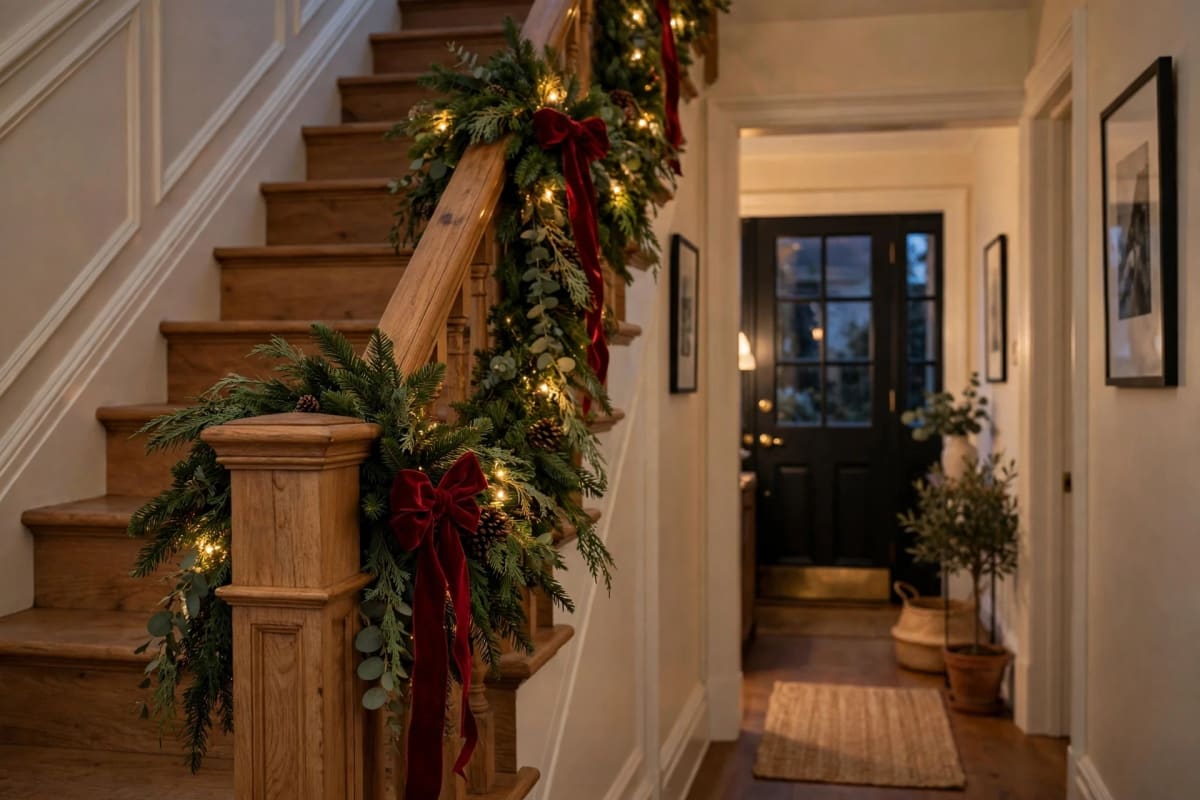
A staircase garland is the first thing guests see, and it turns an ordinary hallway into a holiday card — but only if it is full enough and attached properly.
Run the garland along the banister in a gentle swag, not a tight wrap. Attach it at intervals with ribbon or floral wire, letting it dip between attachment points so it moves like fabric rather than hugging the rail like a snake. Weave lights through before you attach it, and tie bows at the attachment points — the bow hides the wire and turns a fixing into a feature.
The layering trick shines here: a faux base gives you the length and structure a staircase demands, and fresh cedar or pine sprigs tucked in at intervals give it scent and texture that no all-faux garland has. Because a staircase garland is handled and brushed past, make sure every attachment is firm — a garland that slides when someone grabs the rail is worse than no garland at all.
If your staircase has newel posts, treat them as the finale: a larger bow, a cluster of pinecones, or a small wreath on the newel ties the whole run together. And keep one side of the rail clear enough to actually hold — a beautiful garland that leaves nowhere to grip is a hazard dressed as decor.
The doorway formula
First impressions count, and a garlanded doorway tells guests what the rest of the house feels like.
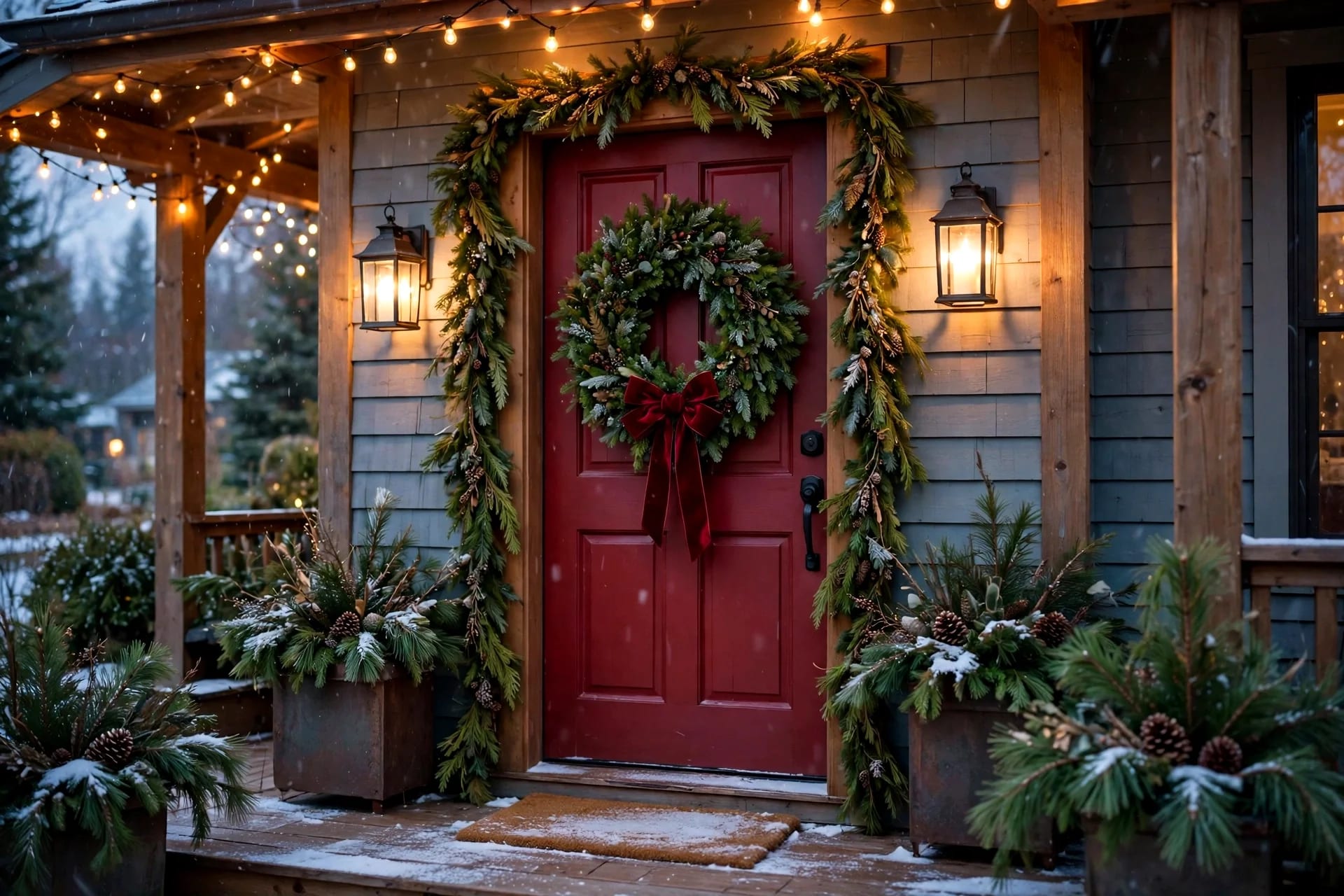
Frame the doorway with a garland that matches the interior's mood: soft and organic with eucalyptus and white lights for a calm home, lush and symmetrical for a formal one, loose and nature-inspired for a rustic one. Secure it with removable hooks or a tension rod across the top — both hold firmly and come off in January without a mark, which matters for door frames you do not want to drill.
Two details make a doorway garland look intentional. First, match it to the wreath on the door: the same foliage family, the same ribbon, or the same accent, so the doorway and the door read as one composition instead of two competing ones. Second, let the tails hang to different lengths on each side rather than cutting them even — a slightly asymmetric drape looks natural, while a perfectly even one looks like a shop display.
For an interior doorway or arch with no door, a tension rod across the top does the same job invisibly, and the garland can hang a little lower and looser since nobody walks through it with coats and bags.
Seven more places that take garland beautifully
Once the big three are done, garland's real gift is how many second spots it fills — as long as each spot has an edge and an anchor point.
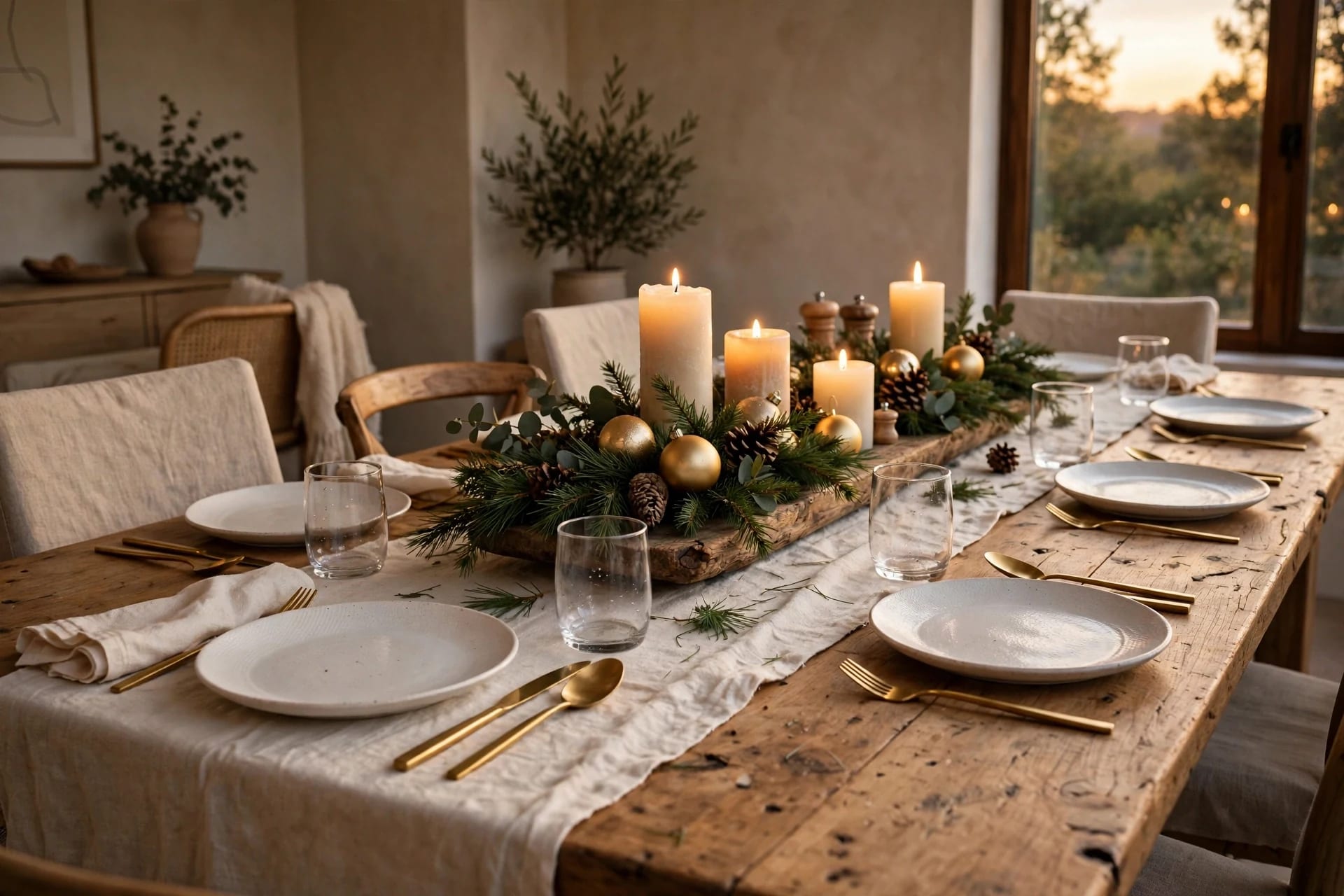
- The dining table, as a runner. Lay garland down the center, nestle in candles of varying heights and a few ornaments or pinecones, and keep it clear of plates and food. It beats a tablecloth for atmosphere and costs nothing extra if you have a spare length.
- A mirror or framed print. Drape a short length over the top edge and let the tails fall down the sides. The reflection doubles the greenery, so a little goes a long way.
- Window frames. Frame one window — the one you see from the street, or the one above the kitchen sink — rather than every window in the house. One framed window looks chosen; every window looks frantic.
- Kitchen cabinets and shelves. A short garland along the top of open shelves or cabinets brings Christmas into the room where everyone actually gathers, and it is the easiest spot to reach for the fresh-sprig trick.
- A chandelier. Wrap a light garland through or around it for a centerpiece nobody expects. Keep it clear of bulbs and heat, and use faux here — fresh foliage near heat dries fast.
- Console tables and sideboards. A garland along the back edge, with candles in front of it, turns a plain console into a holiday display in ten minutes.
- Porch railings and fences. Outside, use weather-resistant faux garland with waterproof wiring if it is pre-lit, and keep it out of prolonged direct sun to slow fading. A porch railing garland is the exterior version of the staircase formula, and it welcomes people before they reach the door.
The discipline rule across all seven: repeat two materials through the house — the same garland foliage and the same ribbon, for example. Repeating those two things connects rooms that would otherwise look like separate decorating projects.
Styling: lights, ribbon, and accents
Three layers, in this order, and no more:
Lights first. Warm-white fairy lights woven through the garland before anything else, with the battery pack or plug hidden at one end. Battery-operated lights keep mantels and staircases cord-free. Pre-lit garlands save this step entirely, and for a staircase or a high mantel they are worth it.
Ribbon second. One ribbon, used everywhere: velvet for elegant, burlap for rustic, linen for clean and modern. Weave it loosely through the garland or tie bows at intervals — at attachment points on a staircase, at the ends of a mantel swag, at the top corners of a doorway. One ribbon repeated through the house is what makes separate garlands look like one design.
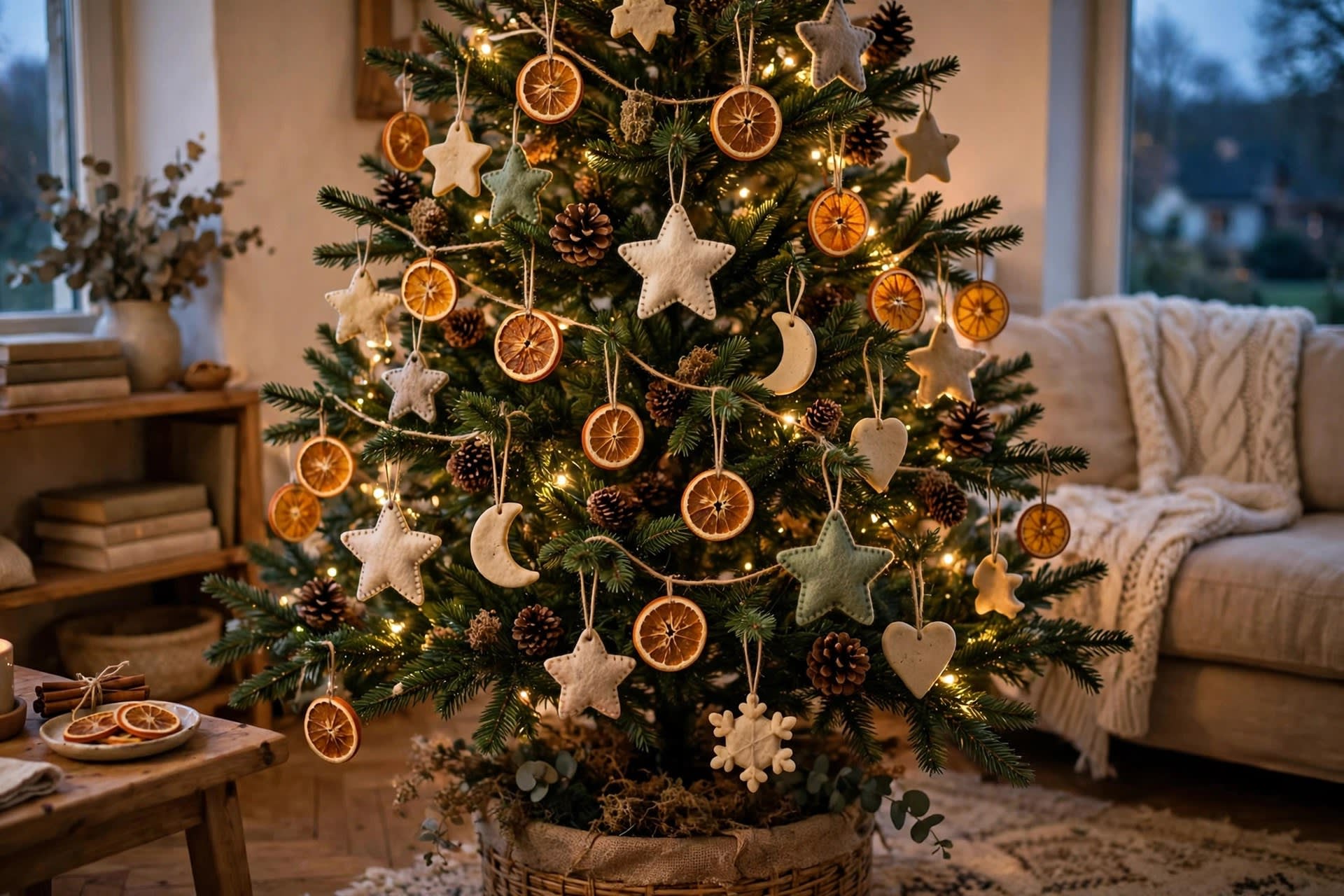
Accents last, and few. Pinecones for texture, dried orange slices for color and scent, cinnamon sticks for a rustic note, a handful of ornaments in one finish. The mistake is adding all of them: three clusters of accents reads intentional, while ornaments scattered everywhere reads like the tree's leftovers. Dried citrus and pinecones have the extra virtue of being compostable or reusable, which keeps the whole display closer to the sustainable end of the spectrum.
For a modern or pared-back home, the accent list shrinks to almost nothing: eucalyptus garland, or cedar blended with white berries, with no ornaments at all. That restraint is a style in itself, and it photographs better than a crowded garland in most rooms.
Making it last and storing it
Fresh garland: mist lightly every couple of days, keep it away from heat sources and direct sun, and accept its season. When it starts shedding heavily, it is done — compost it (unwired pieces only; wired pieces go in the trash unless you strip the wire) and replace the fresh sprigs if you used the layered method.
Faux garland: the enemy is storage, not use. Coil it loosely instead of cramming it into a tight box, keep it away from UV and extreme temperatures, and let it breathe. A garland crushed into a small box all year comes out creased and tired, which is how most faux garlands actually die. Before you hang it each year, fluff every branch outward — the five minutes of fluffing is the difference between a flat garland and a full one, and it is the step people skip most.
Pre-lit garland: check the lights before you hang it, not after. A dead section discovered mid-drape is a much bigger job than one discovered on the floor.
FAQ
How long does a real Christmas garland last indoors?
Typically 2–4 weeks, with the best appearance in the first two. Mist it every couple of days, keep it away from heat vents and fireplaces, and buy it as close to display time as you can. Outdoors in cold weather it can last about four weeks.
Is faux garland better than fresh?
For longevity, yes — years against weeks. For scent and natural texture, no. The layered approach (faux base plus fresh sprigs) gives you most of both, and it is what most designer-looking garlands actually are.
How do I hang garland without damaging my mantel or banister?
Ribbon, floral wire, and removable adhesive hooks all hold firmly and come off cleanly. A tension rod works for doorways and arches. Avoid nails and staples in any mantel, banister, or door frame you care about.
How much garland do I need for a staircase?
Measure along the banister and add at least a third extra for the swag between attachment points. A 12-foot banister with a gentle drape needs roughly 15–18 feet — two standard garlands joined with an overlap wired and fluffed over.
Can garland go outside?
Yes, if it is made for it. Use weather-resistant faux garland, waterproof wiring on pre-lit styles, and keep it out of prolonged direct sun to slow fading. Fresh garland outdoors lasts longer in the cold but still sheds eventually.
What greenery is best for a modern look?
Eucalyptus on its own, or cedar blended with pine and white berries. Both read clean and contemporary next to the classic full-fir look, and both work with a single ribbon and no ornaments.
For the mantel itself, see Christmas Mantel Decor, and for the porch that leads to it, Christmas Porch Decor. The doorway formula pairs with DIY Christmas Wreath Ideas for a matched entrance, and for the whole seasonal plan on a budget, Budget Christmas Decor and Christmas Wall Decor Ideas round it out.