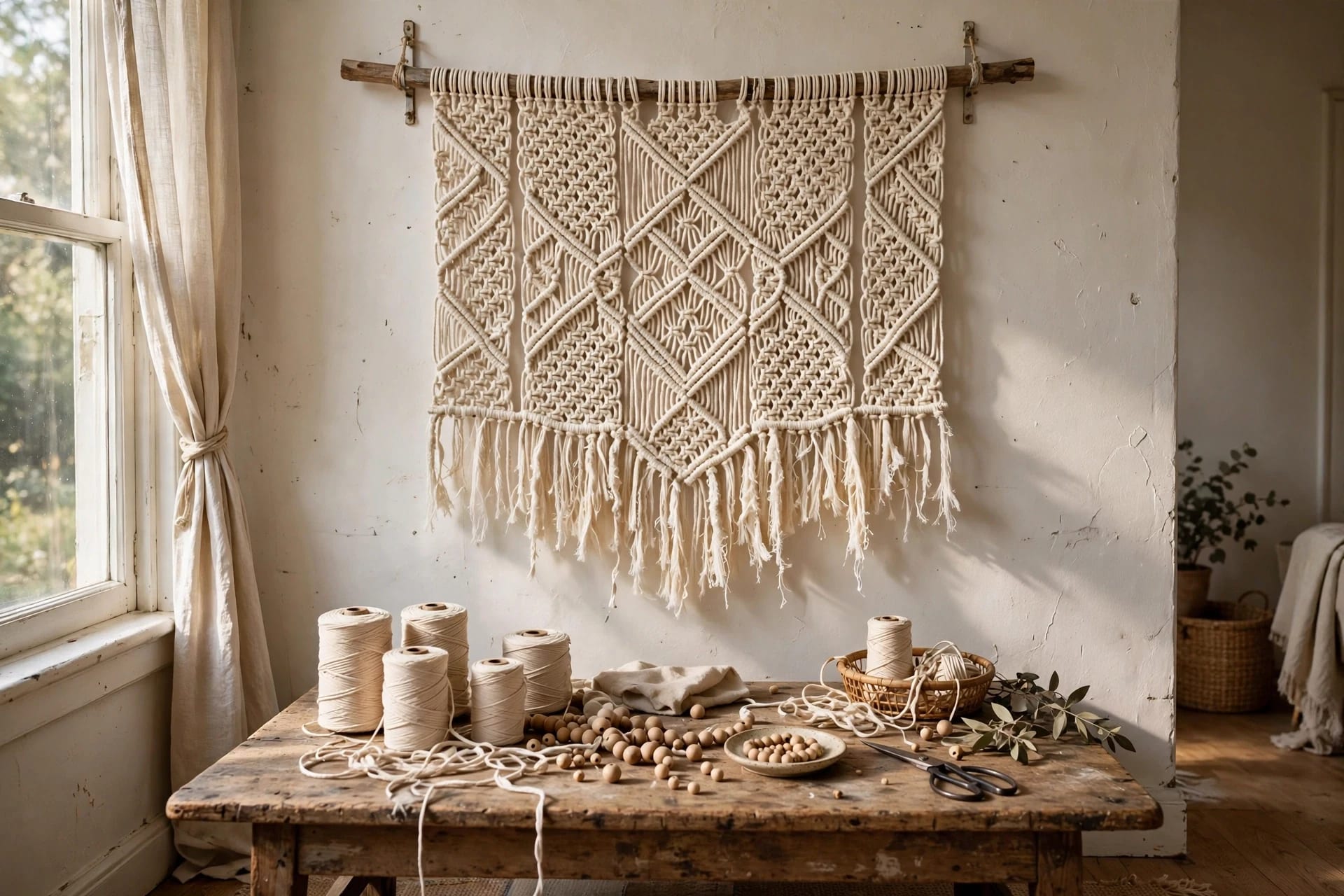
Most failed first macramé projects don't fail at the knots. They fail at the shopping: cord too thin for the design, a roll that runs out three rows from the bottom, or a braided cord bought for a piece whose whole point was soft, combed-out fringe. Cord choice decides how a wall hanging knots, how it hangs, and how it finishes — so it deserves more than grabbing the first spool that looks right.
Here's the full decision: the three constructions, the size ladder, and the measuring formula with worked numbers, so you buy once and buy enough.
Key Takeaways
- Beginner default: 3mm single-strand cotton — soft, forgiving, fringes beautifully
- The cutting rule: finished length × 4 (standard knots) × 2 for the fold
- A medium 24×36" hanging takes roughly 530 feet of 3mm cord
- Cost: one 100m roll ($10–$16) covers most beginner pieces
Table of Contents
- The three cord constructions
- Size guide: 2mm to 6mm
- The cord math: how much to cut
- Worked totals by hanging size
- Working cords vs filler cords
- Materials: cotton, jute, synthetics
- Buying checklist and mistakes
- FAQ
The three cord constructions
- Single-strand (single twist): one bundle of fibers twisted together. The softest option, the easiest on your hands, and the only one that combs out into that wavy, brushed fringe. Knots read slightly softer/less crisp. This is the default for wall hangings and the cord used in our beginner macramé wall hanging tutorial.
- 3-ply (twisted rope): three strands twisted around each other. Stronger, springier, with the sharpest knot definition — patterns like the ones in our macramé patterns guide show best in it. Fringe comes out wavy once untwisted. The workhorse for plant hangers and anything load-bearing.
- Braided: fibers woven into a tube. The most durable and the least stretchy, but it cannot be combed into fringe — if the design ends in loose tassels, braided cord ends the idea. Best for structured pieces, handles, and outdoor use.
Size guide: 2mm to 6mm
Thickness changes both the look and the labor:
- 2mm: fine detail work, small pieces, jewelry-adjacent projects. Slow going on a wall hanging — hundreds of extra knots to cover the same area.
- 3mm: the standard wall-hanging size. Balanced knot size, reasonable speed, the size most patterns and quantity estimates assume.
- 4mm: chunkier knots, faster coverage, a good step up for larger pieces or anyone who finds 3mm fiddly.
- 5mm: bold, sculptural knots; large hangings (36"+ wide) look right at this scale, and each knot covers real territory. Heavier finished piece — plan the hanging hardware for it.
- 6mm+: statement pieces and weaving accents; too coarse for detailed pattern work.
One honest warning: the same design knotted in 5mm needs dramatically more wall width per knot than in 3mm. Scale the pattern to the cord, not the other way round.
Weight scales with thickness too, and it catches people out at hanging time. A large 5mm piece can finish at several pounds of cotton — enough that a small adhesive hook is no longer a serious option. Weigh the finished piece (a luggage scale works) and hang it the way you'd hang a picture of the same weight: into a stud or on a proper picture hook for anything over about 5 lbs. The dowel matters as well — a long, thick-cord piece will bow a skinny dowel; step up to a sturdier branch or rod for 36-inch-plus widths.
The cord math: how much to cut
Every cord gets folded in half over the dowel (a lark's head mount), so cutting length is always a multiple of the finished length of the piece, doubled:
Cut length = finished length × multiplier × 2
The multiplier is set by how much cord your knots eat:
- ×3–4 — simple patterns: alternating knots, lots of open space and fringe
- ×4–5 — standard knotting: square-knot based designs (use ×4 as the default)
- ×5–6 — dense or complex work: spirals, berry knots, packed patterns
Then add a 10–15% buffer for trimming and the inevitable miscount. Worked example: a hanging that finishes 30 inches long, standard knots → 30 × 4 × 2 = 240 inches (20 ft) per cord.

Worked totals by hanging size
For 3mm cord at standard knot density (fringe included, buffer in):
- Small — 12" wide × 18" long: ~210 ft total
- Medium — 24" × 36": ~530 ft total
- Large — 36" × 48": ~960 ft total
A standard 100m roll is ~328 ft — so one roll handles a small hanging with room to spare, a medium takes roughly two rolls, and dense/spiral designs add 30–40% on top of every figure above. Thicker cord changes the count differently than people expect: 5mm knots cover more area each, so you need fewer cords across the width — but each one is cut by the same formula.
Working cords vs filler cords
In most knot patterns, the outer working cords do all the travelling — they wrap around the static center filler cords, which barely shorten at all. Cutting every cord to the full working length wastes a third of your spool on fillers that end up trimmed off.
The pro move: cut working cords by the formula, and filler cords at roughly the finished length plus fringe allowance (about ×1.5–2 total, folded). On a medium hanging this routinely saves 100+ feet — often the difference between one roll and two. It's the same economy mindset as our mini macramé decor projects, scaled up.
Materials: cotton, jute, synthetics
- Cotton is the default for a reason: soft on hands over long sessions, knots cleanly, takes dye, combs into fringe. Recycled cotton behaves the same at a lower price, with slightly more color variation.
- Jute gives a rough, rustic, garden-party texture — and charges you for it in sore fingers and shedding. Outdoor or very textural pieces only; not a beginner material.
- Synthetic/polyester cords are strong and weatherproof but slippery — knots creep and fringe won't comb. Reserve for outdoor hangings that must survive rain.

Buying checklist and mistakes
- Buy the whole project from one dye lot. Natural cotton shades drift between batches; a mid-project roll swap can show as a visible band.
- Tape the ends before cutting. A small wrap of masking tape on the cut line stops single-strand cord unravelling while you work; snip it off at the end.
- Mistake: buying by price per roll instead of price per meter. Rolls vary from 50m to 200m; the "cheap" roll is often just a short one.
- Mistake: using craft twine or yarn. Twine is too stiff and rough to knot comfortably; yarn stretches and pills. Neither produces the drape that makes macramé look like macramé — cord is spun for exactly this job.
- Mistake: skipping the sample. Knot a 6-inch test strip in your pattern and measure what it consumed. Ten minutes of sampling beats every formula in this article for accuracy on your tension.
- Label leftovers by size, construction and dye lot. Half-used spools breed mystery cord; a strip of tape on the roll with "3mm single, natural, March batch" turns leftovers into usable stock for the next project instead of a tangled donation.
- Dyeing? Buy undyed natural cotton and dye the finished piece or the whole spool at once. Piece-dyeing a completed hanging gives the most even result on single-strand cotton; dyeing cord-by-cord invites banding between batches.
Cord is the one macramé supply you can't improvise around — everything else in the craft is knots and patience. Buy 3mm single-strand cotton, cut by the formula, and keep the buffer. The full project list this feeds into lives in our DIY wall decor guide.
FAQ
What is the best macramé cord for beginners? 3mm single-strand cotton. It's soft enough for long sessions, shows knots clearly, unties cleanly when (not if) you make mistakes, and combs into proper fringe.
Can I mix cord sizes in one hanging? Yes — a common structure is 5mm for the main body with 3mm detail sections. Keep the construction the same (all single-strand, say) so the fringe finishes consistently.
How do I stop cord from unravelling while I work? Tape the cut ends with masking tape, work the tape off as you finish, or seal final ends with a dot of fabric glue on pieces that won't be handled.
Why did my hanging come out shorter than planned? Knot density. Dense patterns consume cord faster than the ×4 default assumes — spirals and berry knots belong at ×5–6. The test strip exists precisely to catch this before cord one of forty.
Is expensive cord worth it? For even twist, consistent diameter and clean color, mid-range cord earns its price on wall hangings. Save the budget spools for practice pieces and plant hangers, where small irregularities disappear.