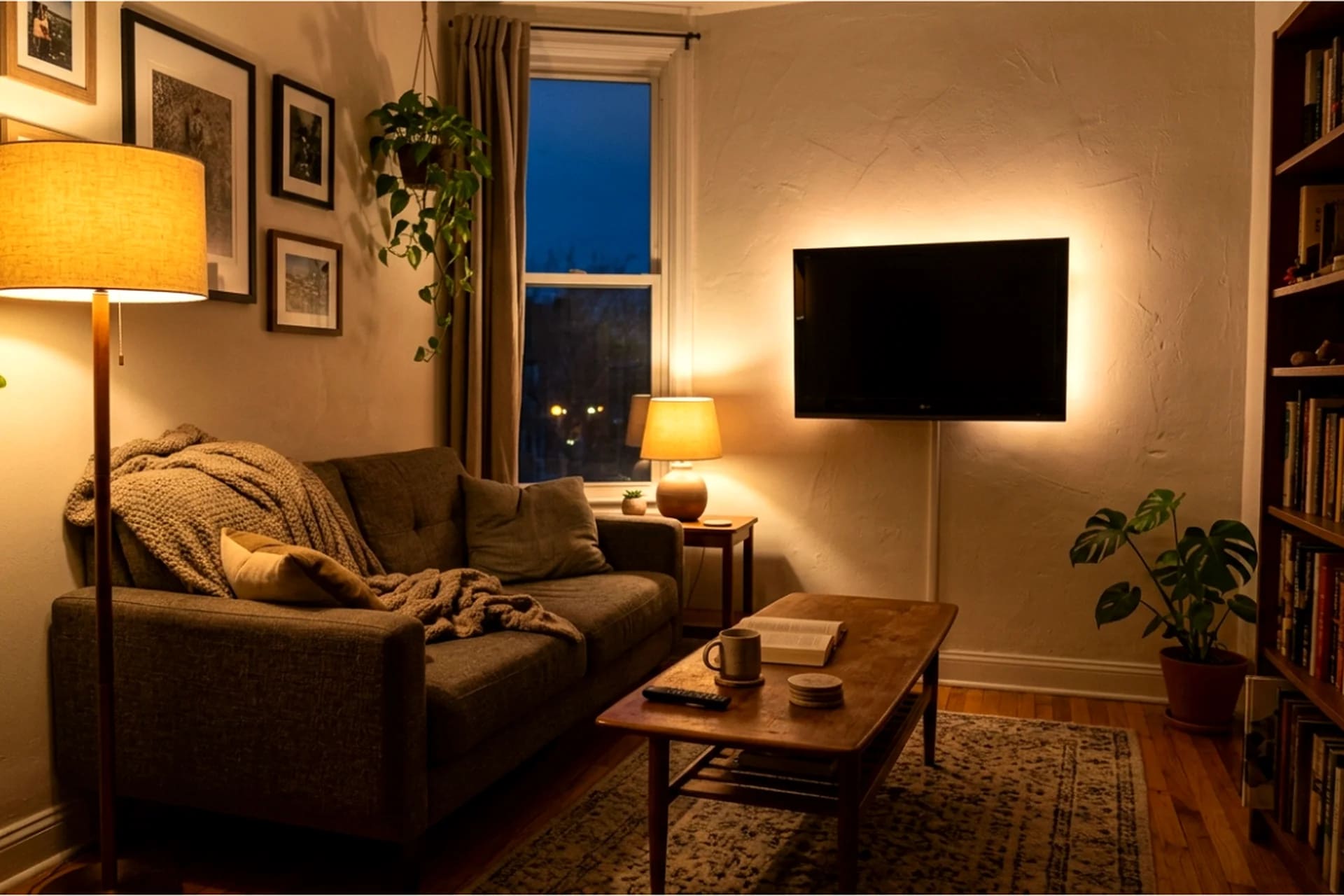
Bad lighting makes a small living room feel like a cave; good lighting makes the same room feel twice its size. It's the cheapest square-footage illusion that exists — cheaper than new furniture, faster than repainting. These seven ideas fix the classic mistake: a single ceiling light doing all the work.
If you haven't mapped out the room itself yet, start with our small living room ideas guide — lighting works best on top of a solid layout.
Key Takeaways
- The rule: light at three heights (ceiling, eye level, low) — never one overhead source alone
- Bulb temperature: 2700K–3000K warm white everywhere; cool daylight bulbs shrink small rooms visually
- Cheapest win: a $25 floor lamp in the darkest corner beats a $200 ceiling fixture
- Brightness target: ~20 lumens per square foot of floor area, spread across 4–6 sources
- #1 mistake: a single bright overhead light — it flattens the room and kills all depth
Table of Contents
- 1. Layer light at three heights
- 2. Choose warm color temperature
- 3. Bounce light with mirrors
- 4. Replace the single ceiling light
- 5. Light the dark corners
- 6. Treat the TV wall as a light source
- 7. Put everything on dimmers
- The one lighting mistake to avoid
- The takeaway
- Frequently asked questions
1. Layer light at three heights
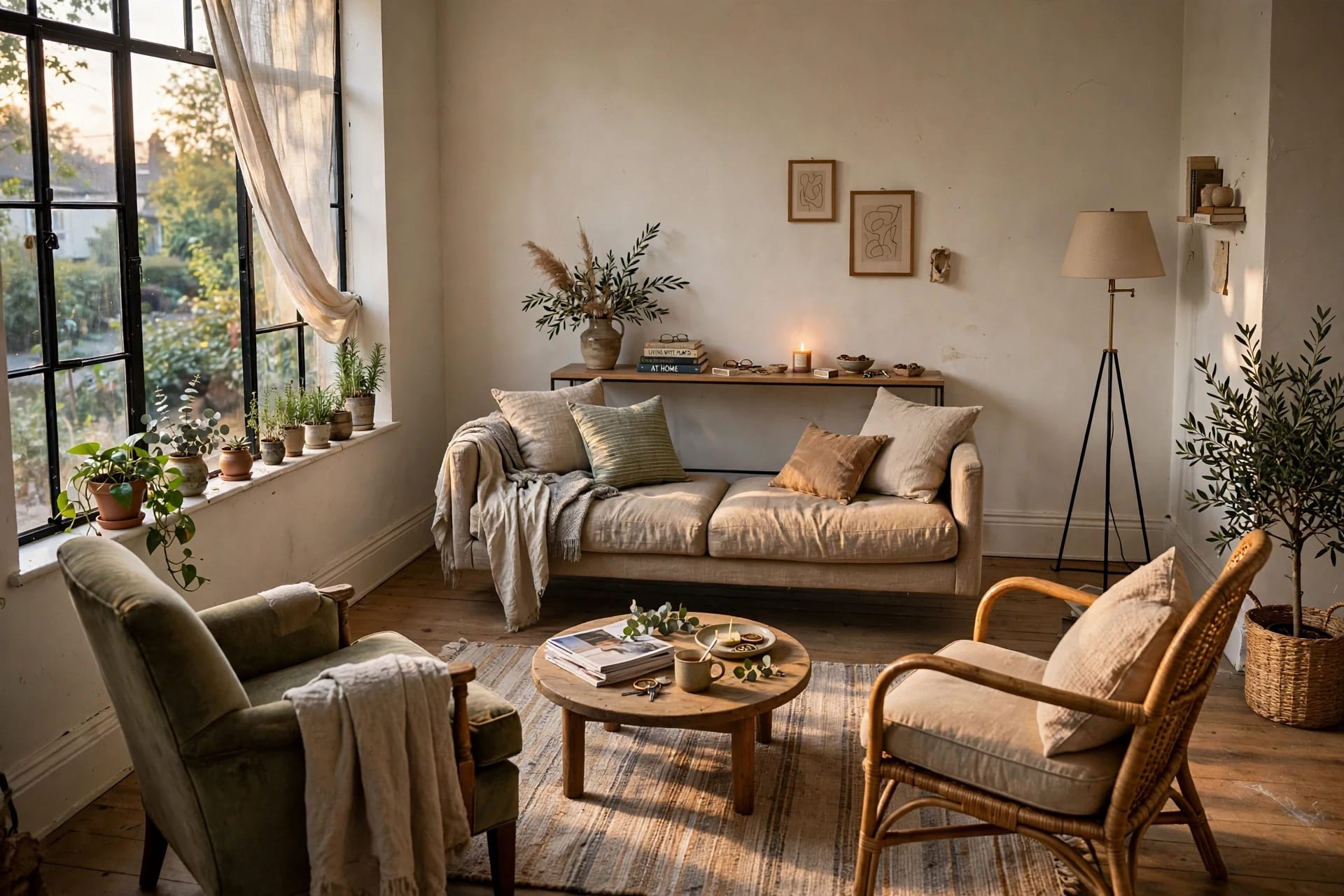
Interior designers talk about three layers, and in a small room the layers matter more, not less — each layer adds a plane of depth the eye reads as space.
- High (ceiling): one soft ambient source — a flush-mount, a pendant on a dimmer, or even just daylight from the window during the day. Keep it gentle; this layer is background, not the star.
- Middle (eye level, ~120–150 cm): table lamps, floor lamps with shades, wall sconces. This is the layer that makes a room feel lived in — it lights faces, art, and the middle band of the walls where your eyes naturally rest.
- Low (below 60 cm): LED strip behind the TV console, a small lamp on a low shelf, candles. Low light stretches the room horizontally in the evening and makes ceilings feel higher by contrast.
The formula that works: in a typical 12–15 sqm living room, aim for 2 middle-height sources + 1 low source + whatever ceiling light exists. Four to six total light points is the sweet spot.
Cost: a decent floor lamp $25–$60, table lamps $15–$35 each, LED strip $12–$20. A full three-layer setup runs $60–$120 total.
2. Choose warm color temperature
Bulb color temperature is measured in Kelvin (K), and it changes how big a room feels more than most people expect.
- 2700K–3000K (warm white): the cozy range. Walls recede softly, wood tones glow, the room feels enveloping rather than exposed. This is what you want everywhere in a small living room.
- 4000K+ (cool/daylight): the office range. It renders every wall edge sharply, which is exactly what you don't want — sharp edges define boundaries, and defined boundaries read as small. Cool bulbs also make skin look gray and fabric look cheap.
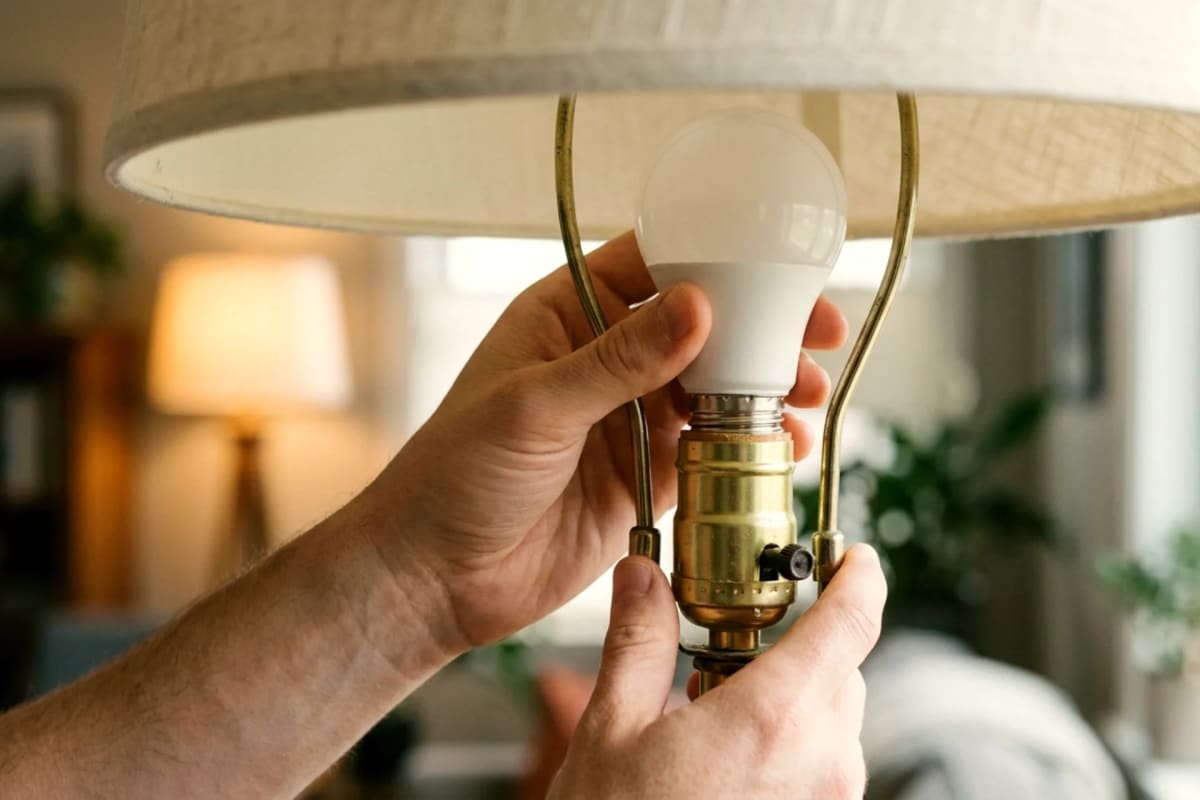
Check every bulb you own. Builders install whatever was cheapest, usually 4000K–5000K. Swapping four bulbs to 2700K costs under $15 and changes the room more than a $200 rug. Look for the number 2700K or 3000K in the specs — don't trust the marketing words alone.
Brightness: aim for roughly 20 lumens per square foot (~215 lumens per sqm). A 150 sq ft room wants ~3,000 total lumens — e.g., two 800-lumen lamps + one 1,000-lumen floor lamp + a 400-lumen strip. Spread beats concentrated: four dim sources always feel bigger than one bright one.
3. Bounce light with mirrors
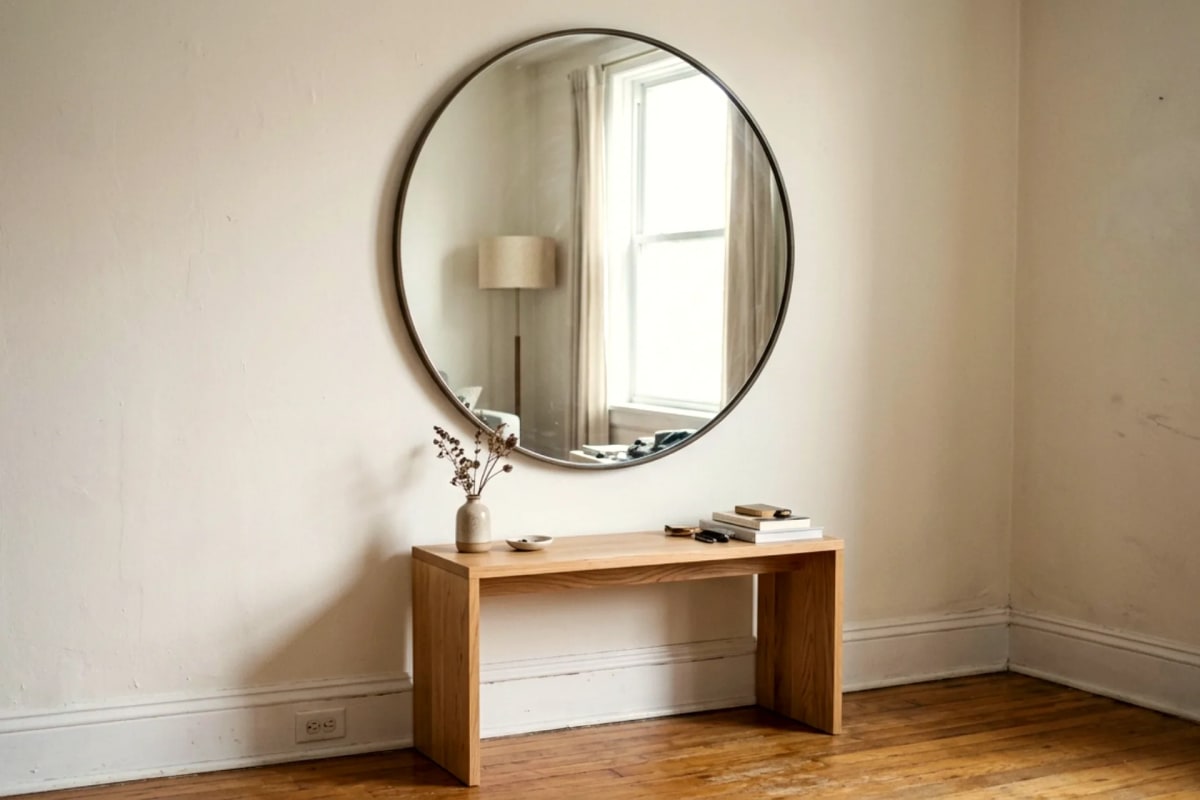
A mirror doesn't create light, but it doubles the perceived light sources and visually extends the wall it's on. In a small living room, one well-placed mirror does the work of an extra window.
Placement rules that actually work:
- Opposite or adjacent to the brightest window — never opposite a blank wall (it just doubles the blankness).
- Go big: one large mirror (70×100 cm or bigger) beats a cluster of small ones. Small mirrors read as decor; a big one reads as space.
- Lean, don't hang, when renting: a full-length mirror leaned against the wall behind a console adds height and light with zero holes.
This pairs directly with wall color: light walls reflect 70–80% of light, dark walls under 20%. If you're choosing paint too, read our paint colors for small living rooms first — the right shade multiplies everything on this page.
4. Replace the single ceiling light
The classic small-apartment setup — one harsh ceiling fixture in the middle of the room — is the fastest way to make 15 square meters feel like 10. Overhead-only light does three bad things: it casts shadows straight down (flattening everything), it leaves the walls dark (walls define perceived size), and it creates a single bright hotspot your eyes lock onto instead of traveling around the room.
You don't need an electrician. Options that need zero wiring:
- Swag a pendant: a plug-in pendant cord ($15–$25) hung from a ceiling hook, draped to the wall outlet. Hang it lower than you think — 150–170 cm from the floor over a reading chair, not jammed against the ceiling.
- Flush-mount with a diffuser: if you must keep the ceiling fixture, swap the bare bulb for a frosted flush-mount ($30–$50). Diffused overhead + two lamps beats bare overhead + four lamps.
- Arc floor lamp: the renter's chandelier. A $60–$120 arc lamp throws light from above without touching the ceiling, and the curve adds vertical drama that lifts the room.
If the ceiling light is on a switch you can't rewire, put a smart bulb in it ($10–$15) and leave it dimmed to 30–40% as background fill while the lamps do the real work.
5. Light the dark corners
Every unlit corner is square footage your brain subtracts from the room. In the evening, a small living room typically has two dead corners — usually the ones farthest from the window and the ceiling fixture. Light them and the room's perceived footprint grows.
The $25 fix: a slim torchiere or stick floor lamp tucked into the darkest corner, aimed up. Uplight washes the ceiling, and a lit ceiling always reads higher than a dark one. Torchiere lamps are 25–30 cm wide — they fit where nothing else does.
Other corner options:
- A small table lamp on a stack of books on the floor (low light in a corner looks intentional and cozy, and costs nothing if you own the lamp)
- Battery puck lights ($10 for a 3-pack) stuck under a floating shelf in a dark corner — no outlet needed
- A candle cluster on a low side table — real flames add flicker variation that reads as depth; keep them 30 cm from anything flammable
Count your corners tonight: turn off the overhead, turn on what you have, and stand in the doorway. Every corner you can't clearly see is stealing space. That's your shopping list.
6. Treat the TV wall as a light source
The TV wall is usually the darkest wall in the room by day (big black rectangle) and a glare problem by night. Bias lighting — light behind the screen — fixes both, and it's the highest impact-per-dollar upgrade on this entire list.
How it works: an LED strip stuck to the back of the TV ($12–$20) throws a soft halo onto the wall behind it — reducing eye strain, making the black screen look smaller, and turning the TV wall into a gentle ambient source.
Setup specifics:
- Use a USB-powered strip that plugs into the TV's USB port — it turns on/off with the TV automatically
- 2700K–3000K warm white, not RGB rainbow (colored bias light is a dorm-room look; warm white is the grown-up version)
- For a 55-inch TV, a 2-meter strip centered on the back is plenty
If your TV sits on a media console, add one more low source nearby — a small lamp or LED puck on the console itself. The TV layout guide covers console heights and viewing distances; get the layout right and the lighting on top of it, and the whole wall stops feeling like a black hole.
7. Put everything on dimmers
Brightness needs change through the day, and a room that can't adapt always feels wrong half the time. Full brightness for cleaning and finding the remote; 30–40% for evening relaxing. Dimmed warm light is the single fastest way to make a small room feel intimate instead of cramped.
Renter-friendly dimming (no wiring):
- Smart bulbs ($10–$15 each): dim from your phone, no switch changes. Start with the two lamps you use most.
- Plug-in dimmer switches ($12–$18): a little dial that sits between the lamp plug and the outlet. Dead simple, works with any dimmable bulb.
- Check the bulb: the bulb itself must say "dimmable" — non-dimmable LEDs flicker or buzz on dimmers. When buying new bulbs for this project, just buy dimmable 2700K across the board.
The evening recipe: overhead off (or 20%), floor lamp 60%, table lamp 40%, TV bias light on, one candle. Five minutes of adjustment, and the same 12 square meters feels like a different, larger, calmer room.
The one lighting mistake to avoid
One bright overhead light and nothing else. A single flush-mount blazing at 100% flattens everything and leaves walls in shadow. If you do nothing else from this guide: tonight, turn the overhead off, turn on two lamps, and stand in the doorway. That depth is what all seven ideas are chasing.
The takeaway
Small-room lighting isn't about more light — it's about more sources at more heights, all warm, all dimmable, with the dark corners eliminated. Budget $60–$120 and one afternoon: start with bulb temperature (under $15, ten minutes), then add one floor lamp to the darkest corner. Those two moves do 70% of the work.
Frequently asked questions
How many light sources does a small living room need? Four to six across three heights: one soft ceiling source, two at eye level, one low. Fewer than three feels flat; more than seven feels cluttered.
What color temperature is best for a small living room? 2700K–3000K warm white everywhere. Cool daylight bulbs (4000K+) sharpen wall edges and make small rooms feel smaller, harsher, and cheaper. Check the Kelvin number on the box — don't trust "daylight" marketing names.
How bright should a small living room be? Roughly 20 lumens per square foot of floor area (about 215 lumens per sqm), spread across multiple sources. A 150 sq ft room wants ~3,000 total lumens — but distributed across 4–6 dimmable sources, never one bright fixture.
Can lighting really make a room look bigger? Yes — perceived size comes from lit walls and visible depth. Layered warm light at multiple heights, lit corners, and a mirror opposite the window routinely make the same room feel 20–30% larger in the evening.
What's the cheapest way to improve small living room lighting? Swap all bulbs to 2700K dimmable LEDs (under $15), then put a $25–$40 floor lamp in the darkest corner. Under $60 total for most of the transformation. Add a $15 TV bias-light strip next.
Should the TV have a light behind it? Yes — bias lighting (a warm-white LED strip behind the TV, ~$12–$20, USB-powered) reduces eye strain, makes the black screen look smaller against a lit wall, and turns the TV wall into a soft ambient source. It's the highest impact-per-dollar upgrade for TV-centered rooms.