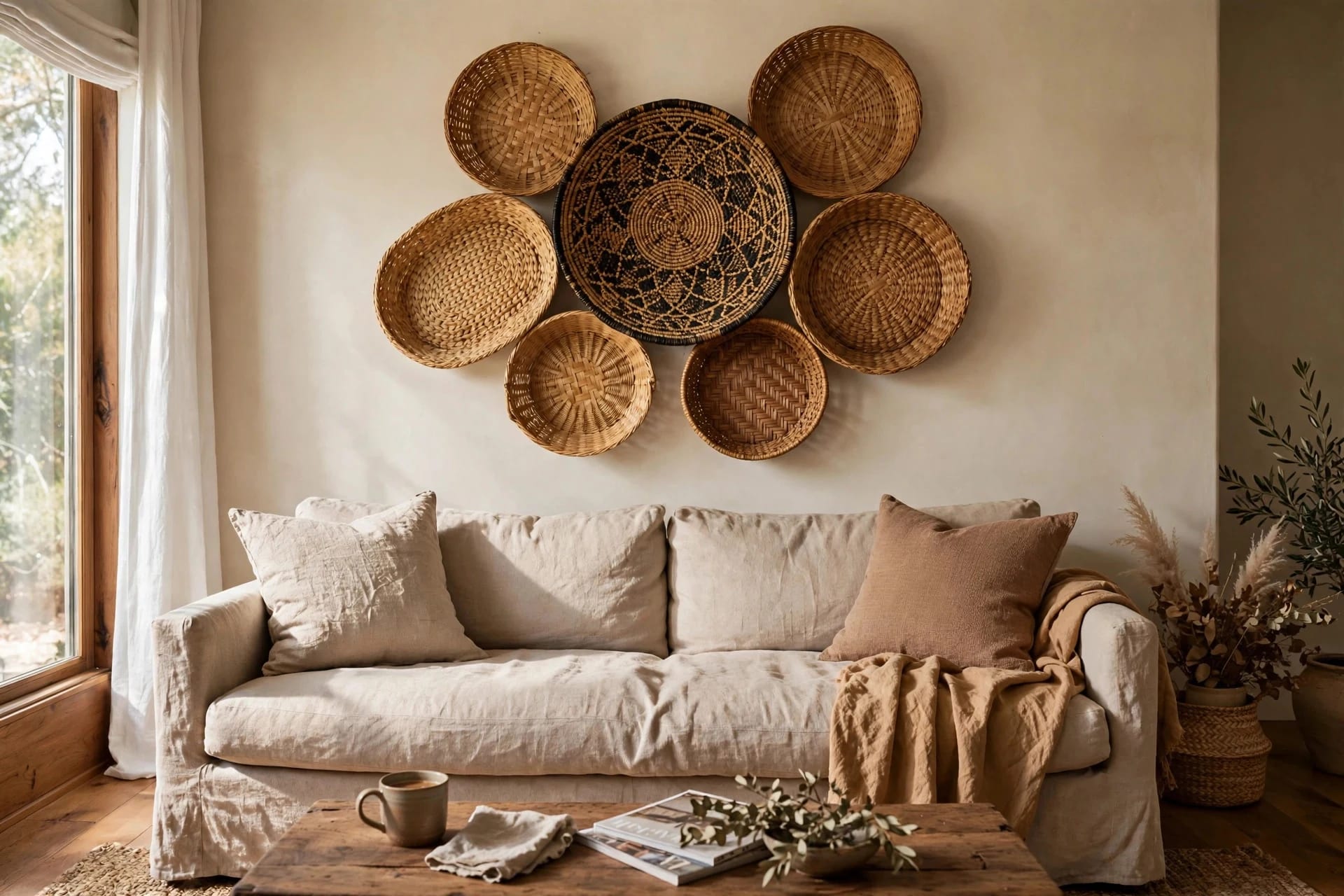
A basket wall is the cheapest piece of "art" you can put on a wall — and the easiest to get subtly wrong. Three lonely baskets floating a foot apart reads as an accident. Nine baskets of identical size reads as a store display. The versions that stop people mid-scroll follow a loose formula: an odd number of baskets, three size tiers, tight spacing, and one clear anchor piece.
Here's the formula, the sourcing strategy that keeps the whole wall under $40, and the layout method that means you only hang everything once.
Key Takeaways
- Cost: $15–$40 thrifted; $40–$90 for a new matched set
- Time needed: an afternoon, once the baskets are gathered
- Skill level: beginner — most baskets hang on a single nail
- The formula: 5–9 baskets, 3 size tiers, 2–4 inches apart, one big anchor in the middle
Table of Contents
- The composition formula
- Which baskets work (and which never sit flat)
- Sourcing a wall for under $40
- Step 1: Build the layout on the floor
- Step 2: Paper templates on the wall
- Step 3: Hang — one nail, a wire loop, or no holes
- Where basket walls work best
- Mistakes that make it look accidental
- FAQ
The composition formula
- Count: 5–9 baskets for a standard wall above a sofa or bed. Small walls and entryway nooks: 3–5. Below three, it's not a composition, it's a couple of baskets.
- Size tiers: one anchor at 14–18 inches across; two or three mediums at 10–12 inches; the rest small fillers at 6–8 inches. The spread matters more than the exact numbers — sameness is what flattens the look.
- Spacing: 2–4 inches between baskets, edges nearly touching, a slight overlap here and there is fine. Basket walls fail at wide spacing: the pieces stop reading as one artwork and start reading as storage that wandered up the wall.
- Height: the arrangement's bottom edge should sit 6–12 inches above the furniture below it. Higher and the group detaches from the room and floats.
- Palette: keep natural tones in one family (honey, walnut, natural, black accents) and vary the weave and pattern instead of the color. One patterned or dark basket as a focal accent is plenty.
Shape variety helps: mostly rounds, plus one oval or a shallow tray shape if you find one. Think of it like a gallery wall layout, except the frames are woven and weigh almost nothing.
Which baskets work (and which never sit flat)
You want shallow, flat-backed baskets — the kind sold as wall baskets, chargers, trays and shallow bowls: seagrass, rattan, wicker, sisal, and flat woven African market baskets all sit flush and show their pattern. Depth is the disqualifier: a basket deeper than about 4–5 inches tilts, casts a clumsy shadow, and never sits right. Deep storage baskets with handles belong on shelves, not walls.
Quality checks at arm's length: no broken spokes at the rim, no musty smell (it doesn't wash out), and a back that lies flat when you press it to a table. The material palette is the decor — varied weave patterns across the group give you the texture that flat art can't, similar to how mini macramé pieces add fiber texture at smaller scale.
Sourcing a wall for under $40
Thrift stores are the whole strategy: woven baskets are among the most-donated home goods in existence, typically $1–$5 each, so a 7-basket wall lands at $15–$35 with patience across two or three visits. Estate sales and flea markets price similarly. Buy the anchor first — large flat baskets are the scarce piece — then fill tiers around it.
New sets exist (5–7 piece woven wall sets run $40–$90) and guarantee a matched palette, but they lean uniform; mixing two thrifted oddballs into a set restores the collected feel. Either route, this is the lowest-cost wall in our entire DIY wall decor guide — cheaper even than the thrifted frame flips once you count prints and mats.
Step 1: Build the layout on the floor
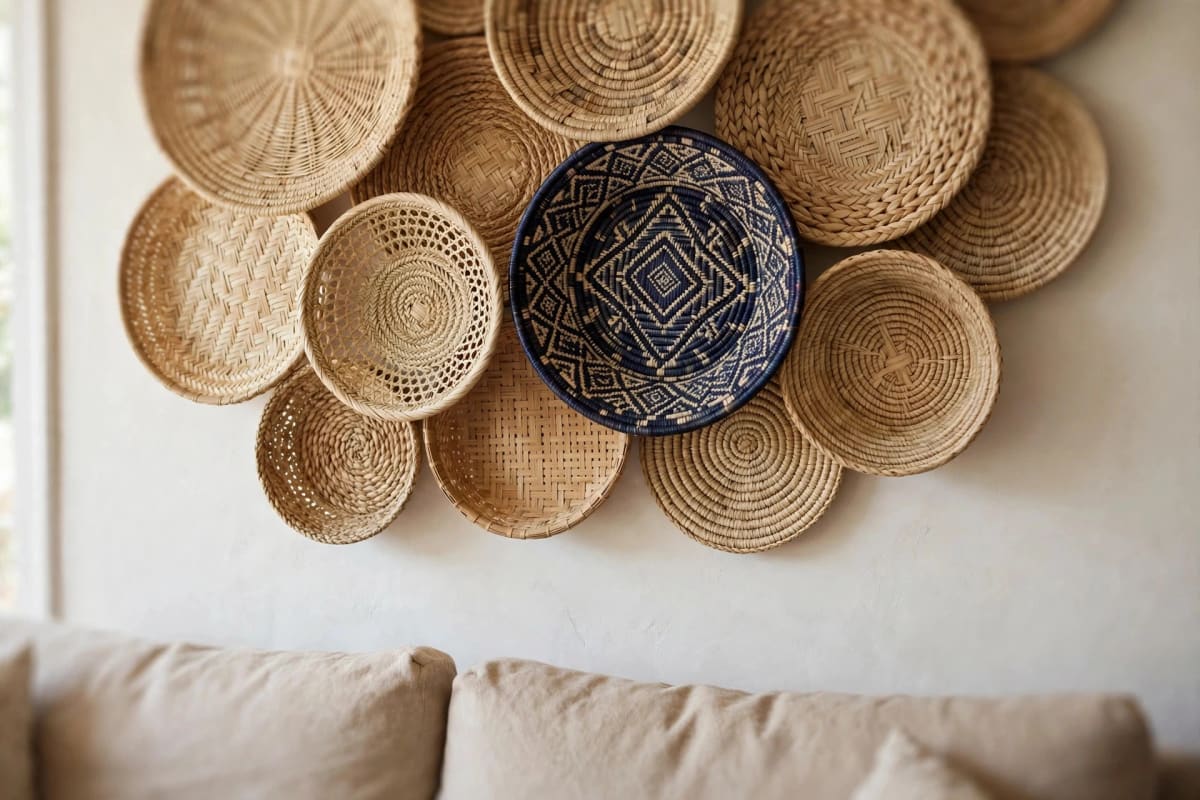
Arrange the baskets on the floor inside a taped rectangle the size of your wall space. Anchor in the visual center (slightly above true center reads better), mediums around it, smalls filling the gaps. Work until the outer silhouette forms one shape — a loose oval or organic blob — with no orphan sticking out alone.
Photograph it. The phone photo is both your hanging map and the fastest way to spot imbalance; arrangements always look different in a frame than under your feet. Sleep on it if you can — tomorrow's eyes catch the awkward gap tonight's miss.
Step 2: Paper templates on the wall
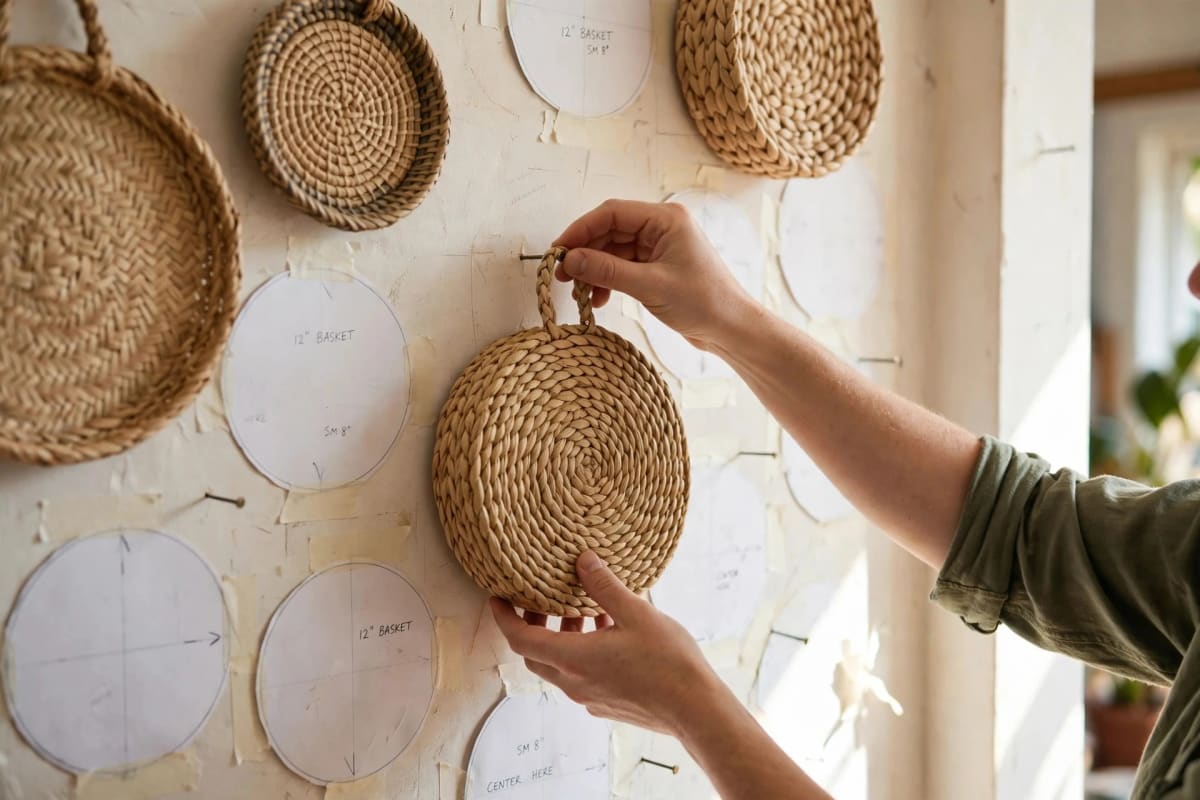
Trace each basket onto kraft paper or newspaper, cut the circles out, and tape them up in the floor arrangement's positions. Live with the templates for a few hours of normal room use. This step feels excessive for objects that weigh ounces — do it anyway. It converts every mistake into a moved piece of tape instead of a moved nail hole, and it's where you confirm the 6–12 inch clearance above the sofa in real sightlines, from seated height.
Step 3: Hang — one nail, a wire loop, or no holes
Decor baskets are light (most under a pound), so hanging is simple:
- Single small nail (homeowners): drive a 1.5-inch nail at a slight downward angle at the template's center mark; most woven baskets hang straight off it through the weave or under the rim. Wide baskets that tilt get two nails, spaced a few inches apart.
- Wire or fishing-line loop: for baskets with no natural hanging point, thread a short loop through the back weave at the top-center and hang the loop on the nail. Invisible from the front, and it self-centers better than a nail through the weave.
- Adhesive hooks/strips (renters): use hooks rated comfortably above the basket's weight, on a cleaned wall, and respect the cure time on the package before hanging. One hook per basket — never double up a hook to save money. More no-damage options live in our renter-friendly wall decor guide.
Hang the anchor first, then work outward, stepping back to seated distance after every two or three baskets. Small drifts are easy to correct early and miserable to correct at basket nine.
Where basket walls work best
Above sofas and beds (soft texture where hard frames feel formal), dining walls, entryways (a shallow basket by the door doubles as a mail/key catch if it's deep enough to hold them — the one functional exception), and the awkward wall above a staircase landing. Care is minimal: dust monthly with a vacuum brush attachment or a barely damp cloth, keep natural fibers out of direct sun (they fade unevenly) and out of steamy bathrooms (sustained humidity warps and can mildew natural weave).
Mistakes that make it look accidental
- Too few baskets. Two or three baskets is a shrug. Commit to five-plus, or choose a different wall treatment.
- Wide, even spacing. A grid of separated baskets reads as inventory. Tighten to 2–4 inches so the group reads as one piece.
- All one size. Without tiers there's no anchor and no rhythm; the eye slides off.
- Hung too high. Floating a foot above the sofa back disconnects the group from the furniture it's meant to crown.
- Deep baskets. They tilt, shadow, and read as storage. Flat only.
- Skipping the floor layout. Composing on the wall means composing with nail holes.
FAQ
How many baskets do I need for a basket wall? Five to nine for a full arrangement over a sofa or bed; three to five for a small wall. Fewer than three doesn't form a composition.
Can I mix basket colors? Mix tones within the natural family freely — honey, tan, walnut, natural — and add at most one or two dark or patterned pieces as accents. A rainbow of dyed baskets fights itself.
Will baskets damage the wall? One small nail hole per basket at worst — among the gentlest wall decor there is — and adhesive hooks make it zero-hole for renters.
How do I stop a basket tilting or spinning? Hang point dead-center on the basket's back, or two nails for wide pieces. A tiny ball of museum putty behind the bottom edge stops rotation on the pieces that insist on it.
Basket wall or gallery wall? Baskets win on cost, weight, and texture — and there's no glass glare. Frames win when the art itself matters. Plenty of walls mix both: two framed prints inside a basket cluster is a legitimate, good-looking hybrid.
Gather slowly, compose on the floor, hang tight. A basket wall is proof that the price of the art and the effect of the art are sometimes barely related.