Everyone asks this question the same way: standing in the store, holding a shelf, wondering whether it will take the books. The honest answer is that the shelf itself is rarely the weak part. What matters is what the bracket is screwed into, because that connection sets the limit long before the board itself is in trouble.
Key takeaways
- The working rule installers use is 45–50 pounds of safe load for every wall stud the bracket is screwed into.
- Drywall anchors alone hold far less: roughly 10–25 pounds for a shelf, no matter what the packaging suggests.
- Depth is a lever. Going from an 8-inch shelf to a 12-inch shelf can cut usable capacity nearly in half.
- Brackets should never sit more than 48 inches apart, and on a standard wall that means lining them up with studs 16 inches apart.
- The manufacturer's rating for your exact bracket always wins over any rule of thumb in this guide.
Table of Contents
- The short answer: the per-stud rule
- Capacity by mounting method
- Depth: the lever most people forget
- Shelf material and sag
- Bracket spacing and span rules
- Finding studs and what to do when there are none
- What to put where: real examples
- Five mistakes that bring shelves down
- FAQ
The short answer: the per-stud rule
A wall stud is a solid vertical timber behind the plasterboard, and a screw driven into it behaves completely differently from a screw driven into a hollow wall. That difference is the whole story. When a floating shelf comes off a wall, the board usually lands on the floor intact, fixings still in it, with a crumbled hole above. The wall connection failed, not the shelf.
The rule of thumb used across installer guides is consistent: count roughly 45–50 pounds per stud the bracket reaches. A shelf whose bracket hits one stud is a 45–50 pound shelf. The same shelf spanning two studs is a 90–100 pound shelf. Three studs take it to 135–150 pounds. Add solid blocking — a horizontal timber fitted between studs so every screw lands in wood — and you are past 200 pounds, which covers anything a living room shelf should ever carry.
Treat these as planning numbers, not promises. Your bracket's own rating, the screw size, and the condition of the wall all move the real figure. But if you only remember one thing from this article, remember this: studs first, everything else second.
Capacity by mounting method
| Mounting method | Safe working load (typical) | Good for | | --- | --- | --- | | One wall stud | 45–50 lbs | A row of books, a few framed photos | | Two wall studs | 90–100 lbs | A full book row, small kitchen dishes | | Three wall studs | 135–150 lbs | Heavy books, dinnerware, a record collection | | Studs + solid blocking | 200+ lbs | The heaviest domestic loads | | Toggle bolts in drywall (no stud) | 25–50 lbs | Light decor, small plants | | Standard drywall anchors only | 10–25 lbs | Picture frames and ornaments, nothing heavy | | Plastic plugs from a retail pack | 10–15 lbs | Almost nothing — treat as temporary |
Two rows in that table surprise people. The first is toggle bolts: good metal toggles in drywall genuinely hold more than cheap plastic anchors, in the 25–50 pound range for a pair, and the best ones stretch toward 75 pounds. They are a real option for a shelf that misses the studs. The second surprise is the bottom row. The little plastic plugs in the box are the weakest part of most kits. If your shelf matters to you, the plugs are the first thing to replace.
One more number helps for kitchen planning. A floating shelf with hidden steel brackets typically carries about 20–30 pounds per linear foot when it is properly fixed into studs, against 40–50 pounds per foot for a shelf on visible end brackets. Hidden hardware looks better and holds less, because the whole load has to travel through rods buried in the shelf into the wall. That trade is worth knowing before you plan a full wall of kitchen shelving.
Depth: the lever most people forget
A floating shelf is a cantilever: one end is fixed, the other hangs in the air, and everything on it pulls down on the wall connection with leverage. The deeper the shelf, the longer the lever, and the harder that pull becomes. This is why two shelves with identical brackets can have very different limits.
The practical effect is large. Moving from a 200 mm (about 8 inch) depth to a 300 mm (about 12 inch) depth typically removes 40–50 percent of usable capacity, because deflection in a cantilever grows with the cube of its length. A shelf that happily held 100 pounds at 8 inches deep may only be safe for 50–60 pounds at 12 inches deep, on the same bracket.
The guidance that follows from this is simple:
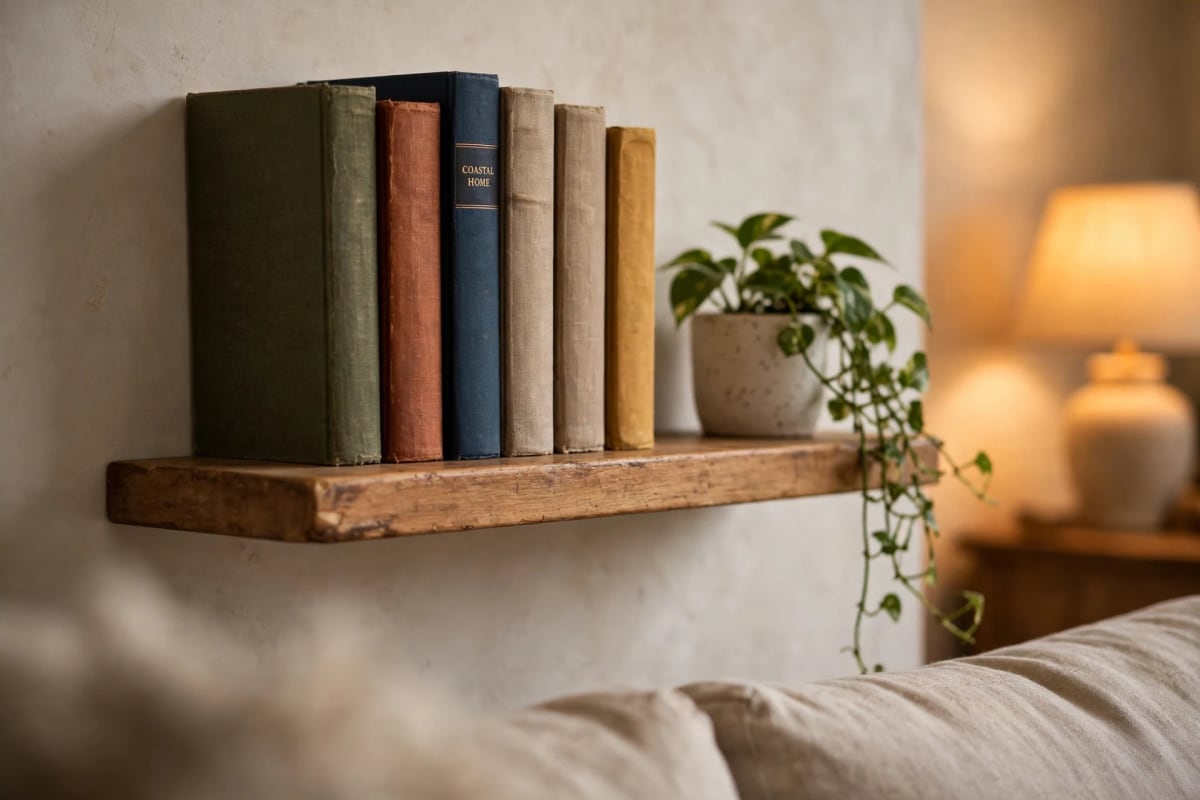
- For books and decor, 8–10 inches deep is the sweet spot. It holds what you need without turning the bracket into a crowbar.
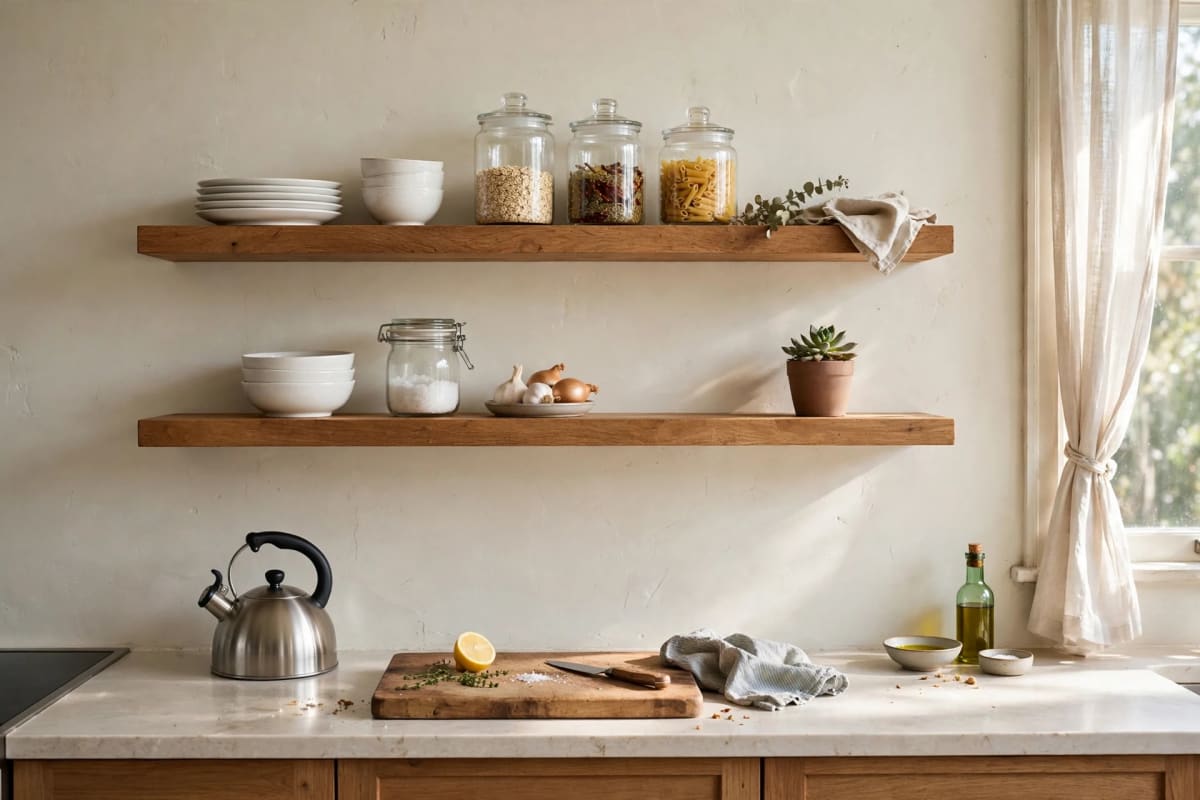
- For kitchen plates and bowls, 12 inches is fine, but only if the bracket is genuinely heavy-duty and fixed into studs.
- Beyond 12 inches, you are in mantel and counter territory. You need a bracket rated for it, ideally a backbar or a system with rods that run most of the shelf's depth, not a standard retail kit.
Depth also decides where weight should sit. Load kept close to the wall stresses the bracket far less than the same weight sitting at the front edge. Put the heavy books at the back, the light decor at the front, and never stack the heaviest thing in the middle of the front edge.
Shelf material and sag
Sagging and falling are different failures, and material decides the first one. Medium-density fiberboard (MDF) and particleboard look clean and cost little, but they are weak inside. Under a steady book load they bow in the middle over months, and once they bow they do not spring back. Solid wood and high-grade plywood resist that bending far better, and a torsion-box build — a hollow, reinforced grid inside the shelf — is what very deep or very heavy shelves use to stay flat.
Span matters as much as material. A longer shelf between two supports sags more than a short one, whatever it is made of. A 6-foot shelf stretched across only two studs will dip in the middle even on strong brackets, because the board itself flexes between its supports. If the shelf is longer than 48 inches, it needs a third bracket, which usually means a third stud or a run of blocking.
Watch for the early warning signs. A shelf that leans forward slightly is telling you something: either the wall is not flat and the bracket is not seated flush (fixed with a shim behind the bracket), or the rods are undersized for the load and flexing (fixed only with a heavier bracket). A shelf that has started to tilt will not correct itself. Take the load off and fix the cause before it becomes a fall.
Bracket spacing and span rules
Three spacing rules cover nearly every installation:
- Line brackets up with the studs. Standard stud spacing is 16 inches, so brackets usually land 16 or 32 inches apart. Never stretch past 48 inches between brackets — beyond that, shelves sag and bracket strength drops off sharply.
- A shelf longer than 48 inches needs at least three brackets. This is the rule people break most often, because two brackets look cleaner. The middle of a long shelf is where sag lives.
- Vertical spacing for stacked shelves. For a run of shelves up a wall, 10–18 inches between shelves covers most uses: 8–12 inches for small decor, 12–15 inches for books and dishes, 18–24 inches for tall items. Measure your tallest object and add 2–3 inches of clearance rather than guessing.
Bracket depth should match shelf depth. The bracket should support most of the shelf's depth — a bracket much shorter than the shelf leaves the front half hanging off an undersized lever. If the shelf runs much deeper than the bracket beneath it, move up a size or a duty tier before you load it.
Finding studs and what to do when there are none
A stud finder is the honest tool for this job, and the magnetic kind that finds the screws in the plasterboard is cheap and reliable. The knock test — tapping and listening for the solid thud instead of the hollow sound — works as a backup, and so does measuring 16 inches from a corner or an outlet, since studs usually sit on that grid.
The drill tells you the truth too. A screw that bites and keeps biting is in timber. A drill that suddenly sinks with almost no resistance has found the hollow cavity, and the dust on your bit will be pale gypsum instead of wood shavings. If you miss, stop, patch the small hole, and move 16 inches along.
When there genuinely is no stud where the shelf must go, you have three honest options, in order of strength:
- Open the wall and add blocking — the strongest fix, and the right one for a heavy shelf in a forever home.
- Rated metal toggle bolts — the best no-opening option, good for 25–50 pounds per pair.
- A French cleat or a visible bracket — both spread the load along the wall instead of hanging it off two rod points, and both hold more than concealed rods in bare drywall.
What does not work is hoping. Standard plastic anchors in bare drywall will hold a shelf up on day one and let it creep down over weeks, especially under books. The failure is slow: the shelf tilts a fraction, the anchors loosen a fraction more, and one evening the whole thing comes down. If the load matters, do not let the anchors be the plan.
What to put where: real examples
Numbers only help when they meet real objects, so here is how the table translates:
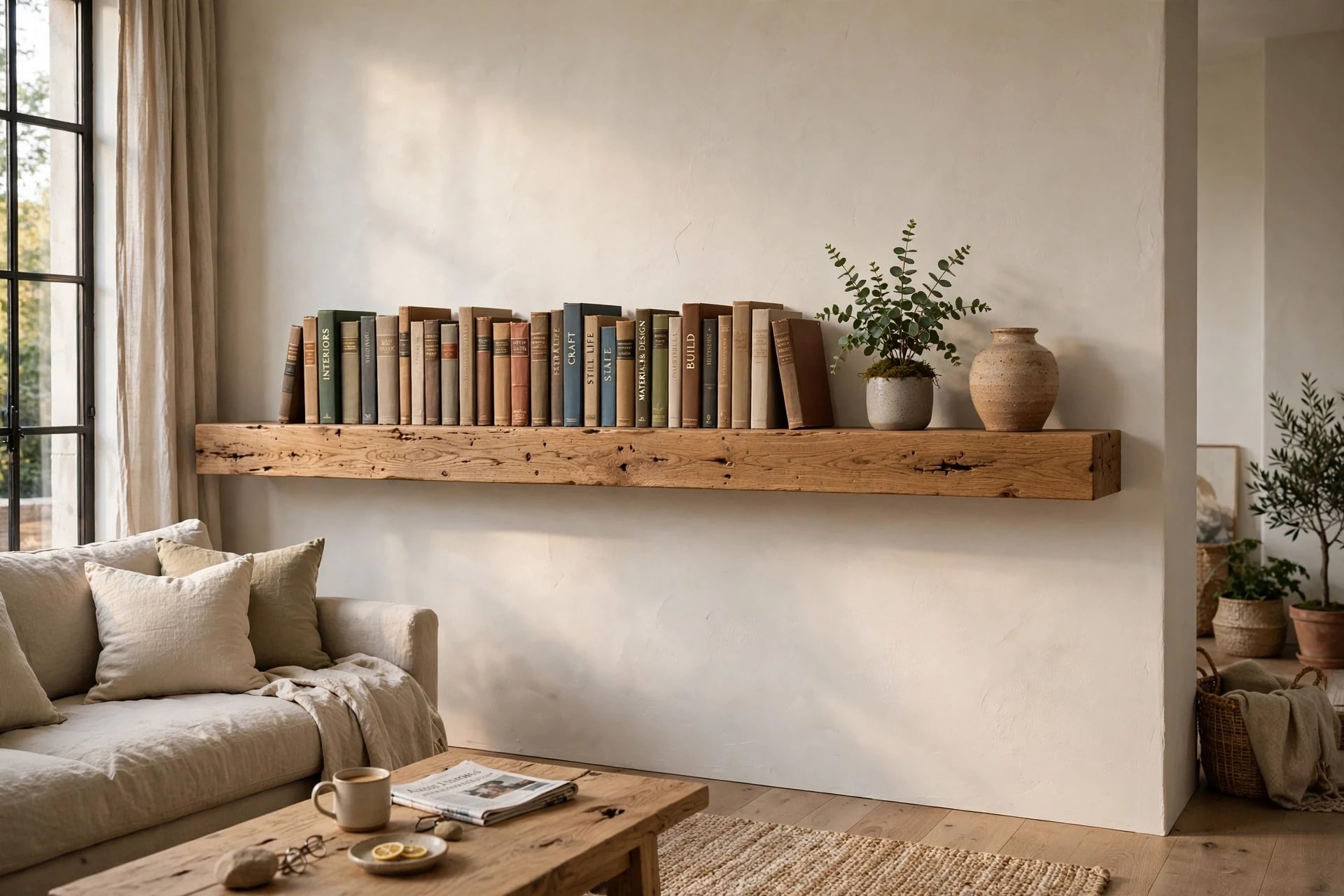
- A row of paperbacks (about 20–25 pounds per foot of shelf) fits a one- or two-stud shelf at 8–10 inches deep. Hardcovers run heavier — a full shelf of them can reach 30–40 pounds per foot, so give them two studs.
- Kitchen plates and bowls belong on a two-stud shelf at 12 inches deep with a heavy-duty bracket, loaded with the stacks near the wall, not the front edge.
- Plants are lighter than they look but get watered, so the weight creeps up. A two-stud shelf handles them; a drywall-anchor shelf does not, once the pots are wet.
- A record collection is the classic overload. Vinyl is dense — a full row easily passes 100 pounds — so that shelf wants three studs or blocking, full stop.
- Photo frames and small ornaments are the one case where drywall anchors are genuinely fine. If the total load is under 15 pounds, anchors will do, and this is their proper job.
When you are close to a limit, the fix is boring and effective: add another bracket, shorten the span, or move the shelf to where the studs are. All three beat buying a stronger-looking shelf and mounting it the same way.
Five mistakes that bring shelves down
- Trusting the box rating as a working load. A bracket rated for 100 pounds in a stud is not rated for 100 pounds in drywall. The rating assumes the ideal fixing, and your wall is the condition that matters.
- Using the plugs that came in the pack. They are the cheapest part of the kit and the first thing to upgrade, especially for anything heavier than decor.
- Two brackets on a long shelf. Past 48 inches, the middle sags and the ends lever. Add the third bracket even though it looks less minimal.
- Loading the front edge. Heavy things at the front multiply the force on the bracket. Heavy at the back, light at the front, spread evenly along the length.
- Ignoring a small tilt. A shelf that has started leaning is already failing. Unload it and fix the bracket or the seating before it finishes the job.
FAQ
How much weight can a floating shelf hold in drywall without studs?
With good metal toggle bolts, roughly 25–50 pounds for a pair. With standard plastic anchors, 10–25 pounds, and only for light decor. For anything heavier, find a stud, add blocking, or switch to a cleat or visible bracket.
Does shelf thickness change the weight limit?
It changes sagging more than falling. A thicker solid-wood shelf resists bowing better than a thin MDF one, but the wall connection still sets the falling limit. Thickness helps the shelf stay flat under load; it does not make weak fixings strong.
How far apart should floating shelf brackets be?
At stud intervals — typically 16 or 32 inches — and never more than 48 inches apart. A shelf longer than 48 inches needs at least three brackets.
Why is my floating shelf sagging in the middle?
Usually the span is too long for the material, the board is MDF or particleboard under a steady load, or the shelf is deeper than the bracket beneath it. Shorten the span with a third bracket, switch to plywood or solid wood, or match the bracket depth to the shelf.
Can I hang a floating shelf with just adhesive strips?
Only for the lightest decor, and even then it is a short-term fix. Strips are rated for frames, not for shelves carrying books or dishes, and heat and humidity weaken them over time. Screws into a stud or toggles are the honest minimum for a real shelf.
How high should floating shelves go?
For a standalone shelf, eye level — about 4–5 feet from the floor. In a kitchen, 18–24 inches above the counter. Above a couch, 10–12 inches above the back cushion. Above a toilet tank, at least 24 inches of clearance.
For the install itself, the companion guide is DIY Floating Shelves, and for choosing the right shelf for a small room, see Best Shelving for a Small Living Room. If the wall is a rental, the damage-free options are in Damage-Free Wall Decor, and for a whole small-room storage plan, Small Living Room Storage ties it together.