Small walls scare people off gallery walls entirely — which is a shame, because small spaces are where gallery walls work best. A tight wall forces decisions: fewer pieces, tighter editing, one clear idea. The result is usually sharper than a sprawling salon wall in a big room. The trick is restraint: the right scale, breathing room around the arrangement, and a limited palette. Below are seven small-space gallery wall ideas with the measurements that keep them airy instead of overwhelming.
New to wall decor planning? Start with our DIY wall decor guide, then come back — everything here builds on those basics.
Key Takeaways
- Scale rule: no single frame wider than two-thirds of the wall section; leave 15 cm of bare wall at the edges
- The 7 ideas: vertical stack, ledge shelf, single statement, 2×2 mini grid, corner cluster, above-furniture anchor, doorway surround
- Color discipline: 2 frame finishes max + artwork in one color family keeps small walls calm
- Spacing: 5 cm gaps (tighter than big-wall galleries — small arrangements need cohesion)
- Renters: all 7 ideas work with damage-free hanging
Table of Contents
- Why small walls are easier than big ones
- The scale rules for tight walls
- Idea 1: The three-piece vertical stack
- Idea 2: The ledge shelf mini gallery
- Idea 3: One statement piece (the anti-gallery)
- Idea 4: The 2x2 mini grid
- Idea 5: The corner cluster
- Idea 6: The above-furniture anchor
- Idea 7: The doorway surround
- Color tricks that keep it airy
- 4 mistakes that shrink a room
- The takeaway
- Frequently asked questions
Why small walls are easier than big ones
A big blank wall is paralyzing — too many options, and whatever you hang looks lost. A small wall gives you a frame (literally): the edges are close, so the arrangement reads as one composed piece almost automatically. Small-space galleries also cost less (fewer frames), hang faster (one afternoon), and are easier to get right because every mistake is visible immediately. If you've been putting off a gallery wall because your place is small, you have the advantage, not the handicap.
The scale rules for tight walls
Three numbers keep small-space galleries from overwhelming the room:
- Two-thirds max: no single frame wider than two-thirds of its wall section. On a 90 cm wall section, your biggest frame is 60 cm wide — tops.
- 15 cm breathing room: leave at least 15 cm of bare wall between the arrangement's outer edge and any corner, doorframe, or ceiling. Crowding the edges is what makes small walls feel cramped.
- Cap the count: 3–6 pieces for walls under 150 cm wide. Every piece beyond six needs to earn its place — in a small room, one weak piece drags the whole wall down.
Frame sizes that work hardest in small spaces: 20×25 cm, 30×40 cm, and one anchor at 40×50 cm max. Anything bigger belongs on a bigger wall.
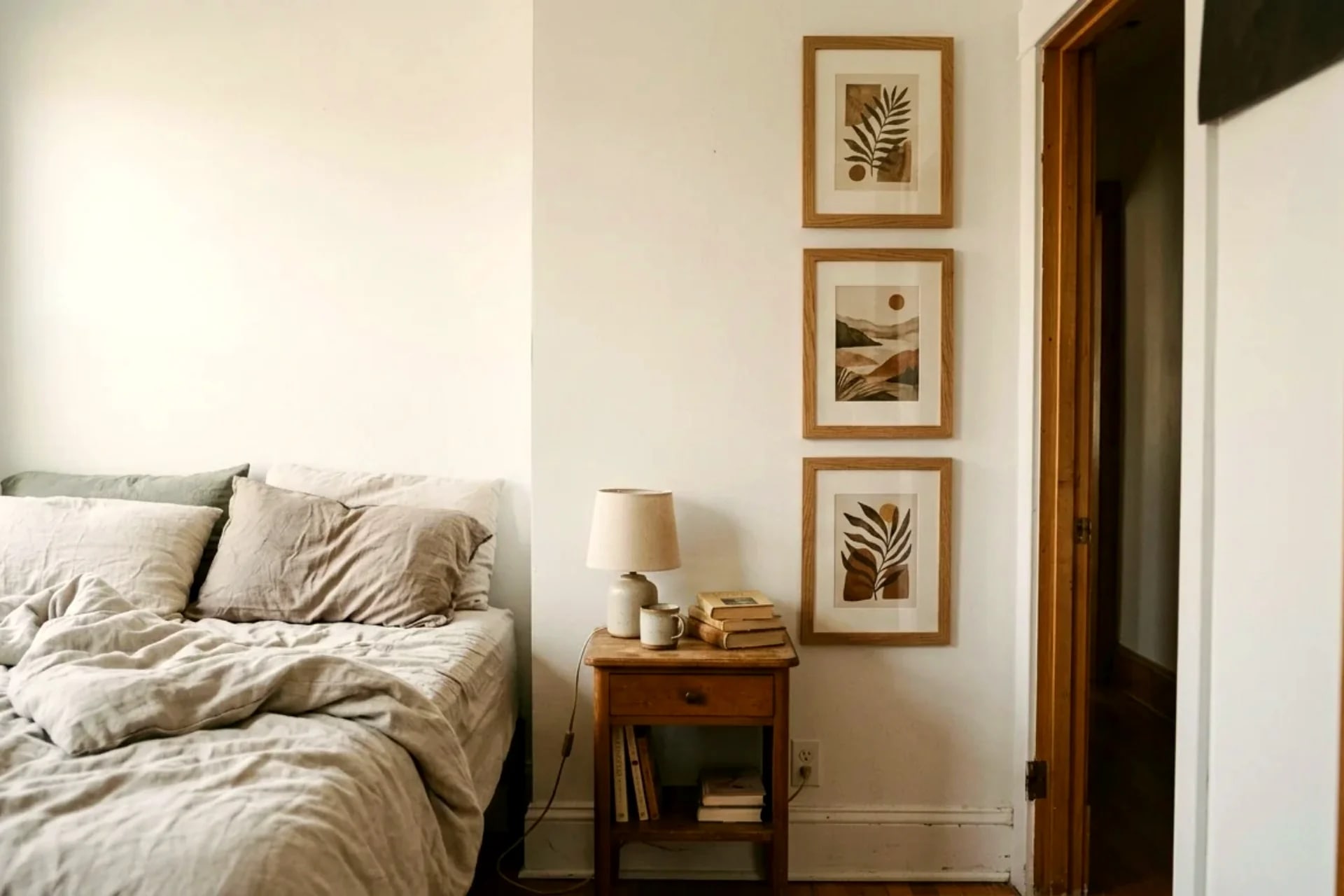
Idea 1: The three-piece vertical stack
Three frames, one above the other, same width. The narrow-wall classic — it fits beside doorways, between windows, and in hallway stubs where nothing else works.
Measurements: three 30×40 cm frames, 6 cm gaps, total 40 cm wide × 132 cm tall. Center the middle frame at 145 cm from the floor. Identical frames, identical mats — the stack's power is its rhythm, so don't break it with mixed finishes.
Best for: walls 50–80 cm wide. Flanking a doorway with a stack on each side doubles the effect.
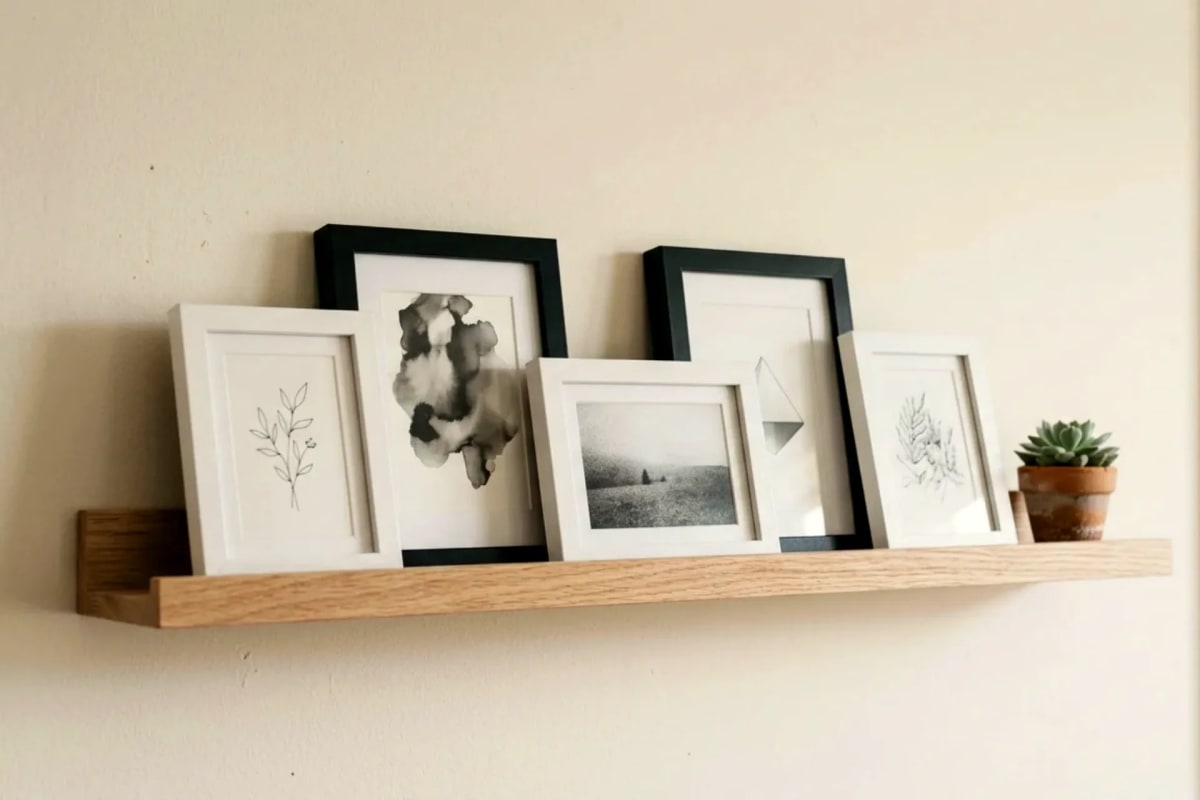
Idea 2: The ledge shelf mini gallery
A picture ledge shelf (60–90 cm) with 4–6 small frames leaned on it, overlapped slightly. The renter's best friend and the commitment-phobe's gallery — rearrange in seconds, zero holes beyond the shelf itself.
Measurements: shelf at 150 cm from the floor. Frames 13×18 cm to 20×25 cm, leaned with front pieces overlapping back pieces by 3–4 cm. Keep the tallest frame at the back.
Best for: renters, anyone who likes to redecorate seasonally. One shelf holds your gallery; swapping art for the seasons takes five minutes. For the full damage-free playbook, see renter-friendly wall decor.
Idea 3: One statement piece (the anti-gallery)
Sometimes the best small-space gallery wall is a single piece. One 50×70 cm print with a wide mat, hung alone at 145 cm center, gives a small wall a focal point without any visual noise.
Measurements: the frame (including mat) should span roughly half to two-thirds of the wall width. On a 100 cm wall: a 50×70 cm frame is perfect. Give it 25 cm of bare wall on each side — the emptiness is the design.
Best for: tiny bedrooms, reading nooks, walls opposite the bed where you want calm, not stimulation.
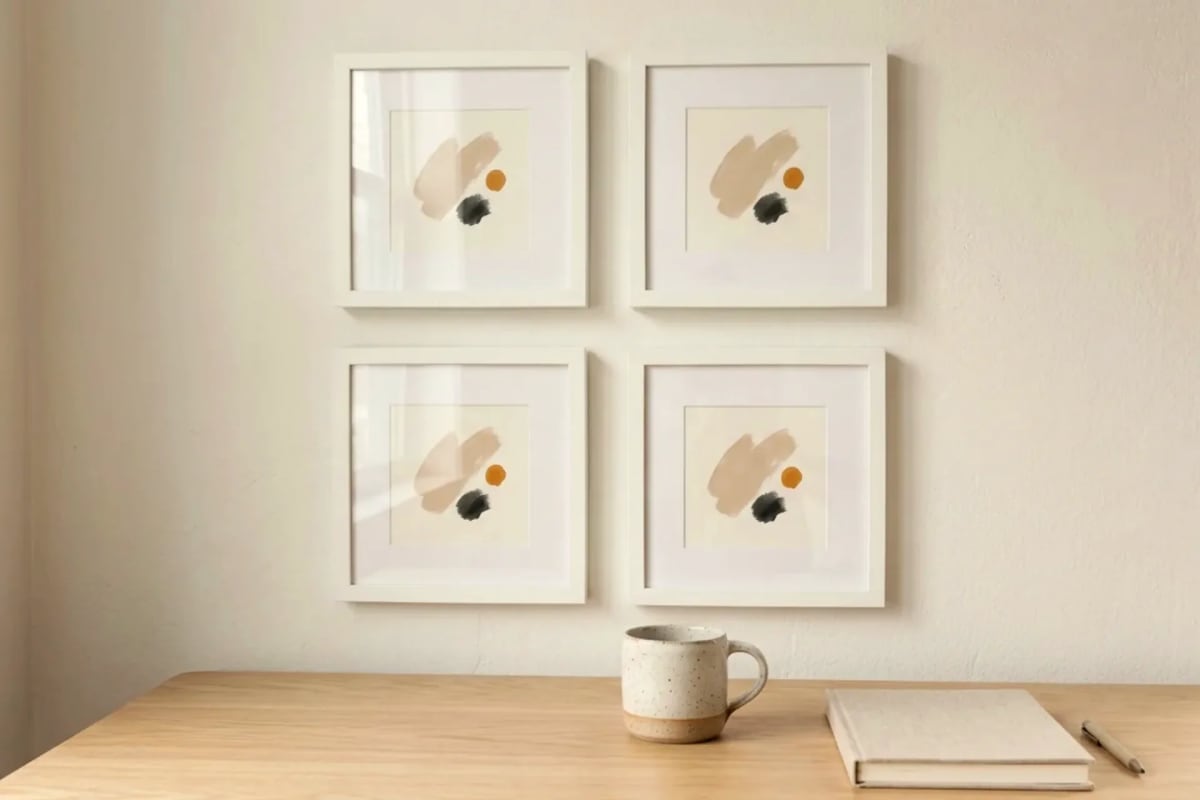
Idea 4: The 2x2 mini grid
Four identical small frames in a tight grid. Jewel-box precision — it reads as one composed artwork from across the room.
Measurements: four 20×20 or 20×25 cm frames, 5 cm gaps. A 20×25 cm 2×2 with 5 cm gaps = 45×55 cm total. Center the grid at 145 cm. Matching frames are non-negotiable here; the grid lives or dies on uniformity.
Best for: sets of four — botanical prints, travel photos, abstract series. Above a desk or dresser it acts like a window.
Idea 5: The corner cluster
When no single wall is big enough, wrap a small cluster around a corner: 3 pieces on one wall, 2 on the adjoining wall. The corner becomes a feature instead of dead space.
Measurements: keep frames 10 cm clear of the corner edge. Total 5 pieces max — 3 on the main wall, 2 wrapping. Spacing 5 cm throughout so both walls read as one arrangement. For exact corner-wrapping technique, our gallery wall templates cover the measurements in detail.
Idea 6: The above-furniture anchor
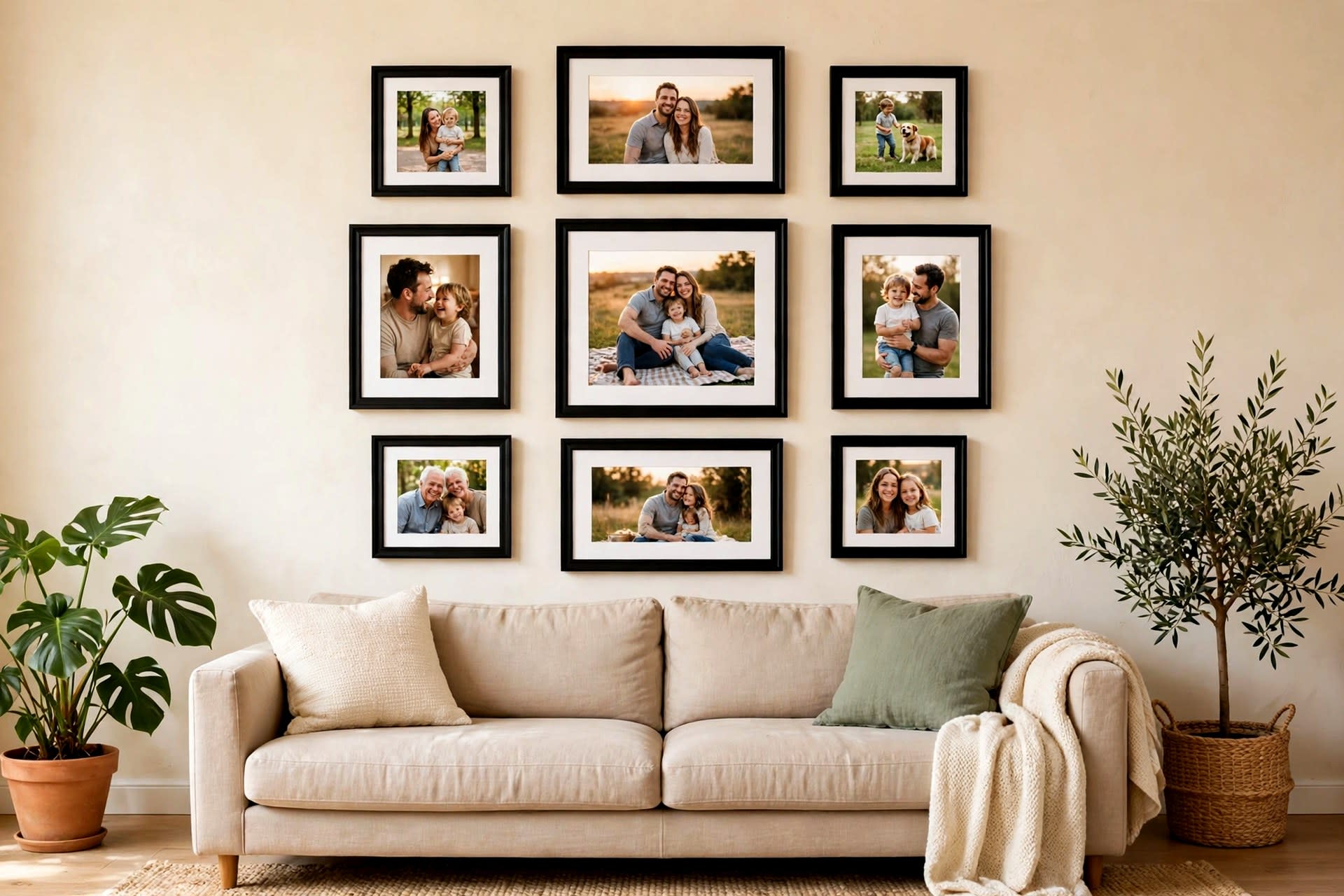
A tight cluster of 3–4 pieces directly above a console, desk, or dresser — the furniture grounds the arrangement so the wall doesn't need to be big.
Measurements: arrangement width = half to two-thirds of the furniture width. Bottom of the lowest frame 15–20 cm above the furniture top. A 120 cm console takes a 60–80 cm wide cluster beautifully.
Best for: entryway consoles, bedroom dressers, home-office desks — the hardworking walls of small homes.
Idea 7: The doorway surround
Frames arranged around a doorway — two stacks flanking it, or small pieces above the doorframe. It turns a plain pass-through wall into a gallery without needing a single large blank surface.
Measurements: flanking stacks: 2–3 small frames (20×25 cm) each side, 10 cm clear of the doorframe trim. Above the door: one horizontal piece centered, at least 15 cm above the trim.
Best for: hallways and small living rooms where the only "walls" are the bits between doors.
Color tricks that keep it airy
In a small room, color discipline matters more than layout:
- Two finishes max. Black + oak, white + brass — pick two frame finishes and repeat. Three or more finishes chop a small wall into visual confetti.
- One color family in the art. The pieces don't need to match, but they should share a palette — all warm neutrals, all blues, all black-and-white. Mixed palettes need space to breathe; small walls don't have it.
- Wide white mats. A 5–7 cm mat around each piece adds air inside the frame. Mats are the cheapest way to make inexpensive prints look gallery-grade.
- Light walls, light frames. Dark, heavy frames advance visually (feel closer); light frames recede. In a 10-square-meter room, that perception shift is real.
4 mistakes that shrink a room
- Too many tiny pieces. Twelve postage-stamp frames on a small wall reads as clutter, not curation. Fewer, slightly larger pieces always win in tight spaces.
- Dark, heavy frames everywhere. A wall of chunky black frames absorbs light and pulls the wall toward you. Mix in light wood or thin-profile frames.
- Hanging too high. The most common gallery wall mistake generally — and fatal in small rooms, where a high-hung cluster disconnects from the furniture and floats. Center at 145 cm; bottoms 15–20 cm above furniture.
- Covering the whole wall. Bare wall is not wasted wall. The 15 cm breathing room at the edges is what makes the arrangement feel intentional instead of desperate. For more layout options at any scale, browse our gallery wall layouts.
The takeaway
Small-space gallery walls are an editing exercise: 3–6 pieces, one clear idea, disciplined color, and 15 cm of breathing room at the edges. Pick the idea that matches your wall's shape — stack for narrow walls, ledge for renters, single statement for calm rooms — and hang it in an afternoon. Small walls don't limit gallery walls; they focus them. The constraint is the style.
Frequently asked questions
How many pictures should be on a small gallery wall? 3–6 pieces for walls under 150 cm wide. Three is the minimum for a "gallery" feel; beyond six, each additional piece needs to justify itself or the wall starts feeling cluttered.
What size frames work best for a small gallery wall? 20×25 cm and 30×40 cm do most of the work, with one anchor up to 40×50 cm. Keep every frame under two-thirds of the wall section's width.
How high should I hang a gallery wall in a small room? Center of the arrangement at 145 cm (57 inches) from the floor — same as large rooms. Above furniture, the bottom of the lowest frame sits 15–20 cm above the furniture top.
Can a gallery wall work in a rental? Absolutely — the ledge shelf idea needs only the shelf mounted (or even a tension-mounted ledge), and adhesive picture-hanging strips handle the rest. Our renter-friendly wall decor guide has the full damage-free method.
Should gallery wall frames match in a small space? For grids and stacks, yes — matching frames are the point. For clusters, limit yourself to two finishes and one art color family. Small rooms punish visual chaos faster than big ones.
What's the cheapest way to fill a small gallery wall? Printable art ($3–8 per print online) in thrifted frames ($2–5 each) with DIY-cut mats. A 4-piece 2×2 grid can cost under $40 total and look like $200.