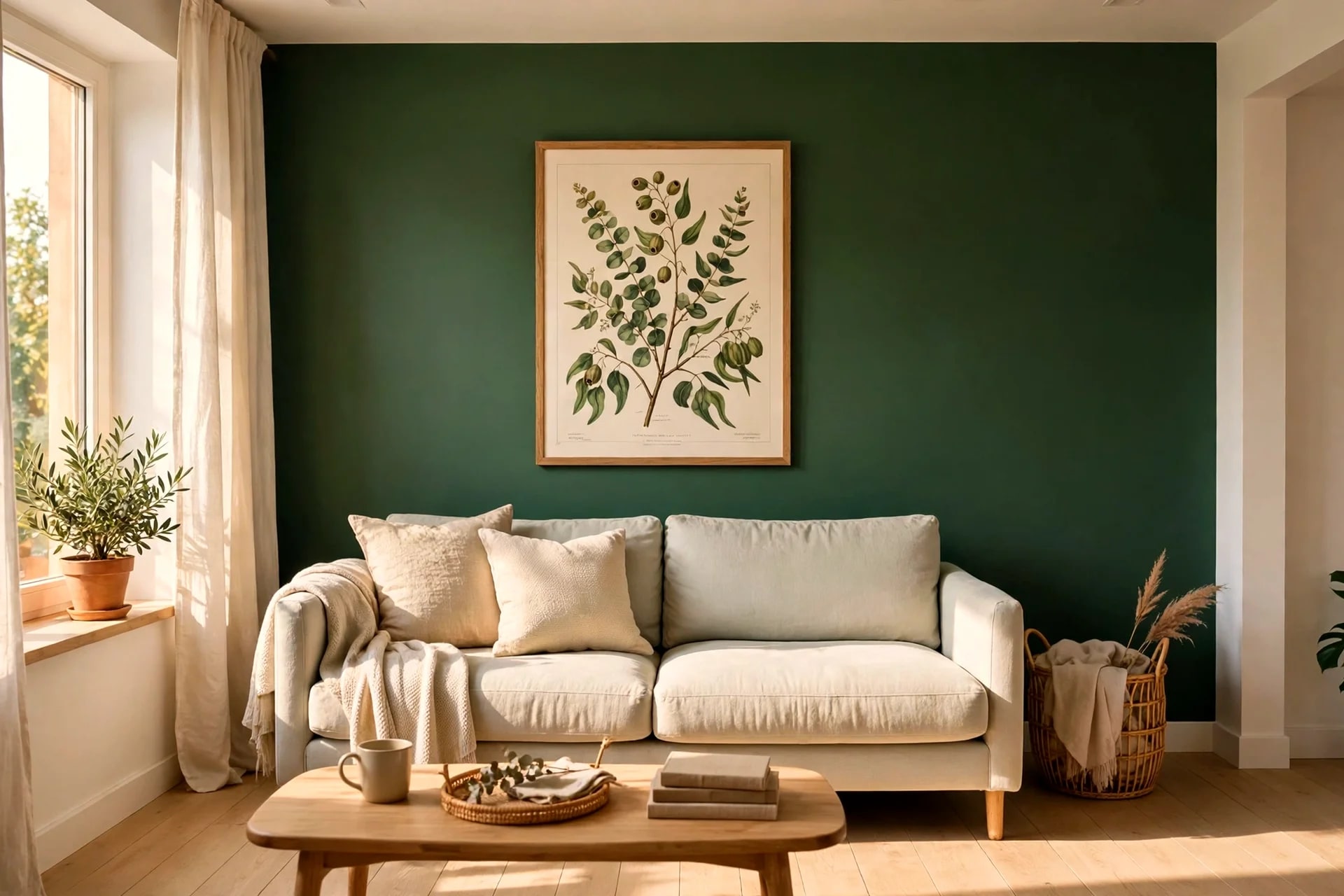
A small living room does not need more floor space to feel interesting. It needs one wall doing a clear job: a well-chosen accent gives the eye somewhere to land and can make the room feel deeper. Get the wall or contrast wrong, though, and it can make a compact room feel boxed in.
That is why this guide starts with choice, not colour: 15 ideas grouped by method, paint quantities and costs, a renter ranking, and a removable project.
Key Takeaways
- Choose the wall you face on entering, usually the sofa wall; avoid walls broken by doors, windows, or storage.
- One strong accent works best when the other walls stay light.
- Paint costs roughly $30–$80 per wall; slats and moulding cost more but add texture.
- Renters should start with framed panels, leaning art, or peel-and-stick treatments.
- Vertical lines, restrained contrast, and a good mirror beat a darker colour alone.
Table of Contents
- Choosing the Right Accent Wall
- Paint Ideas That Add Depth
- Wallpaper and Fabric Panels
- Wood Slats and Panel Moulding
- Limewash and Textured Finishes
- Gallery, Mirror and Art Accents
- Half-Height, Arch and Colour-Block Ideas
- Paint Quantities and Costs
- Renter-Friendliness Ranking
- Small-Room Rules
- Step by Step: Renter-Safe Wallpaper Panel
- Common Mistakes and Fixes
- FAQ
Choosing the Right Accent Wall
Stand in the doorway. The wall your eyes meet first is usually your strongest candidate, because an accent wall works as a focal point, not a surprise behind you. In most small living rooms that is the sofa wall, which already anchors the seating. The TV wall is second-best when the television centres the room; keep it calm so it frames the screen. A fireplace wall can also work when the fireplace is the room's natural heart, but only if the chimney breast is wide enough to balance the finish.
Light matters as much as layout. A wall in soft, indirect daylight shows colour honestly all day, while a wall facing a large window can look washed out at midday and much darker in the evening. Test your colour at three times of day, with a test patch at least 60 cm square. North-facing walls cool colours down, so warm sage or terracotta often suit them better than cool grey.
Disqualify some walls straight away. Skip any wall broken up by two doors, a large window plus a radiator, or floor-to-ceiling storage: the treatment will read as fragments. Skip a wall holding the busiest shelving, and skip a short return wall beside a door — an accent needs at least 2 metres of uninterrupted width. For styling, see these small living room wall decor ideas.
Paint Ideas That Add Depth
Paint is the simplest and cheapest accent in a small room. One tin usually covers the whole wall. Choose a colour two to three shades deeper than the other walls, not near-black, unless the room has generous daylight and very light furniture.
1. Warm deep green behind the sofa. Muted forest or olive green adds depth without coldness and pairs with oak, rattan, and cream upholstery.
2. Soft terracotta for warmth. Terracotta brings instant warmth to a pale room and suits modern and bohemian schemes.
3. Warm navy with light furniture. Navy feels cocooning rather than cramped when the sofa is pale, the floor is light, and curtains stay sheer. If your sofa is dark, choose softer slate blue. For undertones, see our guide to the best paint colors small living room.
Wallpaper and Fabric Panels
Wallpaper gives pattern and texture paint alone cannot, but a full wall of bold pattern can overwhelm a compact space. Panels solve that: they frame the pattern and limit its area.
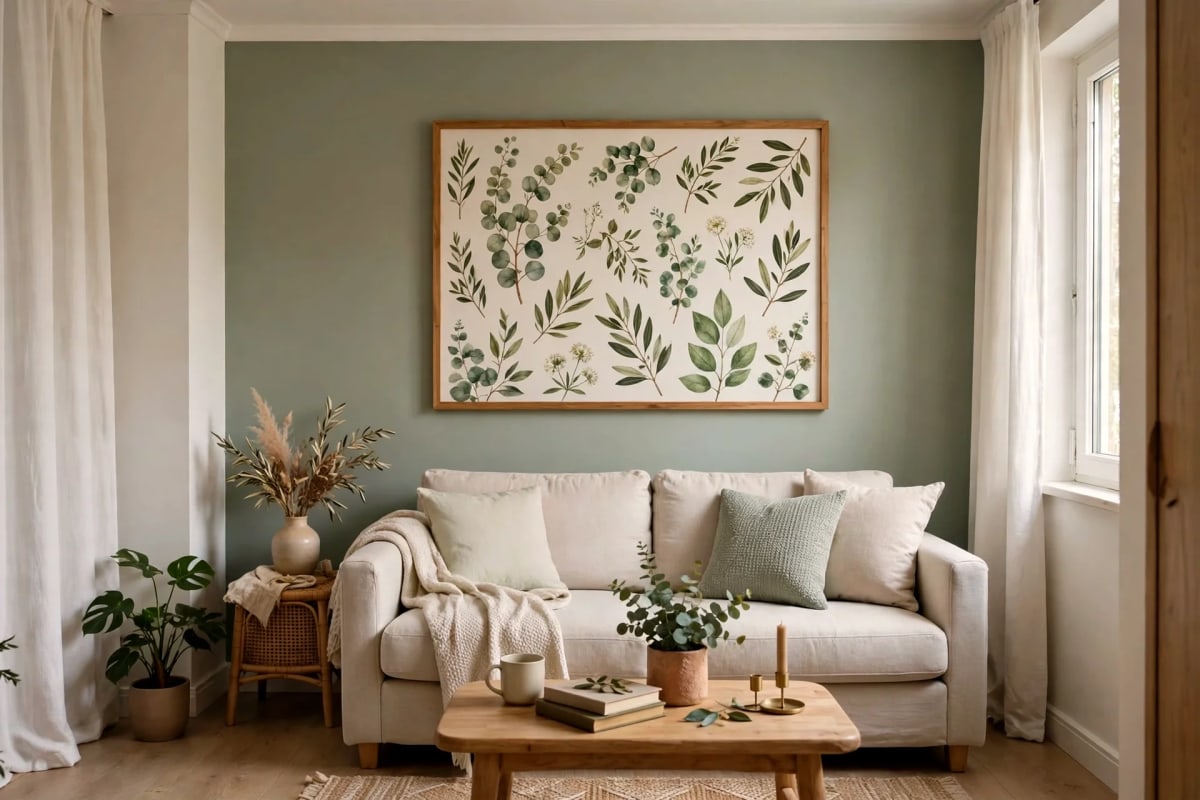
4. A single framed wallpaper panel. Choose one panel roughly 120 cm by 180 cm, centred above the sofa, with a calm botanical, linen, or subtle geometric paper in a painted or timber frame.
5. Peel-and-stick wallpaper on one wall. Modern peel-and-stick papers are genuinely removable on smooth, painted walls and suit renters well. Stick to small-scale patterns, vertical stripes, or soft textures. See our peel-and-stick wallpaper accent wall guide.
Wood Slats and Panel Moulding
Timber and moulding add shadow, rhythm, and height flat paint cannot match. Both suit small rooms well if the profile stays slim.
6. Vertical wood slats in a natural finish. Narrow slats, spaced evenly and run floor to ceiling, draw the eye upward and make a low ceiling feel taller. Light oak, or a painted finish close to the wall colour, keeps the effect airy. See our wood slat accent wall guide.
7. Painted panel moulding rectangles. Moulding rectangles painted the wall colour add detail without visual weight. Keep them large and few — two or three tall panels read calmer than many small boxes.
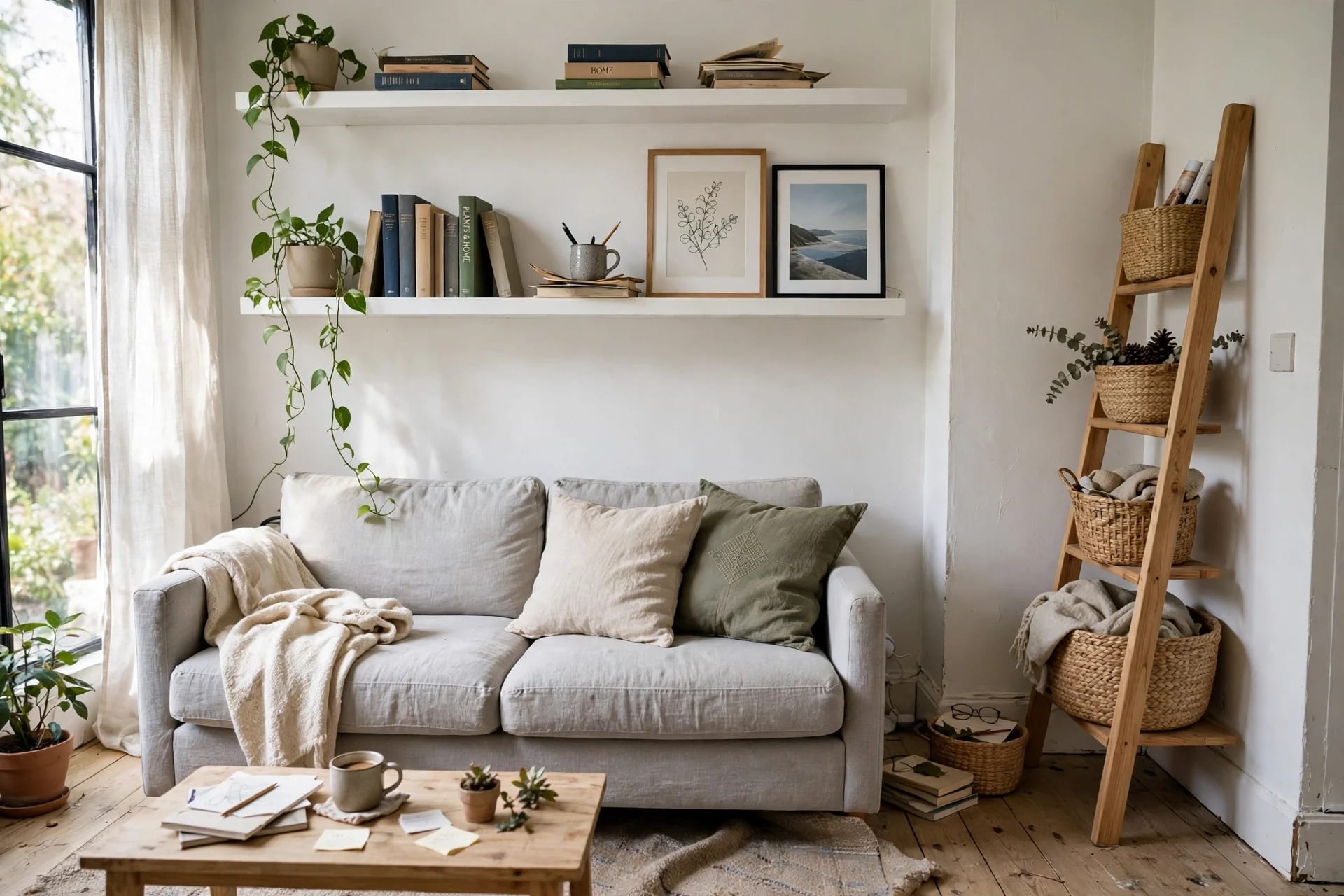
8. A slim picture-ledge accent. One or two timber ledges turn the accent wall into a changeable gallery. Lean framed prints on them rather than hanging a crowded grid.
Limewash and Textured Finishes
Textured finishes suit small rooms because they add interest through light and shadow, not strong colour.
9. Limewash in a warm neutral. Limewash creates gentle movement as light moves across the wall, with soft cloudy variation flat paint lacks. Choose warm white, plaster pink, or pale clay, applied with a block brush. Two coats usually suffice.
10. Subtle plaster-effect paint. A fine plaster-effect paint gives a tactile surface without the cost or mess of real plaster. Keep colour and texture subtle.
Gallery, Mirror and Art Accents
Sometimes the accent is not a finish at all, but an arrangement on a calm wall. This suits renters and minimal rooms.
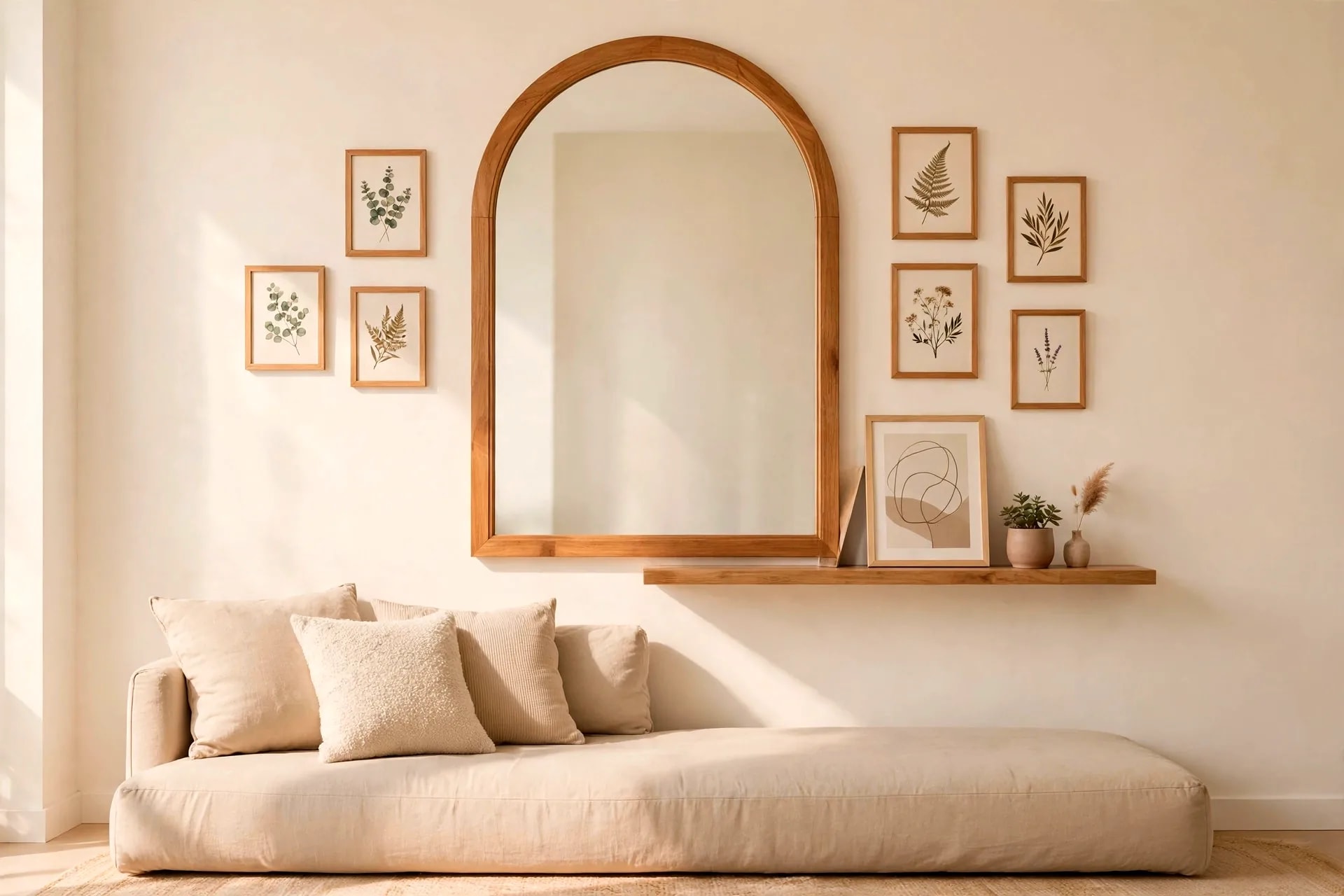
11. A tight gallery above the sofa. Five to seven frames in one finish, hung with consistent spacing, create a focal point without covering the wall. Use one large anchor piece in the centre and smaller pieces around it.
12. A large mirror as the accent. One generous mirror above a console or sofa doubles light and gives the illusion of depth. Place it where it reflects a window, not a television or clutter. See our DIY wall decor guide.
Half-Height, Arch and Colour-Block Ideas
Half treatments are the small room's secret weapon. They add colour while leaving the upper wall light, so the ceiling still feels high.
13. A painted half wall with a crisp line. Paint the lower third or half in a deeper tone and leave the upper wall warm white. A clean horizontal line, finished with slim trim, gives a tailored feel behind a low sofa.
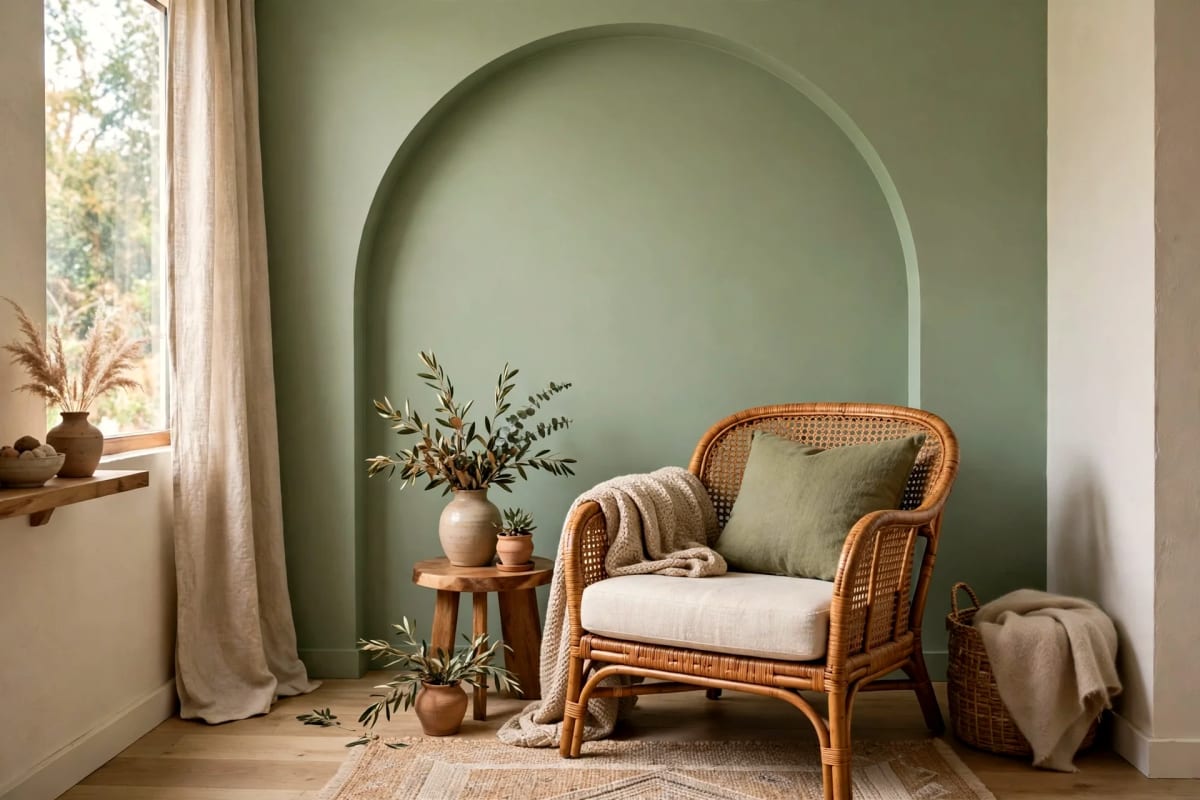
14. A painted arch behind a chair or console. An arch frames a reading chair, console, or plant grouping without painting a whole wall. Keep it at least 20 cm wider than the furniture. See our painted arch accent wall guide.
15. A colour-blocked corner zone. Paint a single block of colour wrapping slightly around a corner, or a zone behind a desk or reading nook. This defines a zone in an open-plan space without building anything.
Paint Quantities and Costs
Measure width times height, minus roughly 10% for furniture covering part of the wall. One litre covers 10–12 square metres per coat; most accent walls need two coats.
| Wall | Area | Paint (2 coats) | Paint cost | Total cost | | --- | --- | --- | --- | --- | | 2.4 × 2.4 m | 5.8 sq m | 1 litre | $25–$40 | $30–$80 | | 3.0 × 2.4 m | 7.2 sq m | 1.5 litres | $30–$50 | $40–$100 | | 3.6 × 2.7 m | 9.7 sq m | 2 litres | $40–$65 | $55–$130 | | Framed wallpaper panel | 2.2 sq m | 1 roll + frame | $35–$90 | $60–$160 | | Wood slats, 3.0 m | 3.0 m wide | Slats + fixings | $90–$220 | $120–$300 |
Buy one tin size up if your wall sits close to a coverage boundary.
Renter-Friendliness Ranking
The cheapest idea is not always the safest rented option. Check your tenancy agreement before drilling or using adhesive.
| Rank | Treatment | Removal | Deposit risk | | --- | --- | --- | --- | | 1, fully removable | Leaning art, mirror, framed panel | Lifts off; fill tiny holes | Very low | | 2, removable | Peel-and-stick wallpaper, decals | Peels away cleanly | Low | | 3, low commitment | Paint with permission | Repaint to original colour | Low to moderate | | 4, semi-permanent | Adhesive moulding, slats | May pull paint | Moderate | | 5, permanent | Glued slats, pasted wallpaper, microcement | Needs filling, repainting | High |
When in doubt, choose one rank higher on removability than you need.
Small-Room Rules
Most disappointing results come from breaking one quiet rule, not choosing the wrong colour.
Limit the contrast. Aim for a colour two to three shades deeper than the surrounding walls. Extreme contrast — near-black against bright white — shortens the room visually.
Keep the other walls light and quiet. The accent only works because the rest of the room recedes.
Match furniture scale to the wall. Pull the sofa 5–10 cm off the wall if space allows, and avoid a tall bookcase against the accent wall.
Use mirrors for light, not just decoration. A mirror opposite or beside a window bounces daylight deeper into the room and softens a dark accent. Hang its centre roughly 140–150 cm from the floor.
Use vertical lines for ceiling height. Vertical slats, tall moulding, and floor-to-ceiling curtains stretch the room upward. Run treatments to the ceiling where possible.
Step by Step: Renter-Safe Wallpaper Panel
This project gives a genuine wallpaper accent with no paste on the wall and only two small hook holes to fill later. Allow about 90 minutes.
You will need: one roll of wallpaper, a lightweight frame or four slim timber battens, a backing panel cut to 120 cm by 180 cm, wallpaper paste or spray adhesive, a craft knife, a spirit level, and two picture hooks rated for at least 5 kg.
Step 1 — Measure and mark. Find the centre of the sofa wall. Mark a rectangle 120 cm by 180 cm, centred above the sofa, with its lower edge about 20 cm above the sofa back. Check with a spirit level.
Step 2 — Prepare the backing panel. Cut the board to size. If you use plywood, paint its edges to match the frame.
Step 3 — Apply the wallpaper. Cut lengths 5 cm longer than the board. Paste or spray the board, lay the first length from the top, smooth outward, and trim once dry. Match the pattern at each join.
Step 4 — Frame it. Fix the slim timber frame around the board with wood glue and small pins, or slide the board into a ready-made frame.
Step 5 — Hang it. Fix two picture hooks at the marked top corners, about 90 cm apart, and hang the panel centred on the sofa. On moving out, lift it off, fill the holes, and touch up. Total cost typically runs $60–$160.
Common Mistakes and Fixes
Painting the wrong wall. A bold colour on a wall broken up by doors or a window reads as patches. Fix: repaint it and move the accent to the sofa wall.
Going too dark in a dim room. A near-black accent in a north-facing corner can make the room feel smaller by evening. Fix: repaint two shades lighter and add a mirror opposite the window.
Adding a second accent by accident. A patterned rug, bold curtains, and a gallery wall can each compete with the accent. Fix: simplify one element — swap patterned curtains for plain linen.
Stopping slats short of the ceiling. A treatment that stops part-way down leaves an awkward band. Fix: extend it to the ceiling.
Hanging art too high above the sofa. Art hung near the ceiling disconnects from the seating. Fix: hang the centre 140–150 cm from the floor.
Ignoring the ceiling and floor. A dark accent with a yellowed ceiling or a clashing rug undermines the effect. Fix: freshen the ceiling in bright white.
FAQ
Which wall should be the accent wall?
Choose the wall you face when you enter, usually the sofa wall, because it anchors the seating. Avoid walls broken up by doors, windows, or storage.
Does an accent wall make a small room look smaller?
It can, but only when the contrast is extreme, the pattern is large, or the other walls are busy. A colour two to three shades deeper than its neighbours usually makes the room feel deeper.
What is the best accent wall colour for a small room?
Warm, muted tones work best: sage green, warm terracotta, soft slate blue, warm greige, or pale clay limewash.
Are accent walls still in style?
Yes, when they are one calm focal point. Current styles favour textured finishes, slim slats, panel moulding, and half-height treatments.
Can renters have an accent wall safely?
Yes. Framed wallpaper panels, leaning mirrors and art, and peel-and-stick wallpaper on sound paint are safest. Paint with written landlord permission is also common, provided you repaint before moving out.
How much does an accent wall cost?
Paint is cheapest at roughly $30–$100 for a typical sofa wall. A framed panel costs $60–$160, panel moulding $90–$200, and vertical wood slats $120–$300.