A small living room punishes every decorating mistake twice. One oversized frame swallows the wall, one dark colour shrinks the room, and a gallery hung without a plan turns the only feature wall into visual noise. Yet the same small room rewards good wall decor more than a large room does, because the walls are most of what you see.
The secret is restraint with intent. Small rooms do not need less decoration; they need decoration with a job: a mirror that bounces light, a shelf that holds books and art in one footprint, a gallery that follows one rule for size and spacing. This guide gives you those exact sizes, spacing and costs, plus one full mirror-centred gallery tutorial.
Key Takeaways
- A mirror should be at least two thirds the width of the sofa or mantel below it.
- Gallery frames work best at 8 by 10 to 16 by 20 inches, with 5 to 8 centimetres between frames.
- One anchored feature wall beats decoration scattered across every wall.
- Floating shelves styled as a gallery give the same look as a drilled gallery with fewer holes.
- Light walls, vertical lines and art hung slightly lower than usual make a compact room feel taller.
In this guide:
- Start with one feature wall
- Mirror rules that actually make rooms bigger
- Gallery walls that do not overwhelm
- Floating shelf galleries for small rooms
- 14 small living room wall decor ideas
- Step by step mirror centred gallery wall
- Renter safe wall decor for small rooms
- Common mistakes and fixes
- FAQ
Start with one feature wall
Walk into your living room and notice which wall your eye lands on first. In most small rooms it is the wall behind the sofa or the wall with the television or fireplace. That wall is your feature wall, and it should carry almost all of the decoration. The other walls get one quiet piece each at most — a single print, a small shelf, nothing competing for attention.
This prevents the most common small-room error: decoration on every wall, which chops the room into fragments and makes it feel smaller. Measure the feature wall first — its width, the sofa or mantel width below it, and the height from sofa top to ceiling — because those numbers drive every size choice that follows.
If your room has no obvious feature wall, create one: hang a large mirror or oversized print on the wall the sofa faces. For layout decisions behind this choice, see the small living room layouts guide.
Mirror rules that actually make rooms bigger
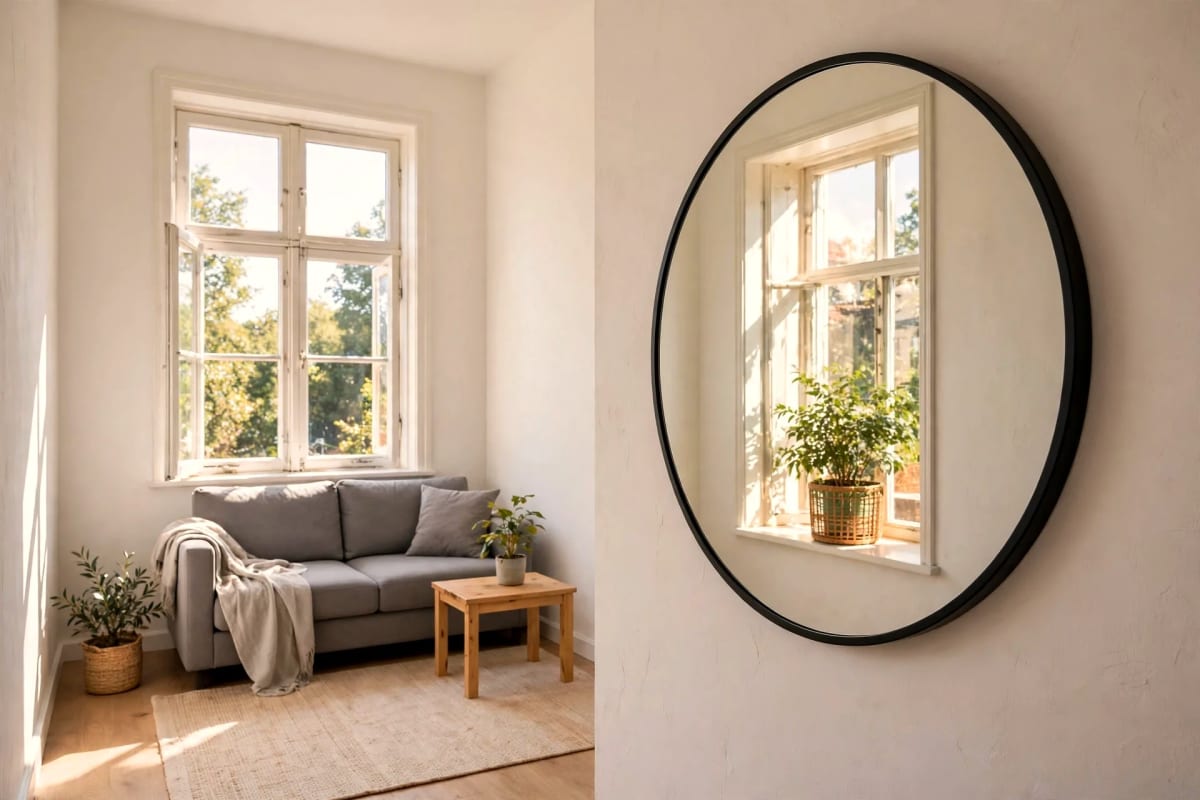
Mirrors only make a room feel bigger when they reflect something worth seeing: a window, a plant, a lit corner, an open doorway. A mirror facing a blank wall or a cluttered corner doubles the problem instead of solving it. Before you buy, stand where the mirror will hang and look at what it will reflect from the sofa. If the reflection is a window or greenery, hang it there. If it is a blank wall, move it.
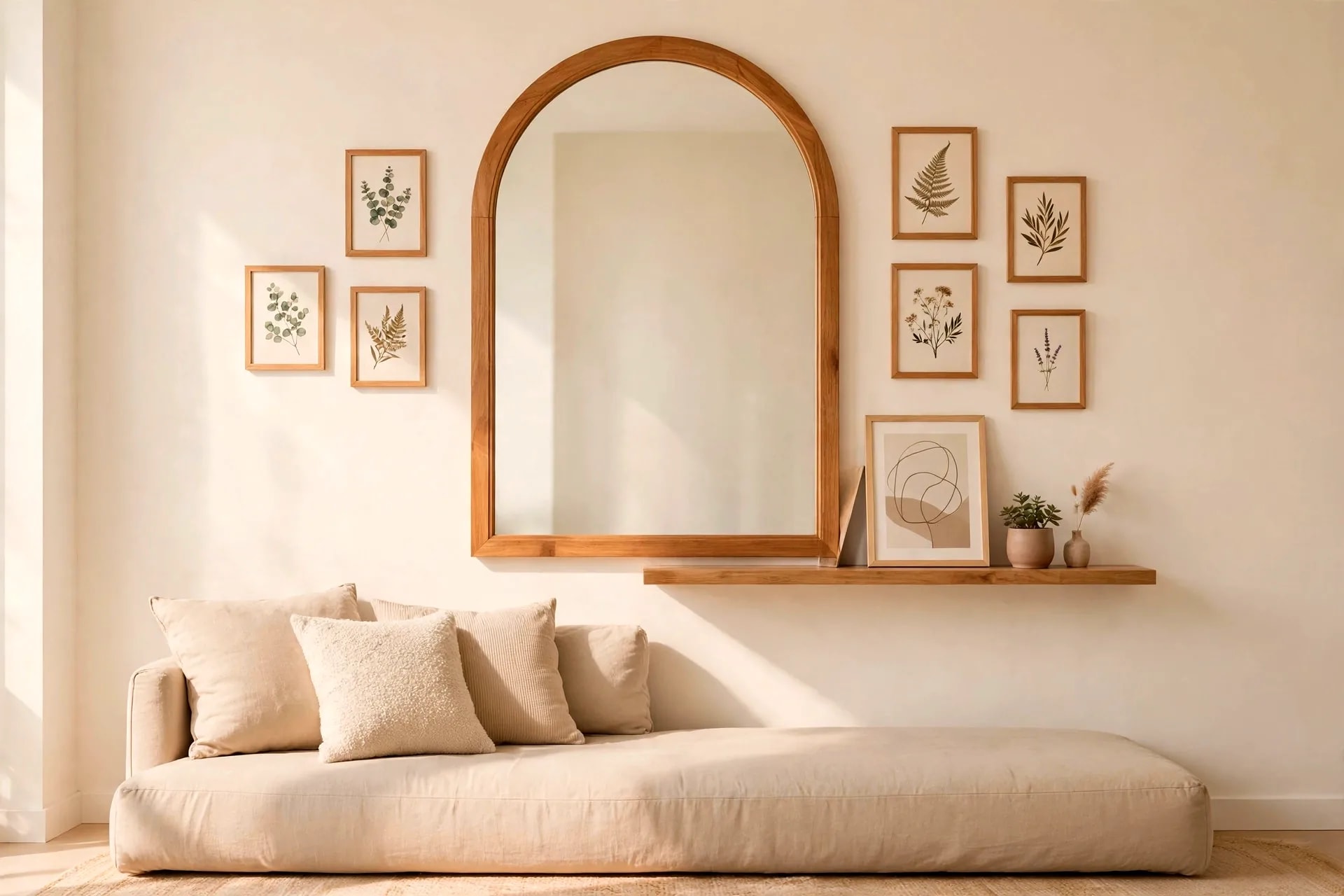
Size is the second rule. A mirror above a sofa or mantel should span at least two thirds of the furniture width below it: a 180-centimetre sofa wants a mirror at least 120 centimetres wide, and a 150-centimetre mantel wants at least 100 centimetres. Below that ratio the mirror looks apologetic. In a small room, one large mirror beats a cluster of small ones for the same reason it does in a hallway: a single unbroken reflection reads as an opening, while fragments read as decoration.
Shape matters too: an arched mirror draws the eye upward and helps low ceilings, a round mirror suits a gallery centrepiece, and a vertical rectangle adds height. Hang the centre at 145 to 155 centimetres, or 15 to 20 centimetres above the sofa back.
Gallery walls that do not overwhelm
Gallery walls fail in small rooms for two reasons: frames too large, or too many of them. The frame sizes that work are 8 by 10, 11 by 14 and 16 by 20 inches, mixed within one arrangement but never jumping straight from the smallest to the largest without a middle size to bridge them. Keep one frame colour throughout — black, oak or white — and let the art itself provide the variety.
Spacing is tighter than in a large room. A gap of 5 to 8 centimetres between frames keeps the arrangement reading as one piece rather than scattered pictures, which is exactly what a small wall needs. Lay the arrangement on the floor first, measure its total width, and check it against the two-thirds rule: the whole gallery should span roughly two thirds to three quarters of the sofa width below it. A gallery wider than the sofa looks top-heavy; narrower looks lost.
Centre the group at 145 to 150 centimetres, measured to the centre of the whole group, and use paper templates before hanging, because in a small room every crooked frame shows from a metre away. See the above-sofa wall decor and gallery wall layouts guides for full spacing formulas.
Floating shelf galleries for small rooms
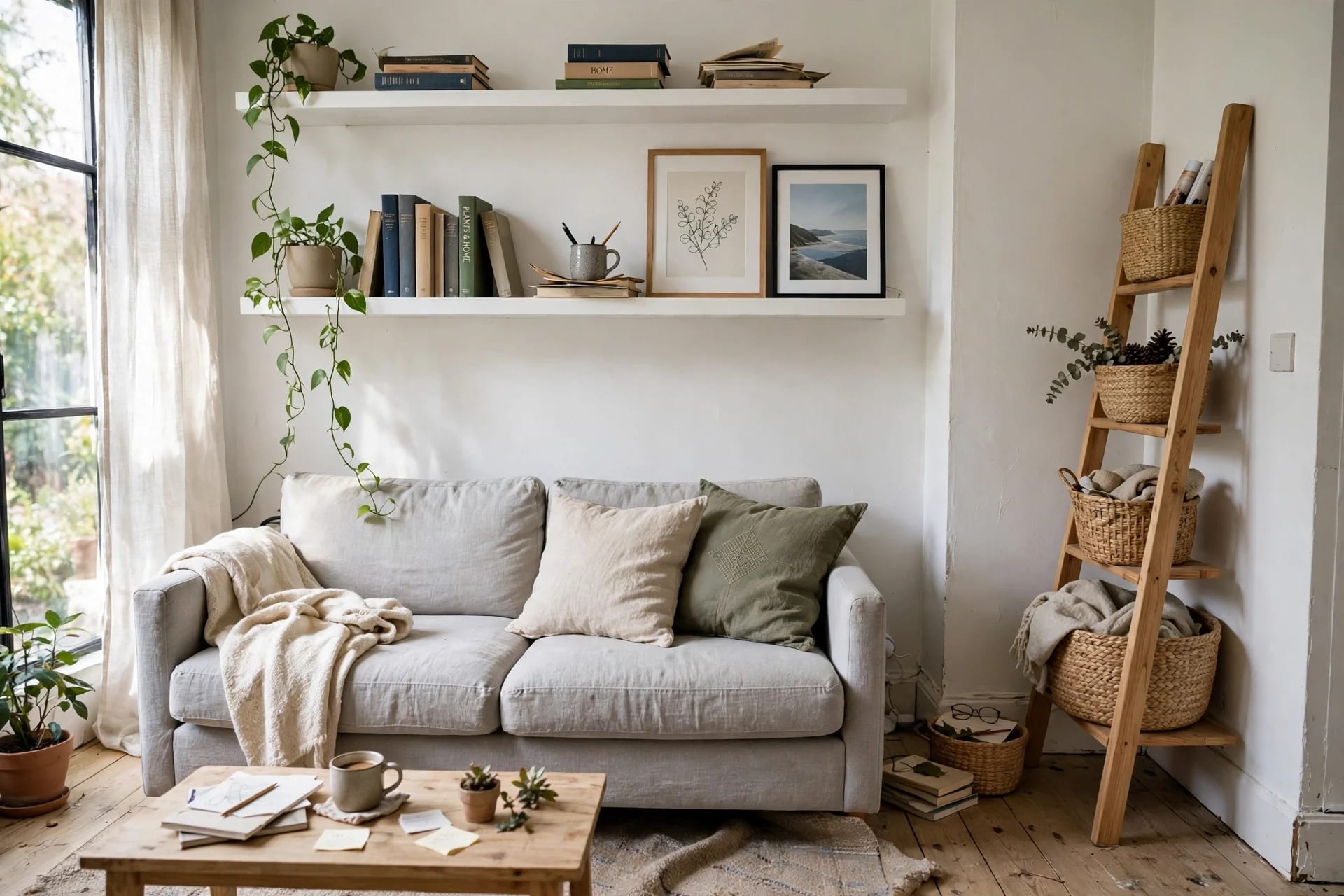
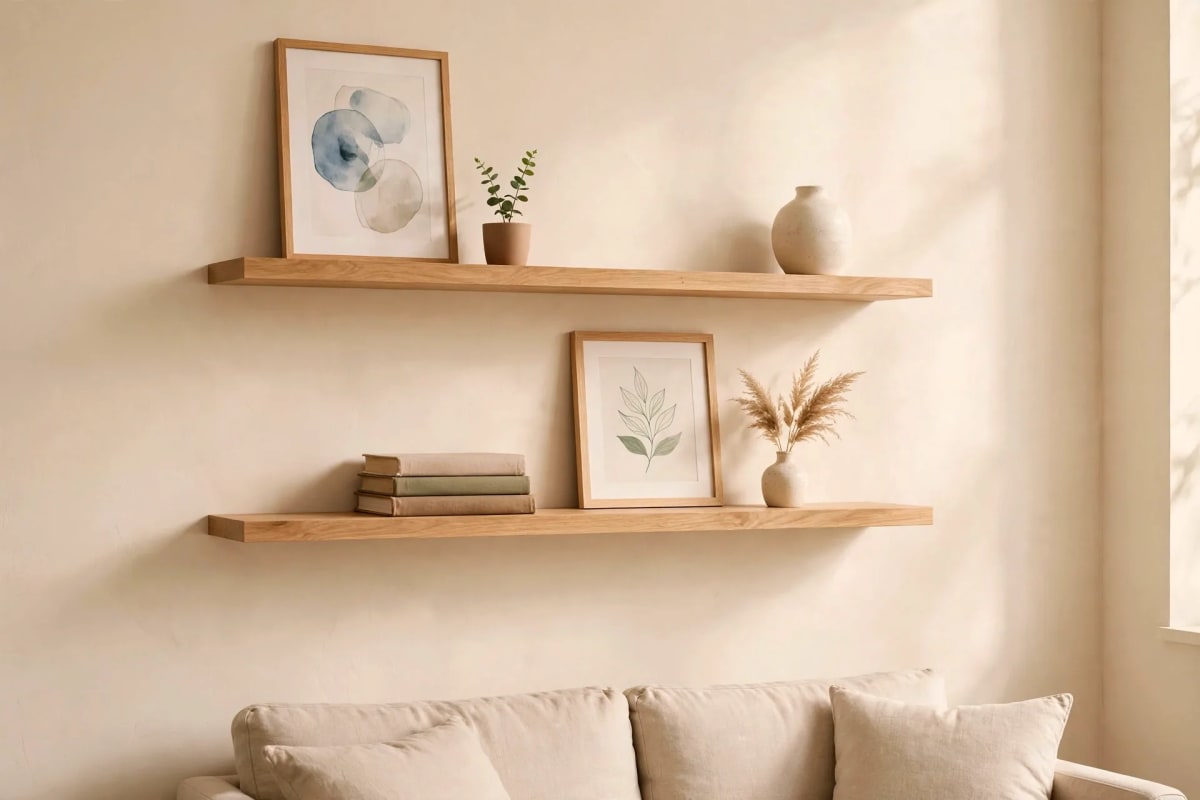
Floating shelves are the small room's best friend because they combine display, storage and decoration in 15 to 20 centimetres of depth. Two shelves above a sofa, spaced 35 to 45 centimetres apart vertically, hold leaning art, books and a plant without a single drilled frame hole per picture — and when you want a change, you swap the leaning pieces instead of patching the wall.
Style shelves by the rule of three: three groupings per shelf, mixing heights. A tall leaning print, a short book stack with a small object, and a trailing plant make a complete shelf. Leave empty space on every shelf — cramming every centimetre makes it look like a cupboard, not a display. Fix both shelves into studs or rated anchors: a 90-centimetre shelf of paperbacks can pass 15 kilograms.
Shelves also soften a television wall: one shelf beside the screen holds a plant and a print without competing with it. Do not hang art directly above a television without a clear 30-centimetre gap, or the two fight for attention.
14 small living room wall decor ideas
Costs are approximate and assume basic tools are already at home.
1. Arched mirror above the sofa
An arched mirror at least two thirds the sofa width, hung 15 to 20 centimetres above the sofa back. Cost around £40 to £140. Time 30 minutes.
2. Mirror centred gallery
A round or arched mirror as the centrepiece, surrounded by four to six small botanical or abstract prints. Cost around £50 to £120. Time two hours. Full tutorial below.
3. Two floating shelves as a gallery
Two oak shelves with leaning art, books and a plant. Cost around £40 to £90. Time one to two hours.
4. One oversized print
A single print 90 by 120 centimetres or larger on the feature wall, nothing else on that wall. Cost around £30 to £100 framed. Time 30 minutes.
5. Leaning art on a console
A large frame leaned on a console or sideboard, no drilling at all. Cost around £25 to £80. Time 10 minutes.
6. Vertical trio
Three prints in a vertical column beside a window or at the end of a sofa. Cost around £30 to £70. Time one hour.
7. Woven wall hanging
A large woven or macrame hanging adds texture and softness where frames feel hard. Cost around £25 to £80. Time 20 minutes. One hook holds most hangings, and they weigh very little.
8. Basket wall cluster
Flat woven baskets in graduating sizes above a sofa or sideboard. Cost around £20 to £45. Time one hour. Keep the cluster within the two-thirds width of the furniture below.
9. Framed wallpaper panels
Two or three large frames filled with a bold wallpaper you love, hung as art. Cost around £20 to £50. Time one hour.
10. Picture ledge with seasonal rotation
One long ledge above the sofa for art you swap with the seasons. Cost around £25 to £60. Time one hour.
11. Wall mounted plant display
A rail or small shelves for trailing plants on the feature wall. Cost around £20 to £50. Time one hour. Keep plants clear of the television's heat and check watering weight before hanging.
12. Grid gallery of nine
Nine identical frames in a strict three-by-three grid, same size, same spacing. Cost around £45 to £100. Time two hours.
13. Chalkboard or fabric pinboard
One framed board for notes, photos and children's art, keeping clutter off every other surface. Cost around £20 to £40. Time 30 minutes.
14. Light coloured panelling
Painted beadboard or slim battens on the feature wall, painted the same warm white as the walls, adding texture without colour. Cost around £50 to £110. Time one weekend.
Step by step mirror centred gallery wall
Choose your mirror first, because it sets the scale. For a 180-centimetre sofa, pick a mirror 120 centimetres wide or a round mirror 80 to 90 centimetres across, then choose four to six prints in 8 by 10 and 11 by 14 inches in one frame colour. Lay everything on the floor with the mirror in the centre and prints arranged around it, leaving 5 to 8 centimetres between pieces. Measure the total arrangement: it should span roughly two thirds of the sofa width.
Trace each piece onto paper and tape the shapes to the wall, mirror first, centred on the sofa at 145 to 155 centimetres. Step back to the far side of the room — the seated view matters more than the close-up view — and adjust until balanced. Mark nail points through the paper, hang the mirror first into a stud or rated anchor, then the prints. See the mirror wall decor ideas guide for sizing and reflection placement in depth.
Renter safe wall decor for small rooms
Small rental rooms benefit most from no-drill decor, because the walls are few and every hole shows. Adhesive strips handle most prints if you clean the wall, press for 30 seconds and wait an hour; leaning art and a leaning mirror need no fixing at all.
Peel-and-stick wallpaper on the feature wall, or framed wallpaper panels if your landlord is strict, adds pattern without paste. Avoid adhesive on textured walls, fresh paint under 30 days old, or wallpapered walls. See the renter-friendly wall decor guide for weight limits by adhesive type.
Common mistakes and fixes
The most common mistake is art that is too small for the wall. A single 8 by 10 print above a 180-centimetre sofa looks lost, and the fix is either a larger frame or a gallery that spans two thirds of the sofa width. Second, decoration on every wall: edit back to one feature wall and let the others breathe. Third, hanging art too high — centre at 145 to 150 centimetres for a small room, not at the top of the wall.
Fourth, dark walls with weak lighting, which shrink the room twice over: either lighten the walls or add wall and lamp light, deciding both together. Fifth, shelves packed edge to edge, which read as storage: remove a third of the objects and leave empty space on every shelf. Sixth, a mirror reflecting clutter: move the mirror until it reflects a window, a plant or an open doorway, because a mirror doubles whatever it faces.
FAQ
What size mirror should go above a small sofa? At least two thirds of the sofa width: 120 centimetres for a 180-centimetre sofa, 100 centimetres for a 150-centimetre sofa. A round mirror 80 to 90 centimetres across works as a gallery centrepiece above the same sofa.
How high should I hang art in a small living room? Centre the arrangement at 145 to 150 centimetres from the floor, or 15 to 20 centimetres above the sofa back. Measure to the centre of the whole arrangement, not to one frame.
Can a gallery wall work in a very small room? Yes, if frames stay at 8 by 10 through 16 by 20 inches, in one frame colour, with 5 to 8 centimetres between frames, spanning two thirds of the sofa width, on one feature wall only.
What wall decor is best for a rental small living room? Leaning art, a leaning mirror, adhesive-strip frames and framed wallpaper panels for pattern. All come down without patching, which matters most on the few walls a small room has.
Does a mirror really make a small room look bigger? Only if it reflects light or a view: a window, a plant, a lit corner or an open doorway. A mirror facing a blank wall or clutter doubles the dullest part of the room.
Should I paint a small living room dark? Only on one feature wall with strong lighting to support it. In a dim room, warm white or pale sage walls with colour in the art and cushions keep the room feeling larger.
A small living room does not need less personality, just better decisions: one feature wall, one mirror big enough to matter, spacing measured rather than guessed, and shelves that work as hard as the art. Start with the mirror and the feature wall, and the rest of the room falls into place around them.