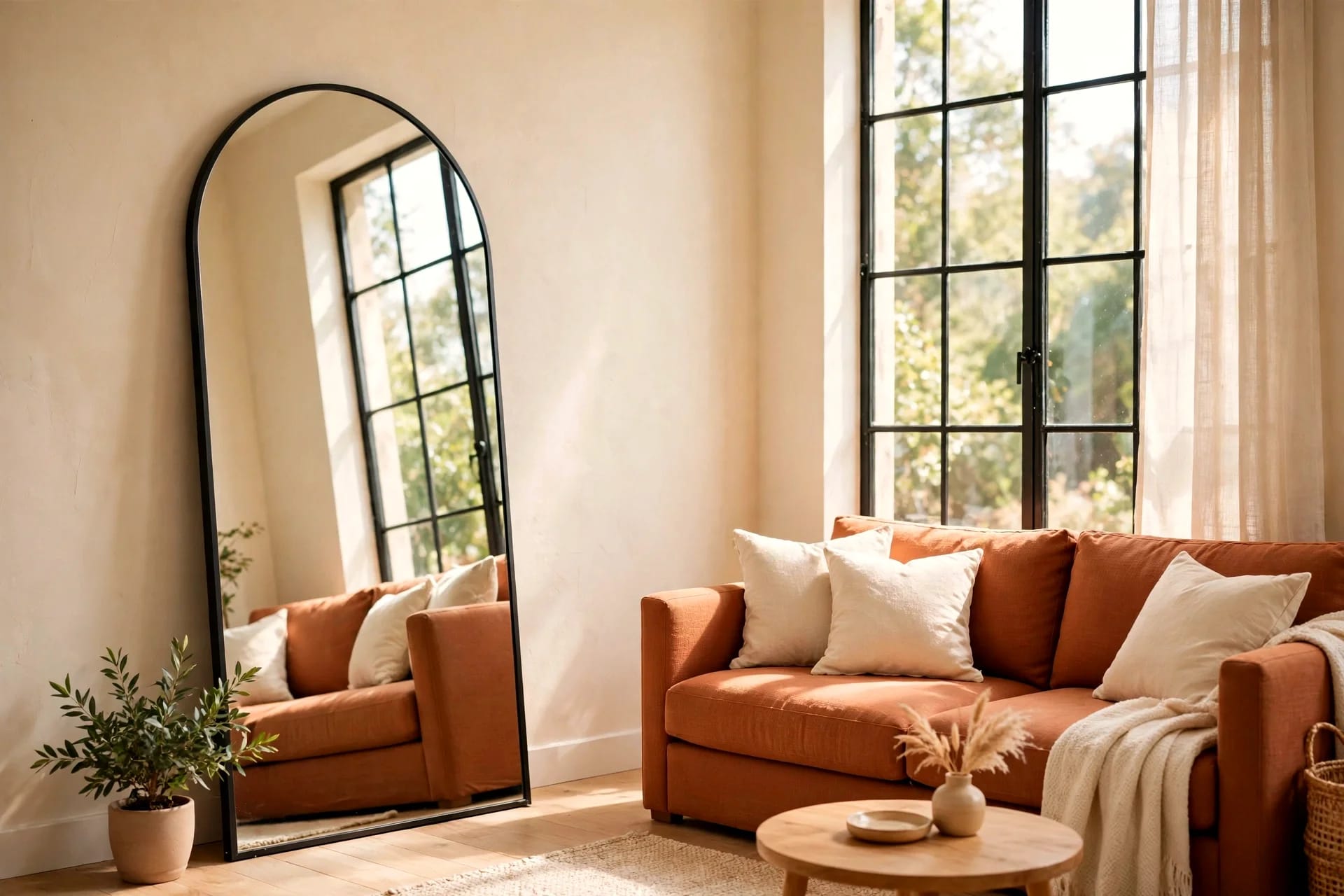
A mirror is the cheapest square footage a small living room can buy. It adds no floor space, yet a well-placed one makes the room feel wider, brighter and taller. The catch is that placement matters more than price: hung in the wrong spot, a mirror doubles your clutter, and one too small above a sofa looks like an afterthought.
This guide gives you the exact numbers other guides skip — hanging height, width-to-sofa ratio, distance from the window — then fifteen small living room mirror ideas built on those numbers.
Key Takeaways
- Hang a mirror opposite or beside a window, never facing clutter, so it reflects light and something worth doubling.
- Centre a mirror at 57 to 60 inches from the floor, and make it about two-thirds as wide as the sofa below it.
- Round mirrors soften small rooms, arched mirrors add height, and wide rectangles stretch a narrow wall sideways.
- Leaning floor mirrors suit renters, but anchor anything taller than 60 inches to the wall, especially with children or pets around.
- A good mirror costs $30 to $80; pay more only for thicker glass and a solid frame.
Table of Contents
- Why Mirrors Work in Small Living Rooms
- The Golden Rule: Mirror Placement vs Your Window
- Exact Sizing: How Big Should a Mirror Be Above a Sofa?
- Best Shapes for Small Rooms: Round, Arched and Rectangular
- Leaning vs Hanging: Renter-Friendly Options That Actually Stay Up
- Mirror Gallery Walls and Art Combos
- What NOT to Reflect: Clutter, TV Glare and Messy Corners
- Budget Guide: Good Mirrors at $30, $80 and $200
- FAQ
Why Mirrors Work in Small Living Rooms
A mirror does two jobs at once, and both matter more in a small room than a large one. First, it bounces daylight deeper into the room: a mirror opposite a window throws the brightest light back across the ceiling and the far wall, so the dim corner behind the sofa stops feeling like a cave. Second, it creates depth. The eye reads a mirror as a continuation of the room, so the wall stops feeling like a boundary.
One well-placed mirror opens a room up; three mirrors on three walls turn it into a hall of mirrors. Keep to one hero mirror per room. When the budget is tight, put the money into glass area first. If you already have a large mirror, spend the money on better lighting instead — see the small living room lighting guide.
The Golden Rule: Mirror Placement vs Your Window
Every placement decision starts with the window. Stand where you plan to hang it and look at what it will face: facing the window, it catches the brightest view in the room; facing a blank wall, it doubles a blank wall.
1. Opposite the window for maximum light
Hang the mirror on the wall directly across from your largest window and it becomes a second window. Daylight hits the glass and bounces straight back into the room. Keep the mirror's centre at 57 to 60 inches from the floor, and leave 6 to 8 inches of clear wall between its bottom edge and any furniture below it.
2. Beside the window to borrow the view
If the wall opposite the window is taken — by a television, a bookshelf or the only wall the sofa fits against — hang the mirror on the wall beside the window instead, at a right angle to it. The mirror still catches daylight, now from the side, and reflects the view at an angle, which reads as depth rather than glare. Avoid hanging a mirror directly facing the television: it catches screen glare in the evening and reflects a black rectangle during the day.
Exact Sizing: How Big Should a Mirror Be Above a Sofa?
Guessing sizes is how small rooms end up with a postage-stamp mirror floating above a three-seat sofa. The two-thirds rule fixes it: a mirror (or a mirror grouping) above a piece of furniture should span roughly two-thirds of that furniture's width. Smaller than two-thirds looks lost; wider than the furniture looks like it is swallowing it.
The centre of the mirror should sit at 57 to 60 inches from the floor, or 6 to 8 inches above the furniture it hangs over, whichever is lower. Measure from the floor and use a spirit level: older walls are rarely level.
- 60-inch loveseat: 40-inch mirror (a 36-inch round works)
- 72-inch sofa: 48-inch mirror
- 84-inch sofa: 56-inch mirror
- 36-inch console: 24-inch mirror (24 to 30-inch round)
- 48-inch console: 32-inch mirror (30 to 36-inch round)
3. The two-thirds sofa mirror
Take your sofa's width, multiply by two-thirds, and buy close to that number. For a standard 72-inch sofa that means a 48-inch-wide mirror, centre at 58 inches from the floor, bottom edge about 7 inches above the sofa back. If you cannot find exactly 48 inches, go slightly larger: a 50-inch mirror looks generous, while a 36-inch one looks like a mistake.
4. The oversized mirror that reads as a window
In a room under 150 square feet, one oversized mirror — 60 inches tall or more — on the longest wall does more than any collection of small ones. Expect to pay $80 to $150, and budget for proper fixings: a mirror this size weighs 20 to 35 pounds.
Best Shapes for Small Rooms: Round, Arched and Rectangular
Shape is not decoration; it changes how the room feels. A round mirror softens a room full of rectangles, and its lack of corners makes a tight wall feel less crowded.
5. The round mirror above a console
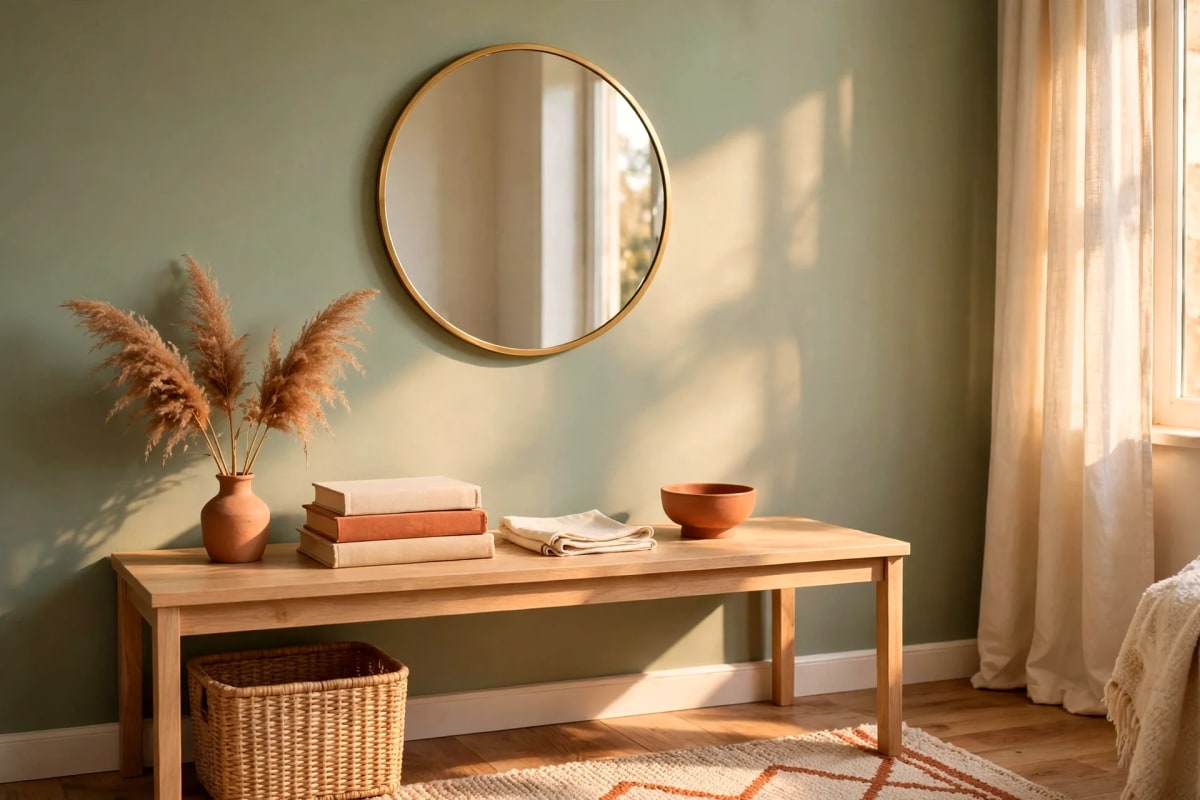
A round mirror is the safest first mirror for a small living room, and the easiest to style. Hang a 30 to 36-inch round mirror above a console table, centre at 57 to 60 inches from the floor, and dress the console with a tall vase, a stack of books and a low bowl. The small living room wall decor ideas guide shows how a round mirror anchors a whole wall arrangement.
6. The arched mirror for low ceilings
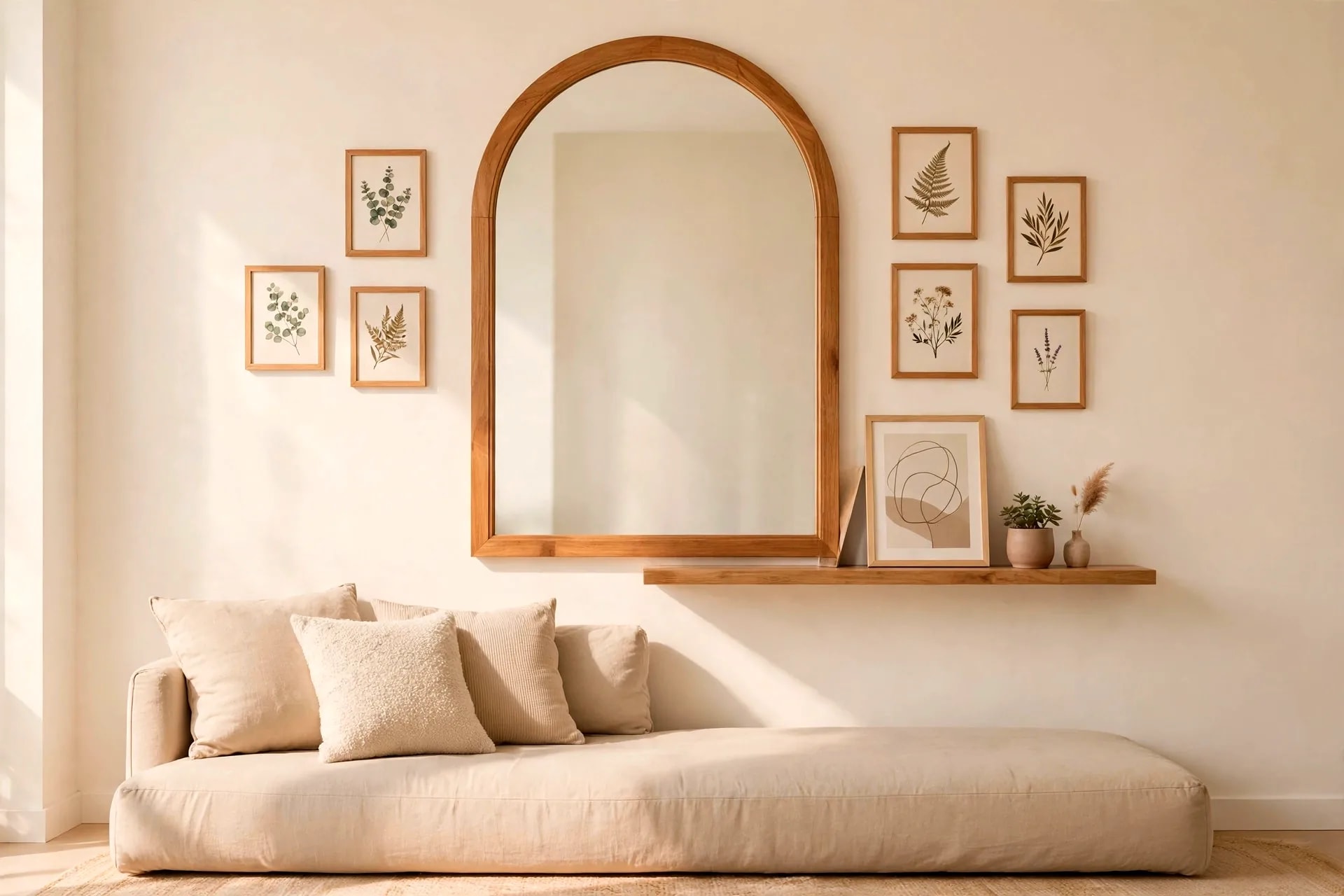
If your ceiling is under 8 feet, an arched mirror is the most flattering shape you can buy: the curve pulls the eye upward and the tall proportions make the wall feel taller. A 60 to 65-inch arched mirror leaned beside the sofa, or hung above a slim console, is the classic small-room move. Keep at least 4 inches of clear wall on each side.
7. The wide rectangle for narrow rooms
A long, narrow living room needs horizontal emphasis, and a wide rectangular mirror delivers it: hang a 48 by 30-inch landscape mirror above the sofa, long edge horizontal, and the wall reads wider. Keep the frame thin — slim black or oak — because a chunky frame eats the very width you are trying to create. If the room is both narrow and dark, choose frameless glass: it maximises the reflective area.
Leaning vs Hanging: Renter-Friendly Options That Actually Stay Up
8. The leaning floor mirror
A floor mirror leaned at 5 to 10 degrees from vertical is the renter's best friend. It suits tall arched and rectangular mirrors from 60 to 72 inches high, and it works best in a corner or beside the sofa, where the lean reads as intentional. Safety rules are non-negotiable: the base must sit on a flat floor, not a rug edge, and anything taller than 60 inches needs a furniture anchor or anti-tip strap.
9. Renter-friendly hanging that holds
If you prefer a hung mirror, you do not need to drill: adhesive picture-hanging strips rated for the mirror's weight hold mirrors up to about 16 pounds on smooth, clean walls — enough for a 24 to 30-inch round mirror — but they fail on textured plaster and anything heavier, so weigh the mirror first and read the rating. The renter-friendly wall decor guide covers damage-free fixings in detail.
A 36-inch round mirror weighs 12 to 18 pounds; a 48-inch rectangle weighs 20 to 30 pounds. Buy fixings rated for at least double the mirror's weight, and hang from two points rather than one.
Mirror Gallery Walls and Art Combos
10. The mirror gallery grid
A grid of four or six identical small mirrors — 12 to 16 inches each, in matching frames — reads as one large mirror, Space the mirrors 2 to 3 inches apart and hang the grid with its centre at 57 to 60 inches from the floor. Keep the frames identical.
11. The mirror and art combo
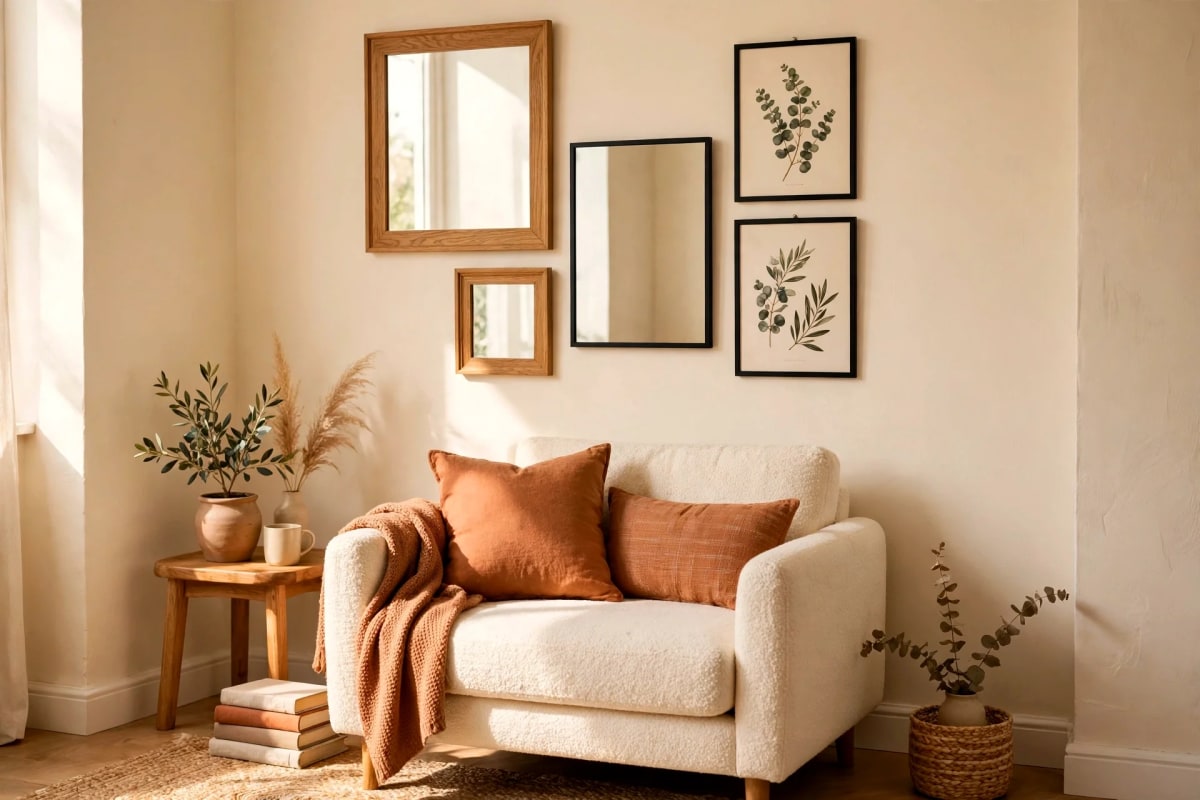
The most useful pairing in a small living room is a mirror beside a piece of art, not above it. Hang a round mirror and a framed print side by side, centres aligned and 4 to 6 inches apart: the mirror doubles the light while the art supplies the colour. This combo is also the fix for a wall too narrow for a sofa-sized mirror: a 24-inch round mirror plus a 16 by 20-inch print fills a 48-inch wall beautifully. The gallery wall layouts guide covers spacing for mixed media.
12. The mirror over a shelf vignette
A small mirror above a picture ledge or floating shelf gives you two layers of decoration for one wall. Keep the mirror 6 to 8 inches above the shelf so the objects do not crowd the glass, and keep the shelf styling low — nothing taller than a third of the mirror's height. The mirror wall decor ideas guide covers pairing mirrors with other wall pieces.
What NOT to Reflect: Clutter, TV Glare and Messy Corners
13. Aim it at something worth doubling
Before you hang anything, test the reflection: hold the mirror up and check what it catches. A window, a plant, a piece of art and a tidy shelf are worth doubling; laundry, an open wardrobe and the kitchen sink are not. If the only available reflection is clutter, fix the clutter first or move the mirror. Never aim a mirror at a television or a coat pile, and never put two mirrors directly opposite each other.
Budget Guide: Good Mirrors at $30, $80 and $200
With mirrors, the price gap is mostly glass thickness, frame material and size — not magic. A $30 mirror can look identical to a $120 one from across the room; the difference shows up close, in the frame joints.
14. The under-$30 mirror that works
At $30 and under, buy a 24 to 30-inch round mirror with a thin metal frame, or a small rectangular mirror from a discount store. Check three things: flat glass with no waviness, a frame flush against the glass, and metal hanging hardware, not plastic.
15. The $80 sweet spot
Around $80 you get the best value: a 36-inch round mirror in a solid brass or black metal frame, or a 60-inch arched floor mirror in a thin steel frame, with 4 to 5 mm glass. Look for sellers who list the weight: a listing that hides the weight is usually hiding thin glass.
Above $200, you are paying for size, solid wood frames and beveled edges — rarely necessary in a small living room. Spend the extra money on proper fixings or better lighting instead. The mirror that makes a small room look bigger is rarely the most expensive one; it is the one hung at the right height, size and angle. The DIY wall decor guide covers the sizing and hanging fundamentals every room guide builds on.
FAQ
How high should I hang a mirror in a small living room?
Centre it at 57 to 60 inches from the floor, which is average eye level. Above furniture, keep the bottom edge 6 to 8 inches above the sofa back or console top.
What size mirror should I hang above my sofa?
About two-thirds of the sofa's width. A 72-inch sofa takes a 48-inch mirror; a 60-inch loveseat takes a 40-inch mirror. If you cannot match it exactly, go slightly larger.
Should a mirror face a window or sit beside it?
Opposite the window gives the most light. Beside the window is better when the opposite wall holds the television or the sofa, or when direct facing would create glare.
Are leaning mirrors safe in a small living room?
Yes, if it is secured: lean it at 5 to 10 degrees, keep its base on a flat floor, and anchor anything taller than 60 inches to the wall.
Can I hang a mirror without drilling in a rental?
Yes, for mirrors up to about 16 pounds, using adhesive picture-hanging strips rated for the mirror's weight on smooth, clean walls. Always weigh the mirror first.
Do round or arched mirrors make a room look bigger?
Both help. Round mirrors soften a boxy room and suit consoles; arched mirrors add vertical height and suit low ceilings. Size and placement matter more than shape.
What should a mirror never reflect in a living room?
Clutter, a television screen, an open wardrobe, a messy desk or a bright lamp at night. Aim a mirror at a window, a plant, a piece of art or a tidy shelf instead.