Key Takeaways
- A mirror earns its wall space by doing three jobs at once: bouncing light, stretching how large a room feels, and acting as art.
- Size it to the furniture below it, not to the empty wall: roughly two-thirds of the width of the piece underneath.
- Hang the center at eye level, about 57 to 60 inches from the floor, and keep the bottom edge 6 to 10 inches above the furniture below.
- A mirror only pays off when what sits opposite it is worth doubling: a window, a lamp, a plant, or a styled corner. Pointed at a blank wall, it doubles nothing.
- Heavy mirrors must go into studs or properly rated anchors. A leaning floor mirror must be secured to the wall, not just leaned.
Table of Contents
- Why a mirror works harder than any other wall decor
- The three numbers that get sizing right
- Where to hang a mirror, room by room
- Styles that are current right now
- The renter's mirror playbook
- Mistakes that waste a good mirror
- Hanging a heavy mirror safely
Why a mirror works harder than any other wall decor
Most wall decor does one thing: it looks nice. A mirror does three things at once, which is why designers reach for it in rooms that feel dark, small, or unfinished.
First, it moves light around. A mirror placed where it can catch a window or a lamp throws that light back into the room, and the effect is visible the moment you hang it. Second, it changes how large a room feels, because the eye reads the reflection as continuation rather than as a flat surface. Third, the mirror itself is the art: an arched frame, a sunburst, or a cluster of small mirrors gives the wall a focal point without needing a single print.
That combination is also why mirrors are the most forgiving purchase in wall decor. A print that clashes with your sofa stays a clash. A mirror in the wrong spot can usually be fixed by moving it six feet to the wall that actually catches light.
The three numbers that get sizing right
Almost every mirror that looks wrong is wrong in one of three measurements. Get these right and the rest is taste.
Two-thirds of the furniture below. A mirror above a console, a sofa, or a dresser should span roughly two-thirds of that piece's width. Narrower than half and it looks stranded, like it wandered onto the wrong wall. Wider than the furniture and it starts to dominate the piece instead of complementing it. On a wall with no furniture below, size the mirror to the wall itself: a tall, narrow mirror suits a narrow strip of wall, and an open wall needs a larger piece or a grouping to avoid looking lost.
Eye level for the center. The center of the mirror should sit at about 57 to 60 inches from the floor, which is average adult eye level and the same line galleries use. This is about the center, not the top edge and not the hook. People who hang mirrors too high almost always measured from the ceiling or held the mirror up while standing and judged by feel.
Six to ten inches above the furniture. When a mirror hangs above a console or a sofa back, leave 6 to 10 inches between the top of the furniture and the bottom edge of the mirror. Closer than that and the two pieces crowd each other; further apart and they stop reading as one composition, and the mirror looks like it is floating on its own.
When the eye-level rule and the gap rule disagree, follow the gap rule. A tall sofa back can push a mirror's center well above 60 inches, and that is fine: how the mirror sits against the furniture counts for more than a number measured from the floor.
Where to hang a mirror, room by room
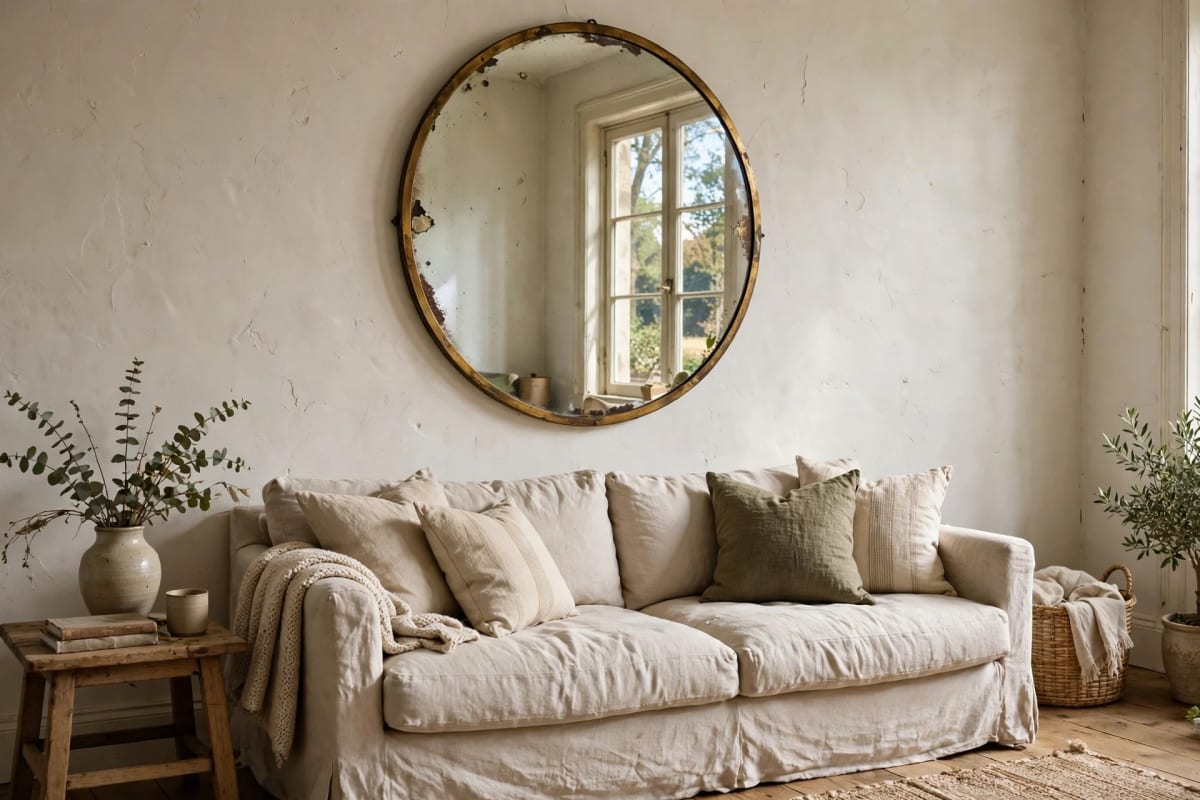
Living room. The two placements that pay off most are above the sofa and on the wall that catches the window. Above the sofa, follow the two-thirds rule and the 6 to 10 inch gap, exactly as you would for art. For light, the best wall is the one opposite or beside a window, not necessarily the one facing it head-on: a mirror angled slightly to the window spreads light more evenly and avoids a hard glare spot. If your living room has one strong window, that is the wall to prioritize.
Entryway. A mirror over a console is the classic entryway move, and it works because it serves a real daily purpose: one last look before leaving. Size it to two-thirds to three-quarters of the console width, with the bottom edge 6 to 10 inches above the tabletop. In a long, narrow hall, a tall mirror on the end wall visually pushes that wall back, which is the closest thing to widening a hallway without construction.
Bedroom. The calmest bedroom placement is a side wall, a dressing area, or inside a wardrobe door. Many people avoid a mirror directly facing the bed, and there is a practical reason beyond tradition: a mirror that reflects movement, doorways, or shifting light keeps the eye busy in a room meant for rest. If the only wall available faces the bed, a smaller mirror or one angled away from the sleeping position is a reasonable compromise.
Hallway and narrow spaces. Narrow halls are where mirror clusters earn their keep. A loose group of small mirrors in different shapes, kept within one frame family such as all warm metals or all dark iron, reflects light down the corridor and creates depth without the closed-in feeling a dense art gallery can give a tight space. Keep the frames in one tonal family; too many finishes and the eye does not know where to rest.
Dining room. Hang the mirror where it reflects the table or a lamp, not the kitchen doorway. A round or oval mirror suits most dining rooms because it softens the hard rectangle of the table, and the reflected candle or pendant light doubles the warmth after sunset.
Styles that are current right now
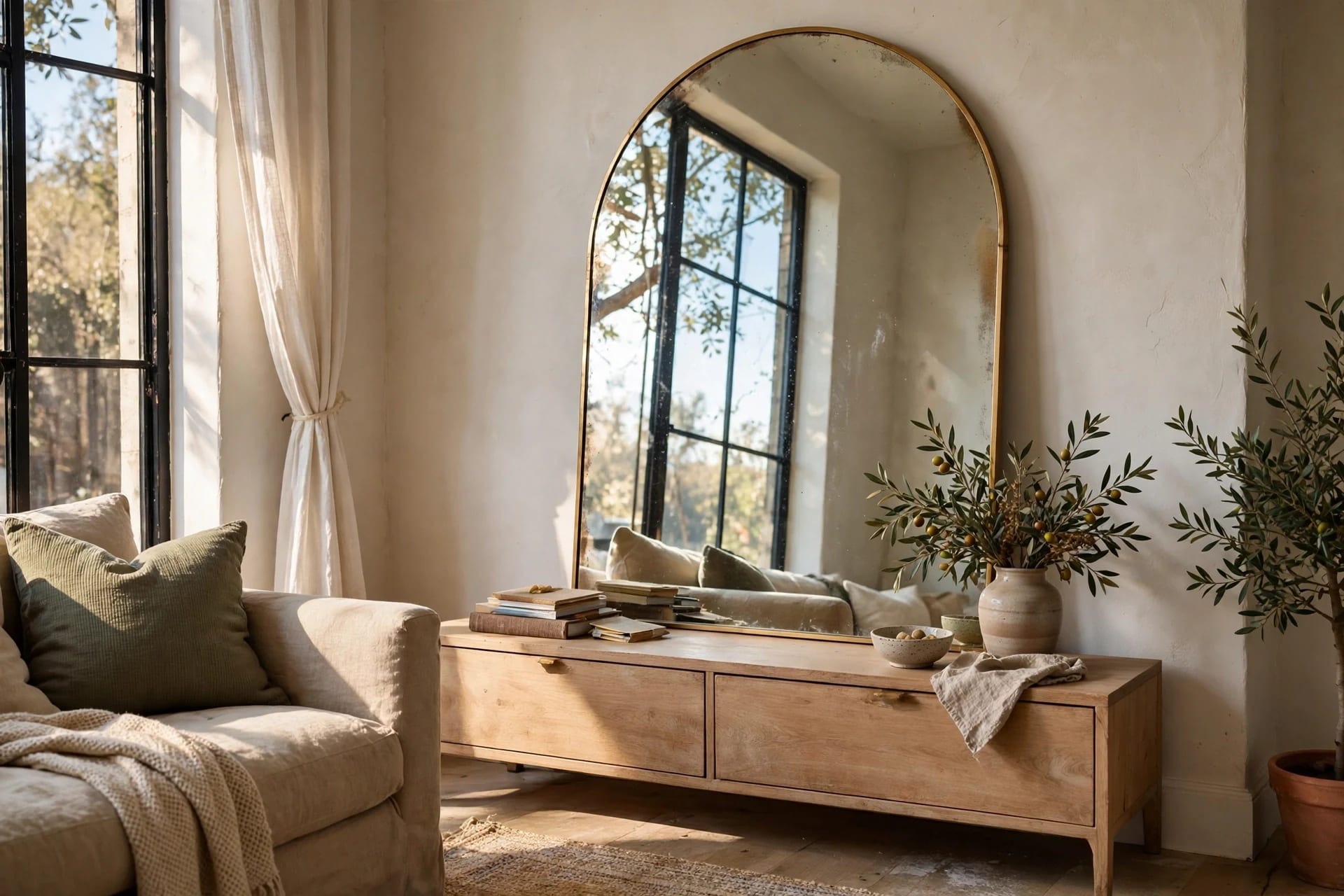
Oversized round and arched mirrors. The single most common living room choice at the moment is one large round or arched mirror above the sofa or console. A round mirror softens a room full of straight lines; an arch adds a traditional, elegant note without feeling heavy. If you buy one statement mirror, this is the safest shape.
Sunburst mirrors. A sunburst works as a standalone focal point on an otherwise plain wall, especially in a room that does not already have much pattern or texture. Brass and gold finishes are the most popular, and they pair naturally with the warm, earthy palettes that are everywhere this year.
Rattan and natural frames. Rattan-framed mirrors bring a relaxed, collected feel and suit bedrooms and casual living rooms. They are lighter than metal or wood frames, which also makes them easier to hang.
Organic and irregular shapes. Asymmetric, sculptural frames are increasingly chosen as much for the frame's form as for the reflection. These work best as the only statement on a wall; pairing an irregular mirror with a busy gallery wall is usually one strong shape too many.
Mirror-only gallery walls. A cluster of differently shaped and sized mirrors, grouped the way you would arrange framed art, is a genuinely newer trend. It solves a real problem: a traditional gallery wall of framed art can make a small room feel more closed in, while a cluster of mirrors keeps the same layered, curated look and still reflects light.
Leaning floor mirrors. A full-length mirror leaned against the wall at a slight angle is the renter's best friend: no holes, repositionable, and the slight angle creates a flattering, expansive reflection. It must still be secured to the wall with the hardware it comes with or a simple anti-tip strap, because a leaning mirror in a hallway or a home with kids is a tipping risk, not a decoration.
The renter's mirror playbook
Renters get more from mirrors than almost anyone, because mirrors change a room without paint or holes.
Start with a leaning floor mirror if the room allows it: it needs no fixings at all beyond its wall anchor, and it can move with you. For smaller mirrors, adhesive strips rated for the mirror's weight are an option, but weigh the mirror on a bathroom scale first and stay well under the strip's rating; mirrors are heavier than they look, and a fallen mirror is a safety problem, not just a broken frame.
The damage-free route pairs well with the rest of a rental decorating plan. If you have not already read it, our guide to renter-friendly wall decor covers the full no-drill toolkit, and damage-free wall decor explains which strips and hooks hold what. For the wall above the sofa specifically, the sizing rules in wall art above a sofa apply exactly the same to mirrors as they do to framed art.
One more renter advantage: a mirror is the easiest decor to resell or carry to the next place. Buy the large round or arched mirror once, and it will work in three apartments in a row.
Mistakes that waste a good mirror
Facing a blank wall. This is the number one waste. Before hanging, stand where the mirror will go and look at what it will reflect. If the answer is a bare wall or a dark corner, pick another wall. The mirror should catch a window, a lamp, a plant, or a styled corner.
Too small. A small mirror on a large wall looks like an afterthought, and a cluster of tiny mirrors rarely adds up to the impact of one large piece. For maximum spatial effect, one large mirror, ideally 120 cm or taller in a living room, creates a far more powerful illusion than several small ones scattered around.
Facing the bed. As covered above, a mirror that throws movement and light toward the sleeper makes the bedroom feel less restful. Side walls and dressing areas are better.
Unsecured leaners. A leaning mirror that is not anchored is an accident waiting for a slammed door, a pet, or a child. Anchor it.
Mixed finishes in a cluster. A mirror cluster works when the frames share a family. Mixing brass, black iron, white wood, and rattan in one small grouping reads as a yard sale, not a collection.
Hanging too high. The classic error, shared with all wall art: measuring from the ceiling or judging by feel while standing on a chair. Measure 57 to 60 inches to the center, and use a level.
Hanging a heavy mirror safely
A large mirror can weigh 15 to 30 kg, and ordinary picture hooks are not the tool for it.
First, find the studs. A stud finder is inexpensive, and knocking on the wall to hear the difference between hollow drywall and solid timber works as a rough check. Drive the mounting screws into studs wherever possible. Where there is no stud in the right spot, use wall anchors rated for well above the mirror's weight: toggle bolts are the reliable choice for heavy mirrors on drywall, and the rating on the package is a maximum, not a target, so keep a comfortable margin.
Hang the mirror on proper hardware, not on a single nail or a wire looped over a hook. D-ring hangers screwed into the frame, or a French cleat for very heavy pieces, spread the load and keep the mirror level. After hanging, tug the bottom edge gently toward you: if anything shifts, take it down and redo the fixings before it comes down on its own.
If you are planning the wall above the sofa, our gallery wall layouts guide covers spacing for groupings, and entryway wall decor ideas shows how a mirror fits into a complete entryway. For small rooms generally, small living room ideas explains how mirrors fit into the bigger small-space toolkit.
FAQ
How big should a mirror be above a sofa?
Roughly two-thirds of the sofa's width, with the bottom edge 6 to 10 inches above the sofa back. For an 84-inch sofa, that means a mirror about 56 inches wide.
Where is the best place to hang a mirror to make a room look bigger?
On the wall opposite or beside the main window, where it reflects daylight and something pleasant, like a plant or a styled corner. A mirror facing a blank wall does almost nothing for the sense of space.
Should a mirror face the bed?
Most people are happier when it does not. A mirror reflecting movement and light toward the bed makes the room feel less restful. Side walls, dressing areas, and wardrobe doors are better placements.
Can I hang a heavy mirror without drilling into studs?
Yes, with the right anchors: toggle bolts rated well above the mirror's weight are the standard choice for heavy mirrors on drywall. Adhesive strips are only for light mirrors, and you should weigh the mirror first rather than guessing.
Is one large mirror better than several small ones?
For making a room feel larger and brighter, yes. One large mirror creates an uninterrupted reflected plane. Small mirrors work best as a deliberate cluster in a hallway or entryway, kept within one frame family.